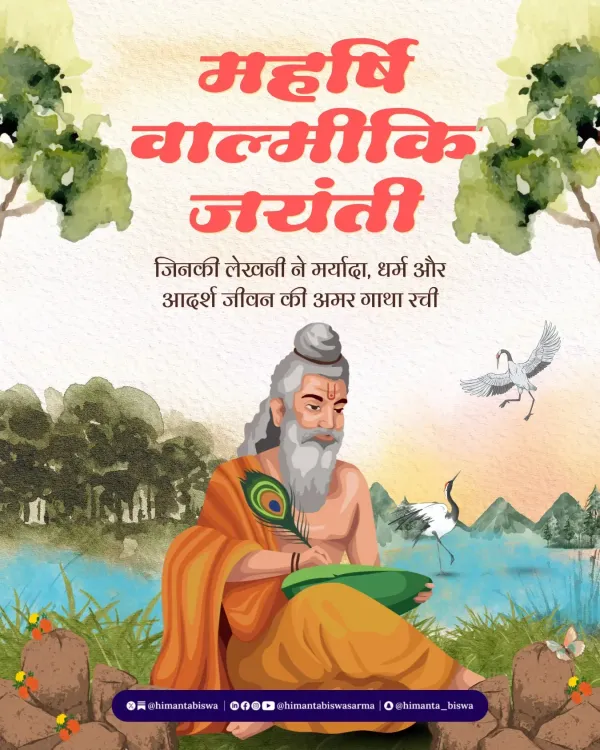
CM Himanta Greets Nation on Maharshi Valmiki Jayanti
Synopsis
Assam CM Himanta Biswa Sarma marked Valmiki Jayanti by honouring Maharshi Valmiki's Ramayana and spotlighting 14th-century Assamese poet Madhav Kandali's Saptakanda Ramayana, linking Assam's regional literary identity to India's civilizational epic tradition.
Key Takeaways
Assam CM Himanta Biswa Sarma extended Valmiki Jayanti greetings to the nation on 26 October 2026 .
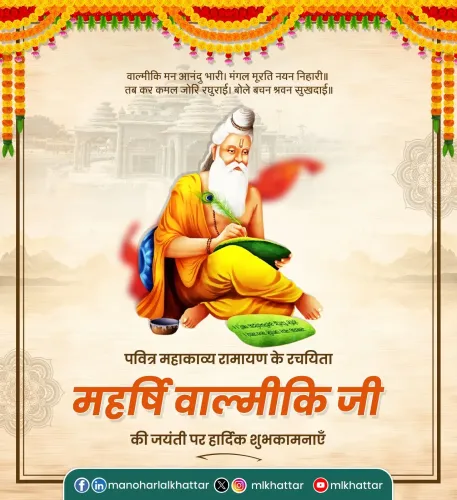
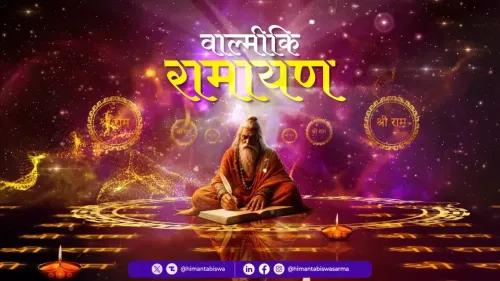
Maharshi Valmiki is traditionally credited with authoring the Sanskrit Ramayana, a cornerstone of Indian literature and culture.
Sarma highlighted Kaviraj Madhav Kandali , a 14th-century Assamese poet who translated Valmiki's epic into Assamese as the Saptakanda Ramayana .
The Saptakanda Ramayana is considered one of the earliest vernacular adaptations of the Ramayana in the subcontinent.
The post reflects a consistent BJP Northeast strategy of anchoring regional literary heritage to pan-Indian cultural observances.
A Monday morning salute to one of India's oldest literary legacies — Assam Chief Minister Himanta Biswa Sarma extended warm greetings to the nation on Maharshi Valmiki Jayanti, weaving in a pointed reminder of how Assam's own medieval literary tradition grew from the same root.
Posting in Hindi on 26 October 2026, Sarma wrote: 'महर्षि वाल्मीकि जी की रामायण ने भारतीय साहित्य और संस्कृति को अमर विरासत दी' — 'Maharshi Valmiki's Ramayana gave Indian literature and culture an immortal legacy.' That much is standard festival-day fare. What stands out is the next line.
Madhav Kandali and the Assamese Ramayana connection
Sarma specifically invoked Kaviraj Madhav Kandali, the 14th-century Assamese poet who rendered Valmiki's Sanskrit epic into the regional tongue as the Saptakanda Ramayana — the 'Seven-Canto Ramayana.' The reference is historically significant. Scholars regard Kandali's work as one of the earliest vernacular translations of the Ramayana in the Indian subcontinent, predating several other regional adaptations. By naming him, Sarma planted Assam firmly within the civilizational arc of the Ramayana tradition — not a distant province receiving a great text, but an active, creative participant in its retelling.Regional identity woven into a national occasion
The move is characteristic of a broader pattern among BJP leaders in the Northeast: using pan-Hindu observances as a canvas on which to paint regional literary and cultural identity. Assam's vast and distinct literary heritage — often underacknowledged in national conversations — gets visibility through exactly this kind of political-cultural signalling. Sarma closed his message with a call for Valmiki's ideals to continue guiding the nation: 'महर्षि वाल्मीकि के आदर्श सदैव हमारा मार्गदर्शन करते रहें' — 'May the ideals of Maharshi Valmiki always guide us.' For the Assamese literati and the wider Northeast, the shout-out to Madhav Kandali carries weight — a reminder that the story of the Ramayana was never one language's monopoly, and that Assam shaped its telling too.Point of View
Inserting Assam into the national Ramayana narrative via Madhav Kandali. This fits a broader BJP playbook in the Northeast: using civilizational touchstones to build a sense of shared Hindu cultural citizenship while simultaneously celebrating distinct regional identity. The Saptakanda Ramayana reference is a well-chosen detail that resonates with Assamese pride without alienating wider audiences. It is soft cultural politics with a long shelf life.
NationPress
26 Oct 2026
Frequently Asked Questions
What is Maharshi Valmiki Jayanti?
Maharshi Valmiki Jayanti is the annual observance marking the birth anniversary of the sage Valmiki, traditionally regarded as the author of the Sanskrit epic Ramayana and a foundational figure in Indian literature.
Who was Madhav Kandali and why is he important?
Madhav Kandali was a 14th-century Assamese poet who translated Valmiki's Ramayana into Assamese as the Saptakanda Ramayana, making it one of the earliest vernacular renditions of the epic in the Indian subcontinent.
What is the Saptakanda Ramayana?
The Saptakanda Ramayana is a seven-canto Assamese translation of Valmiki's Sanskrit Ramayana composed by Kaviraj Madhav Kandali in the 14th century, a landmark work in Assamese literary history.
Why did CM Himanta mention Madhav Kandali on Valmiki Jayanti?
By referencing Madhav Kandali, CM Himanta Biswa Sarma connected Assam's regional literary tradition to the broader pan-Indian Ramayana heritage, highlighting the state's historic contribution to the epic's dissemination.
When did Himanta Biswa Sarma post Valmiki Jayanti greetings in 2026?
Assam Chief Minister Himanta Biswa Sarma posted his Valmiki Jayanti greetings on 26 October 2026.