Karnataka CMO Pays Tribute to Ex-CM Bangarappa's Pro-Poor Legacy
Synopsis
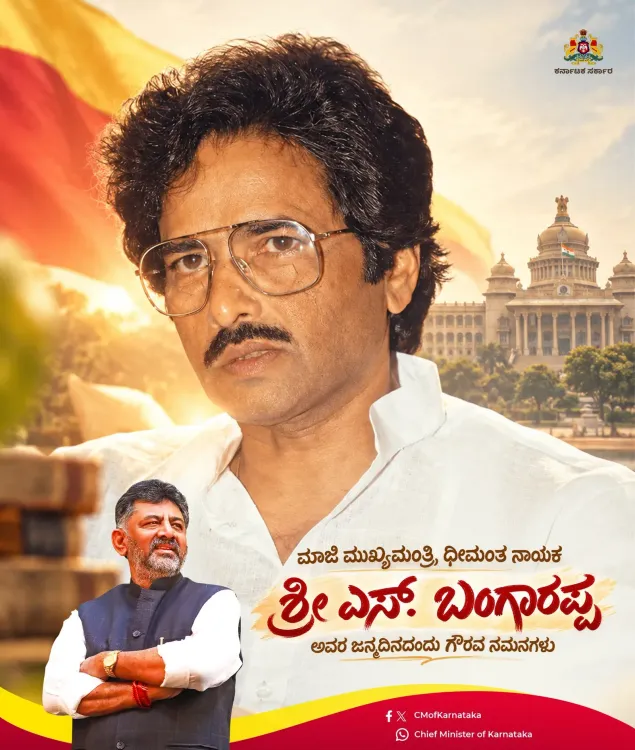
The Chief Minister's Office of Karnataka paid tribute to former CM S. Bangarappa on October 26, 2026, highlighting his Ashraya housing, Akshaya education, and Bhagyajyothi free-electricity schemes that transformed rural and marginalised communities during his 1990–1992 tenure.
Key Takeaways
Bangarappa served as Chief Minister of Karnataka from 1990 to 1992 , hailing from Soraba, Shivamogga district .
His Ashraya scheme provided housing to rural poor families across Karnataka.
The Bhagyajyothi programme extended free electricity connections to poor rural households.
The Akshaya scheme focused on shaping students' futures and expanding educational access.
Bangarappa's core ideology centred on equal rights and justice for the last person in society, particularly backward classes and farmers.
The Karnataka CMO's tribute on October 26, 2026 reaffirms the enduring political relevance of his pro-poor legacy in the state's governance discourse.
From the red soil of Soraba in Shivamogga district, a leader grew who would light up thousands of homes — literally and figuratively. The Chief Minister's Office of Karnataka on Monday, October 26, 2026, paid tribute to former Chief Minister S. Bangarappa, remembering a politician who built his entire career on one conviction: that the last person in society deserves equal rights and justice.
The man from Soraba who became Karnataka's CM
S. Bangarappa served as Chief Minister of Karnataka from 1990 to 1992, arriving in office as a voice for backward classes and small farmers at a time when rural Karnataka was still largely locked out of basic civic amenities. His roots in Soraba — a small taluk town in Shivamogga — were not biographical colour; they were the engine of his politics. The CMO's tribute described him as someone who 'ತಳಸಮುದಾಯಗಳ ನೋವಿಗೆ ಸದಾ ಮಿಡಿದವರು' — 'one who always felt the pain of the most marginalised communities.'
Ashraya, Akshaya and Bhagyajyothi — three schemes that outlived a tenure
The tribute specifically named three welfare initiatives from Bangarappa's tenure. The Ashraya housing scheme aimed to bring shelter to rural poor families, putting a physical roof over the most vulnerable. The Akshaya scheme targeted students, shaping the educational futures of children who might otherwise have slipped through the cracks. And Bhagyajyothi — perhaps the most evocative of the three — delivered free electricity connections to poor rural households, turning on lights in homes that had never seen them.
Together, these three programmes sketched a coherent philosophy: housing, education and power as rights, not privileges. The CMO's post noted that through these initiatives, Bangarappa 'became a light in the lives of lakhs of the poor.'
A legacy that keeps informing Karnataka's welfare politics
Bangarappa's imprint did not dissolve when his tenure ended. Karnataka's political tradition of targeted welfare schemes for backward communities — housing subsidies, power tariff concessions, education support — traces a direct line back to the architecture he helped build in the early 1990s. Successive state governments, regardless of party, have continued, rebranded or expanded programmes in the same three domains.
The CMO's tribute underlines that this legacy remains active currency in Karnataka's public discourse. His 'firm ideology,' the post says, was that equal rights and justice must reach every last person in society — a standard that continues to be invoked whenever the state rolls out a new welfare scheme.
Bangarappa's farmer-facing stance and his work for backward classes set a template that Karnataka's politics still measures itself against — a yardstick that does not age.
Point of View
Power, education — visibly tethered to the current Karnataka government's identity. In a state where backward-class and rural constituencies are electorally decisive, invoking Bangarappa is both historical acknowledgement and political signalling. The three named schemes prefigure a governance model that later administrations have replicated under different labels, suggesting continuity matters more here than party lineage. For observers tracking Karnataka's welfare architecture, this tribute is a reminder that the state's social-spending instincts have deep roots.
NationPress
26 Oct 2026
Frequently Asked Questions
Who was S. Bangarappa and when did he serve as Karnataka Chief Minister?
S. Bangarappa was a Karnataka politician from Soraba in Shivamogga district who served as Chief Minister of Karnataka from 1990 to 1992. He was known as a strong advocate for backward classes and small farmers.
What is the Ashraya scheme launched by Bangarappa?
The Ashraya scheme was a rural housing programme implemented during Bangarappa's tenure as Chief Minister, aimed at providing shelter to poor rural families in Karnataka.
What was the Bhagyajyothi scheme in Karnataka?
Bhagyajyothi was an electrification programme introduced during Bangarappa's government that provided free electricity connections to poor rural households in Karnataka, bringing light to homes that previously had none.
Why did the Karnataka CMO pay tribute to Bangarappa?
The Chief Minister's Office of Karnataka posted a tribute on October 26, 2026 honouring S. Bangarappa's welfare-focused governance, his schemes for the rural poor and marginalised communities, and his lasting impact on Karnataka's public life.
What is the Akshaya scheme associated with Bangarappa?
The Akshaya scheme was an education-support initiative launched during Bangarappa's tenure designed to shape the futures of students from poor and marginalised backgrounds in Karnataka.