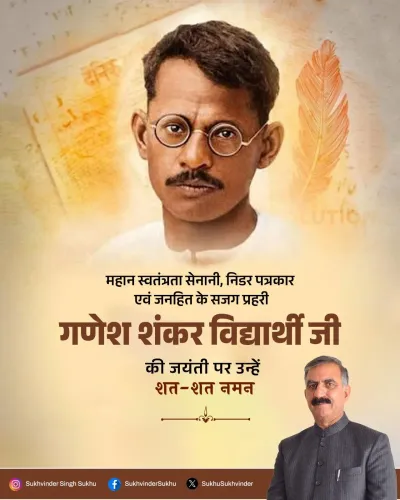
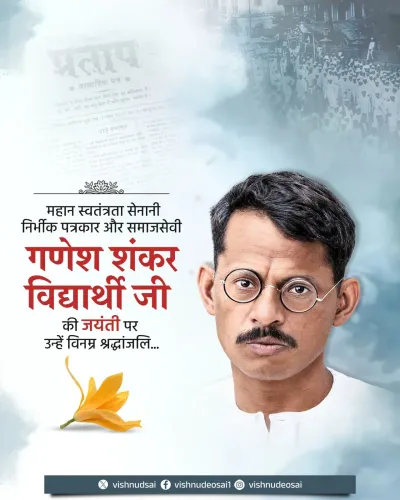
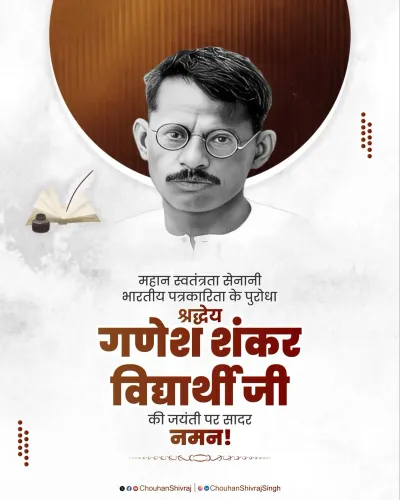
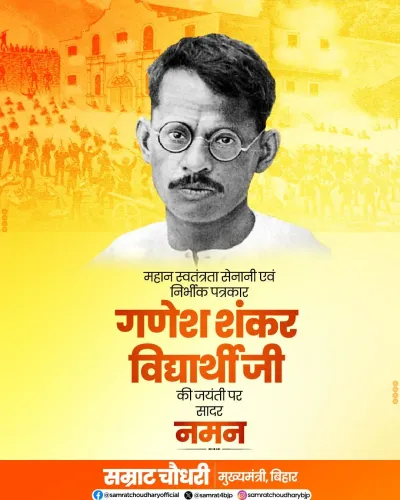
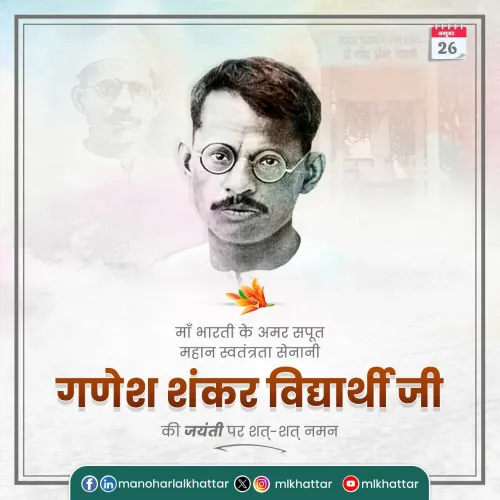
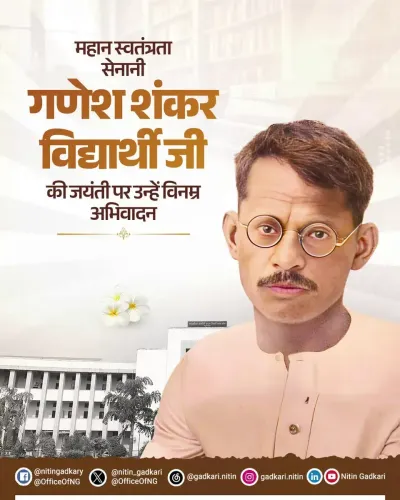
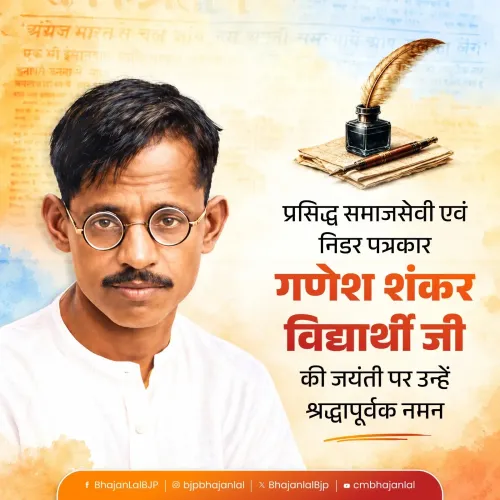
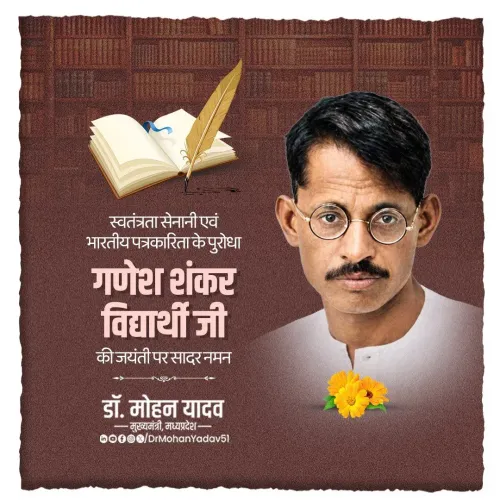
HP CMO pays tribute to Ganesh Shankar Vidyarthi on birth anniversary
Synopsis
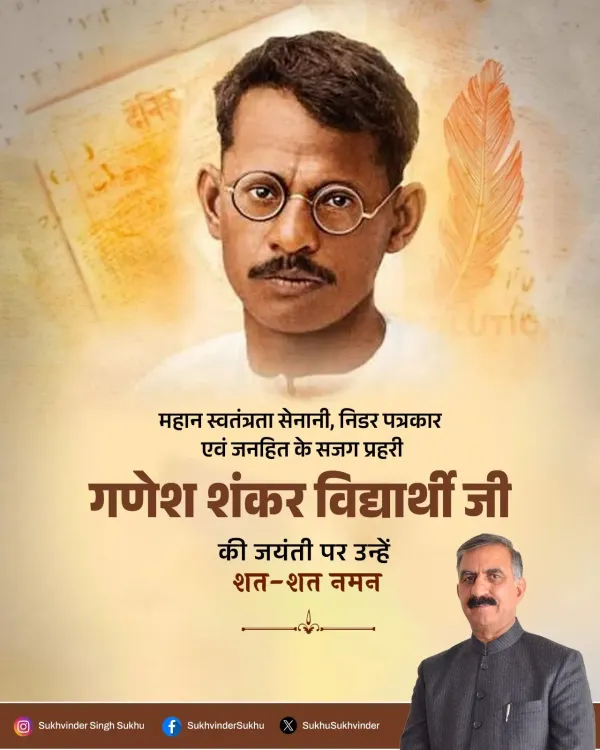
On his 136th birth anniversary, the Chief Minister's Office of Himachal Pradesh paid tribute to Ganesh Shankar Vidyarthi — editor of Hindi paper Pratap, Congress activist, and martyr killed in the 1931 Kanpur riots while shielding people from mob violence.
Key Takeaways
Ganesh Shankar Vidyarthi was born on 26 October 1890 in Allahabad .
He edited the influential Hindi newspaper Pratap , using it as a platform against British colonial rule.
He was an active participant in Indian National Congress -led agitations during the independence movement.
He was killed in 1931 during communal riots in Kanpur while trying to protect people from mob violence — aged 40 .
The Chief Minister's Office of Himachal Pradesh honoured him on his birth anniversary on 26 October 2026 .
His life is cited as proof that India's free press tradition predates independence — and was forged in the resistance to empire.
A fearless pen that rattled colonial power and a life laid down in the cause of communal harmony — on Monday, 26 October 2026, the Chief Minister's Office of Himachal Pradesh paused to honour one of India's most consequential journalist-freedom fighters on his birth anniversary.
The office posted a tribute in Hindi, offering sadar naman (respectful salutations) to Ganesh Shankar Vidyarthi, describing him as a 'great freedom fighter and fearless journalist.' The message read: 'Through active participation in Congress-led agitations and his fearless writing, he strengthened the freedom struggle. His sacrifice and patriotism will forever remain a source of inspiration.'
The journalist who made 'Pratap' a weapon against empire
Ganesh Shankar Vidyarthi was born on 26 October 1890 in Allahabad. He rose to edit the Hindi newspaper Pratap, turning its pages into a relentless indictment of British rule and a platform for the voices of ordinary Indians ground down by colonial policy. At a time when the press was one of the few weapons available to a subjugated people, Vidyarthi wielded it without flinching.
His journalism was inseparable from his activism. He was a committed participant in the Indian National Congress-led movements of his era, walking the line between reportage and resistance that defined the nationalist press of the early twentieth century. Arrests did not silence him. Threats did not slow him.
A martyr to the unity he preached
Vidyarthi's end was as telling as his life. In 1931, during communal riots in Kanpur, he stepped into the violence not to report on it but to stop it — physically shielding people from the mobs. He was killed in the attempt. The man who had spent his career arguing for Hindu-Muslim unity died proving he meant every word of it. He was 40 years old.
His death drew nationwide mourning and cemented his place not merely as a journalist or a Congress activist, but as a moral figure of the independence movement — one whose sacrifice carried a distinct, painful weight.
Official memory and the press's role in the freedom story
State governments and official offices across India regularly mark the jayantis of independence-era journalists and activists. These tributes are part of a sustained, cross-party effort at national memory-building — asserting that the freedom movement was won not only on battlefields but in newsrooms, courtrooms, and public squares. Vidyarthi's anniversary sits squarely in that tradition.
His legacy endures as a reminder that a free press is not a modern invention in India — it was, from the beginning, a condition of India's survival as an idea.
Point of View
Desperate attempt to stop neighbours from killing each other. That story cuts through the routine of anniversary tributes. For a ruling Congress government in Himachal Pradesh, invoking Vidyarthi's Congress-era activism also carries a mild but unmistakable party-lineage signal — though the tribute's language stays broad enough to function as straightforward national homage.
NationPress
26 Oct 2026
Frequently Asked Questions
Who was Ganesh Shankar Vidyarthi?
Ganesh Shankar Vidyarthi was an Indian journalist and freedom fighter born on 26 October 1890 in Allahabad. He edited the Hindi newspaper Pratap and was a prominent participant in Indian National Congress-led movements during the independence struggle.
How did Ganesh Shankar Vidyarthi die?
Vidyarthi was killed in 1931 during communal riots in Kanpur. He died while trying to physically protect people from mob violence, an act consistent with his lifelong advocacy for Hindu-Muslim unity.
What was the newspaper Pratap associated with Vidyarthi?
Pratap was a Hindi-language newspaper edited by Vidyarthi. He used it as a powerful platform to criticise British colonial rule and to amplify the voices of the independence movement.
Why is the Himachal Pradesh CMO office paying tribute to Vidyarthi?
The Chief Minister's Office of Himachal Pradesh posted a tribute on 26 October 2026 to mark Vidyarthi's birth anniversary. Indian state offices routinely honour freedom fighters on their jayantis as part of national memory-building.
What is Ganesh Shankar Vidyarthi's connection to the Indian National Congress?
Vidyarthi was an active participant in Indian National Congress-led agitations during the independence movement, combining his journalism with on-the-ground activism under the Congress banner.