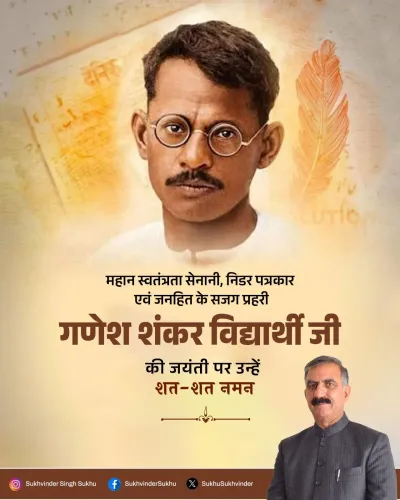
CM Sukhu pays tribute to freedom fighter Ganesh Shankar Vidyarthi
Synopsis
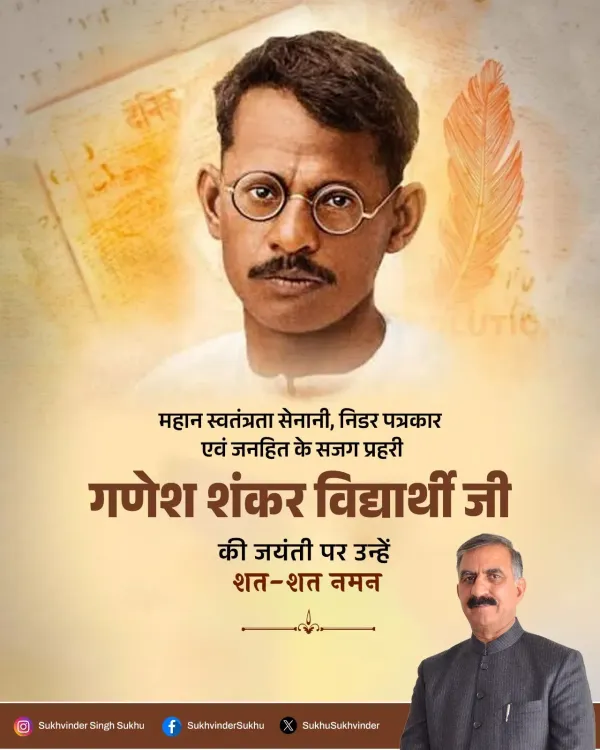
Himachal Pradesh Chief Minister Sukhvinder Singh Sukhu honoured freedom fighter and fearless journalist Ganesh Shankar Vidyarthi on his birth anniversary, saluting his role in Congress-led independence movements and his martyrdom in Kanpur in 1931.
Key Takeaways
CM Sukhvinder Singh Sukhu posted a tribute to Ganesh Shankar Vidyarthi on his birth anniversary, October 26 .
Vidyarthi, born in 1890 , edited the Hindi nationalist daily Pratap and actively participated in Congress-led movements including the Non-Cooperation Movement.
He was killed in 1931 in Kanpur while trying to stop communal riots — an act of sacrifice that cemented his legacy.
CM Sukhu described his 'fearless writing' as a pillar of the independence struggle and called his sacrifice and patriotism a 'permanent source of inspiration.' Congress leaders have observed Vidyarthi's October 26 jayanti with public tributes as part of the party's broader effort to connect with its nationalist historical legacy.
A journalist who wielded his pen like a weapon and died stopping a riot — Himachal Pradesh Chief Minister Sukhvinder Singh Sukhu marked the birth anniversary of Ganesh Shankar Vidyarthi on Monday, October 26, saluting the freedom fighter whose courage in life and sacrifice in death defined an era.
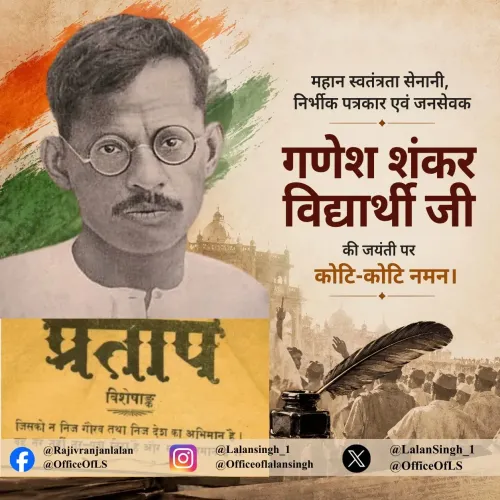
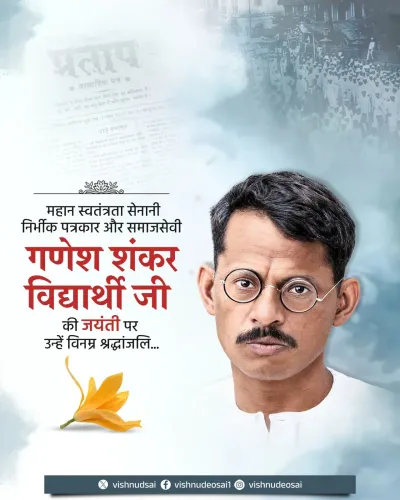
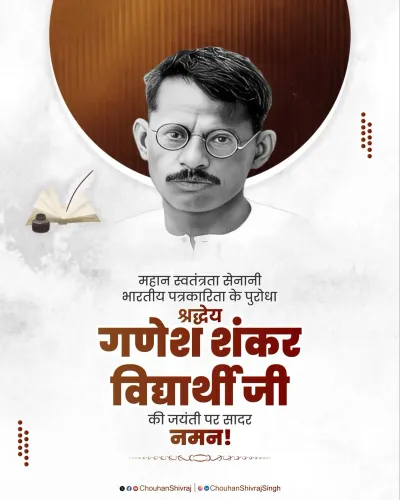
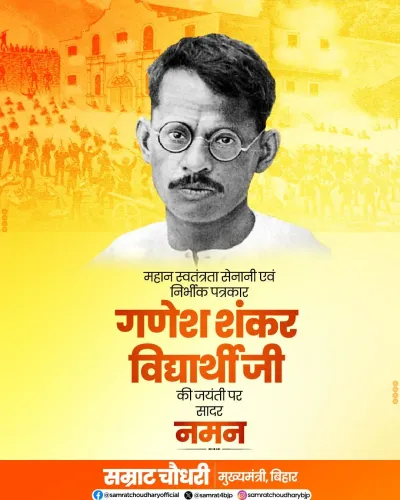
Posting in Hindi, CM Sukhu wrote: 'महान स्वतंत्रता सेनानी एवं निर्भीक पत्रकार श्री गणेश शंकर विद्यार्थी जी की जयंती पर उन्हें सादर नमन' — 'Respectful homage to the great freedom fighter and fearless journalist Shri Ganesh Shankar Vidyarthi on his birth anniversary.' He added that Vidyarthi's active participation in Congress-led movements and his fearless writing strengthened the independence struggle, and that his sacrifice and patriotism 'will always remain a source of inspiration.'
The editor who took on the colonial press
Born in 1890, Ganesh Shankar Vidyarthi edited the Hindi daily Pratap, one of the most outspoken nationalist newspapers of the colonial period. At a time when sedition charges silenced many voices, Vidyarthi used Pratap to challenge British authority, amplify Congress campaigns, and reach readers in the Hindi heartland who had no other nationalist platform. His journalism was not commentary from a distance — he was embedded in the movement, organising alongside the people he wrote about.
He threw himself into the Non-Cooperation Movement, participating in the Congress-led campaigns that Mahatma Gandhi mobilised across the country in the early 1920s. For Vidyarthi, the press and the street were the same battlefield.
A death that defined his legacy
Vidyarthi's end came not in a colonial prison but in the lanes of Kanpur. In 1931, when communal violence tore through the city, he stepped into the riots to shield civilians from the violence — and was killed in the attempt. The act distilled everything he had written about: sacrifice without calculation, duty without self-preservation. He was 40 years old.
That combination — nationalist journalist, Congress volunteer, and martyr to communal harmony — makes Vidyarthi a figure Congress leaders return to repeatedly, especially when the party seeks to anchor its present identity in the moral capital of the independence movement.
Congress and the jayanti tradition
Tributes on Vidyarthi's October 26 birth anniversary have been a consistent feature of Congress political culture since independence. By invoking his 'fearless pen' and 'sacrifice,' CM Sukhu is participating in a well-worn but genuinely felt ritual — one that reminds party workers that the Congress's roots run through printing presses and protest marches as much as through legislative chambers. In a media environment where press freedom debates remain live, the tribute carries a quiet contemporary resonance.
More than nine decades after his death, Ganesh Shankar Vidyarthi remains proof that the most durable political legacies are built not with power, but with purpose.
Point of View
Particularly its tradition of press freedom and anti-communal values. In an era of heated debates around media autonomy, saluting a journalist-martyr doubles as a soft political signal. The consistency of these jayanti observances also reflects a party machinery that still treats historical memory as an active political resource, not archival sentiment.
NationPress
26 Oct 2026
Frequently Asked Questions
Who was Ganesh Shankar Vidyarthi?
Ganesh Shankar Vidyarthi was an Indian freedom fighter and journalist born in 1890 who edited the Hindi nationalist daily Pratap and actively participated in Congress-led independence movements. He was killed in 1931 in Kanpur while trying to stop communal violence.
When is Ganesh Shankar Vidyarthi's birth anniversary?
Ganesh Shankar Vidyarthi's birth anniversary falls on October 26 , and it is marked annually by Congress leaders and others as a tribute to his role in India's freedom struggle.
What newspaper did Ganesh Shankar Vidyarthi edit?
Vidyarthi edited the Hindi daily Pratap , one of the most prominent nationalist newspapers of the colonial era, which he used to challenge British authority and support the independence movement.
How did Ganesh Shankar Vidyarthi die?
Vidyarthi was killed in 1931 in Kanpur while trying to protect civilians caught in communal riots — an act of selfless bravery that became central to his enduring legacy.
Why did CM Sukhu pay tribute to Ganesh Shankar Vidyarthi?
Himachal Pradesh Chief Minister Sukhvinder Singh Sukhu paid tribute on Vidyarthi's birth anniversary, October 26 2026 , honouring his fearless journalism and sacrifice in the independence struggle — a tradition Congress leaders have maintained since independence.