Assam Cabinet Clears Mineral Rules Amendment for Iron Ore, Limestone
Synopsis
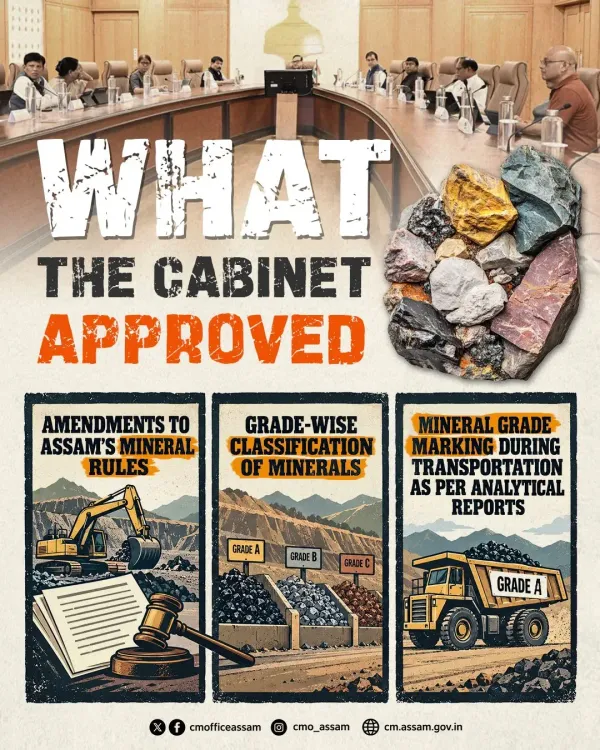
The Assam Cabinet has cleared a gazette notification for the Assam Mineral Regulation and Trading (Amendment) Rules, 2026, introducing grade-based classification for iron ore and limestone to strengthen mineral oversight and trading procedures.
Key Takeaways
The Assam Cabinet approved a gazette notification for the Assam Mineral Regulation and Trading (Amendment) Rules, 2026 on October 26, 2026 .
The amendment introduces grade-based classification specifically for iron ore and limestone .
The move aims to strengthen mineral resource management, valuation, and regulatory oversight in the state.
The rules operate within the framework of the central Mines and Minerals (Development and Regulation) Act, 1957 .
Key stakeholders include mining companies, mineral traders, and state revenue authorities .
The gazette notification's publication is the next step before the amendment acquires full legal force.
Assam just tightened its grip on the minerals buried beneath its soil. The Assam Cabinet on Monday, October 26, 2026, approved the issuance of a gazette notification for the Assam Mineral Regulation and Trading (Amendment) Rules, 2026 — a regulatory move designed to sharpen how the state classifies, oversees, and trades its mineral wealth, with a specific focus on iron ore and limestone.
Grade classification at the heart of the amendment
The amendment's most concrete provision is the introduction of grade-based classification for key minerals. For iron ore and limestone — two commercially significant resources in Assam's extractive economy — grading standardises how material quality is assessed, which directly affects valuation, royalty computation, and compliance monitoring. Without clear grade definitions, regulators and traders operate on contested terms; the amendment aims to close that gap.
The step follows the broader architecture of the Mines and Minerals (Development and Regulation) Act, 1957, the central framework under which all Indian states formulate their mineral rules. Assam's 2026 amendment layers state-specific precision onto that national scaffold.
Why mineral rule reform matters in Assam now
Indian states have been steadily updating mineral regulations to plug revenue leakages and bring trading procedures in line with modern administrative standards. Assam's move is consistent with that national pattern — but the explicit callout of iron ore and limestone signals a targeted intent: these are not niche minerals. Limestone is a primary input for cement manufacturing; iron ore feeds steel supply chains. Better classification means better oversight of who is extracting what grade, at what volume, and at what declared value.
The gazette notification, once published, will give the amendment legal force. Mining companies, mineral traders, and state revenue authorities — the three principal stakeholder groups — will need to align their operations and documentation with the revised rules.
What comes after the gazette
The Cabinet approval clears the policy hurdle; the publication of the gazette notification is the next concrete milestone. Subsequent notifications may spell out the precise grade thresholds and revised trading procedures that operationalise the amendment. Until those details are public, the full regulatory picture remains to be drawn — but the Cabinet's green light marks the decisive first move.
Assam has signalled that better mineral governance is a priority. The gazette notification will tell the industry exactly what that means on the ground.
Point of View
The Assam government is aligning administrative precision with economic accountability. The move also signals the state's intent to position itself as a more predictable regulatory environment for mining investment, which matters as northeast India sees growing infrastructure demand. The real test will be in the detail of the gazette notification and whether enforcement mechanisms match the ambition of the amendment.
NationPress
26 Oct 2026
Frequently Asked Questions
What is the Assam Mineral Regulation and Trading (Amendment) Rules, 2026?
It is a state-level regulatory amendment approved by the Assam Cabinet on October 26, 2026, that introduces grade-based classification for minerals — particularly iron ore and limestone — to improve oversight and trading procedures.
Why has Assam amended its mineral rules?
The amendment aims to strengthen mineral resource management by standardising grade classification, which supports better valuation, royalty computation, and administrative control over the extractive sector.
Which minerals are covered under the 2026 amendment?
The amendment specifically targets grade classification for iron ore and limestone, two commercially significant minerals in Assam's mining economy.
When will the Assam Mineral Regulation and Trading Amendment Rules take effect?
The Cabinet has approved the issuance of a gazette notification; the rules will acquire full legal force once that notification is published.
What central law governs mineral rules in Assam?
The Mines and Minerals (Development and Regulation) Act, 1957, provides the overarching central framework under which Assam formulates its state-level mineral rules.