CM Himanta Credits Modi Govt for Empowering India's Middle Class
Synopsis
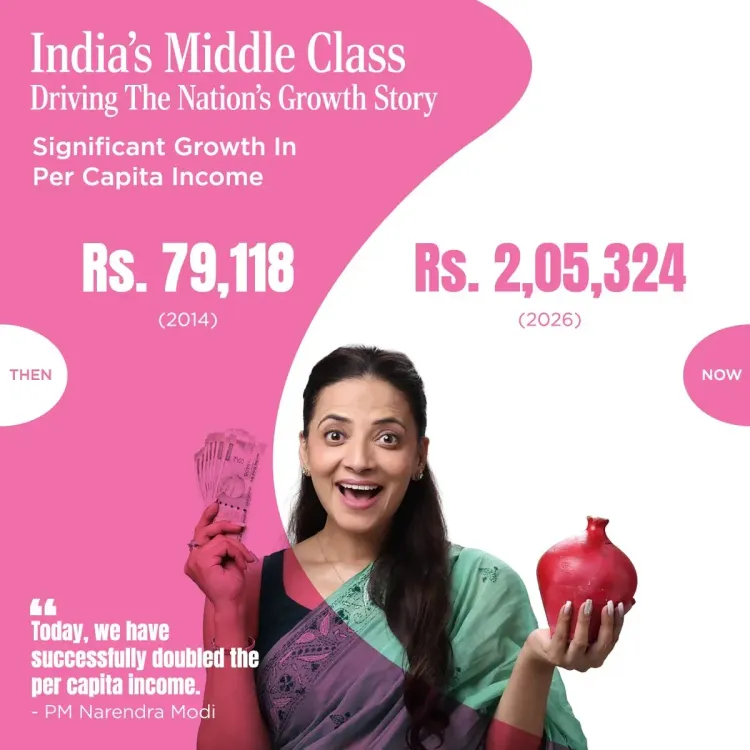
Assam Chief Minister Himanta Biswa Sarma marked 12 years of the Modi government by crediting its policies on inflation, healthcare, electricity, and per capita income with fully empowering India's middle class, amplifying the BJP's #12YearsOfSakshamMiddleClass campaign.
Key Takeaways
Assam CM Himanta Biswa Sarma posted on June 15, 2026 crediting the Modi government with empowering India's middle class across four policy areas.
The post is tied to the BJP's #12YearsOfSakshamMiddleClass campaign marking twelve years of Modi-led governance.
Key schemes cited in context include Ayushman Bharat PMJAY (launched September 2018 ) for affordable healthcare and the Saubhagya scheme (announced September 2017 ) for universal household electrification.
The GST rollout of July 2017 is part of the policy lineage the government links to moderated inflation and price stability.
Sarma's amplification carries regional significance given his role as convenor of the North-East Democratic Alliance (NEDA) .
The next Union Budget and any changes to tax slabs or health-insurance caps will test whether middle-class relief is sustained.
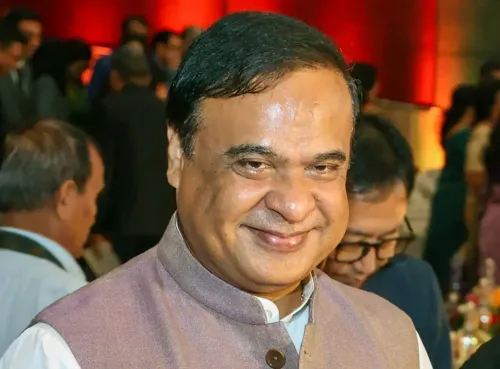
Assam Chief Minister Himanta Biswa Sarma on Monday, June 15, 2026, credited the Narendra Modi-led central government with comprehensively empowering India's middle class through policies spanning inflation control, affordable healthcare, rising per capita income, and wider electricity access, marking the occasion with the hashtag #12YearsOfSakshamMiddleClass.
Context
Sarma's post arrives as the BJP marks twelve years of the Modi government's economic stewardship, a milestone the party is framing around measurable gains for middle-income households. The Chief Minister listed four pillars — lower inflation, affordable healthcare, enhanced per capita income, and accessible electricity — as evidence of what he described as 'a huge scope for development' for this demographic.
The #12YearsOfSakshamMiddleClass hashtag signals a coordinated party communication effort to consolidate the narrative that the central government's policy architecture has delivered tangible relief to urban and aspirational households, a constituency that has been central to the BJP's electoral coalition since 2014.
Policy Backdrop
The healthcare plank of Sarma's argument rests on Ayushman Bharat Pradhan Mantri Jan Arogya Yojana, launched in September 2018, which extended health insurance coverage to economically vulnerable families and has since been positioned as a cornerstone of affordable medical access. The scheme has progressively widened its eligibility criteria over successive years.
On electricity access, the Saubhagya scheme — formally the Pradhan Mantri Sahaj Bijli Har Ghar Yojana, announced in September 2017 — was designed to provide last-mile electricity connections to unelectrified households across the country. The rollout of the Goods and Services Tax in July 2017 is also frequently cited by the government as a structural reform that unified indirect taxation and helped moderate price volatility over time.
Since 2014, successive Union Budgets have combined fiscal consolidation with targeted welfare delivery, a pattern the ruling party describes as inclusive growth that benefits both urban middle-class consumers and aspirational rural segments alike.
Stakeholders and Impact
Middle-class households and urban consumers are the primary stakeholders invoked in Sarma's framing. For this segment, the intersection of price stability, health-cost reduction, and reliable electricity supply directly affects disposable income and quality of life — making these metrics politically significant ahead of any future electoral cycle.
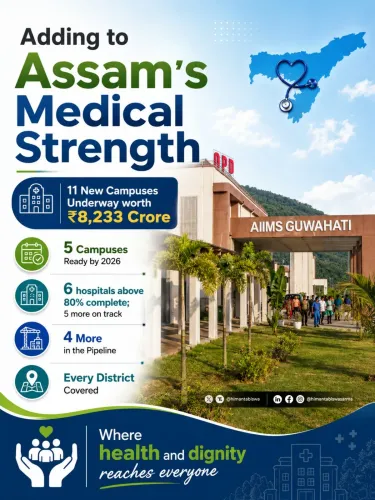
As NEDA convenor, Sarma's amplification of central government messaging also carries weight across the North-East region, where infrastructure gaps in power and healthcare have historically been more acute than in mainland urban centres. His endorsement ties regional development gains to the broader national middle-class narrative.
What's Next
The next Union Budget speech and any revisions to income-tax slabs or health-insurance coverage caps will be closely watched as indicators of whether the government intends to deepen middle-class fiscal relief. Analysts will also track retail inflation data and per capita income figures in official releases to assess whether the gains highlighted in the #12YearsOfSakshamMiddleClass campaign hold up against independent benchmarks.
For Sarma personally, continued alignment with central government economic messaging reinforces his standing within the BJP's national leadership structure, even as Assam navigates its own development challenges in healthcare delivery and power infrastructure.
Point of View
Lending regional credibility to a national campaign. By anchoring the argument in tangible policy pillars — inflation, healthcare, electricity, income — rather than abstract growth figures, the communication strategy targets the aspirational voter who evaluates governance through household-level outcomes. The twelve-year framing is deliberate: it positions the Modi era as a completed arc of reform rather than a work in progress, pre-empting opposition critiques of unfinished agendas. Whether independent data on retail prices and per capita income corroborates the campaign's claims will determine how durable this narrative proves beyond party channels.
NationPress
19 Sept 2026
Frequently Asked Questions
What is the #12YearsOfSakshamMiddleClass hashtag about?
The hashtag marks twelve years of the Narendra Modi-led central government and is used by BJP leaders, including Assam CM Himanta Biswa Sarma, to highlight policies said to have benefited India's middle class in areas such as inflation control, healthcare, electricity access, and per capita income growth.
What is the Ayushman Bharat scheme and how does it help the middle class?
Ayushman Bharat Pradhan Mantri Jan Arogya Yojana, launched in September 2018, provides health insurance coverage to economically vulnerable families, reducing out-of-pocket medical expenses and making healthcare more affordable for lower-middle-income households.
What is the Saubhagya scheme?
The Saubhagya scheme, formally known as Pradhan Mantri Sahaj Bijli Har Ghar Yojana and announced in September 2017, aimed to provide last-mile electricity connections to every unelectrified household in India, improving quality of life and enabling economic activity.
Why is Himanta Biswa Sarma commenting on central government economic policy?
As Assam Chief Minister and BJP leader, Sarma regularly amplifies central government messaging; in his role as NEDA convenor he also speaks to development gains across the North-East, where power and healthcare access have been longstanding concerns.
What should we watch for next on India's middle-class economic policy?
The next Union Budget is the key event to watch, particularly any revisions to income-tax slabs or health-insurance coverage caps, alongside official data releases on retail inflation and per capita income that will independently test the claims made in the #12YearsOfSakshamMiddleClass campaign.