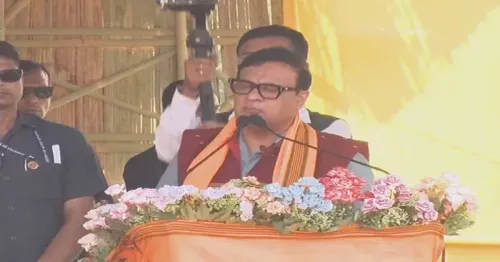
CM Himanta to lay Sainik School foundation stone in Karbi Anglong

Synopsis
Chief Minister Himanta Biswa Sarma lays the foundation stone of a new Sainik School at Langvoku in Karbi Anglong on November 17, 2026, extending defence-oriented residential education into Assam's largest tribal hill district for the first time.
Key Takeaways
Himanta Biswa Sarma will lay the foundation stone of a new Sainik School at Langvoku, Karbi Anglong on November 17, 2026 .
Karbi Anglong is Assam's largest autonomous hill district with a predominantly tribal population and historically limited access to premium residential schooling.
Sainik Schools operate under the Ministry of Defence and were established from 1961 onward to prepare cadets for the National Defence Academy .
Assam's first Sainik School, at Goalpara , dates to 1964 ; the Langvoku campus would be the state's next such institution.
India's Sainik Schools network has expanded from an original 5 institutions to over 30 campuses nationwide.
Key next steps include construction completion, formal Sainik Schools Society affiliation, and the first student admission cycle.
A defence-oriented school for tribal Assam is about to break ground. Chief Minister Dr. Himanta Biswa Sarma will lay the foundation stone of a new Sainik School at Langvoku in Karbi Anglong district on Tuesday, November 17, 2026, marking what the Chief Minister's Office of Assam calls 'a new milestone in advancing educational excellence.'
A Sainik School comes to Karbi Anglong's hills
Karbi Anglong is Assam's largest autonomous hill district, home to a predominantly tribal population that has historically been underserved by mainstream educational infrastructure. Placing a Sainik School — a residential institution designed to prepare cadets for the National Defence Academy and the broader officer cadre — squarely inside that landscape is a pointed choice.
Sainik Schools operate under the Ministry of Defence and have been part of India's educational architecture since 1961, with the network growing from an original cluster of five institutions to over 30 campuses nationwide today. Assam's first such institution, Sainik School Goalpara, was established in 1964. The proposed school at Langvoku would be the state's next step in that lineage — decades later, and aimed at a region the earlier expansion did not reach.
The Northeast calculus: representation in uniform
Across the Northeast, Sainik Schools have been positioned as twin-purpose instruments: quality residential schooling in geographically remote areas, and a deliberate pipeline to increase the representation of regional youth in the armed forces' officer ranks. The aspiration is concrete — a student from a tribal household in Karbi Anglong who might never have accessed NDA-level preparation now has a potential pathway within district boundaries.
The pattern fits a broader state-centre collaboration that successive governments have leaned into. States identify underserved districts; the Sainik Schools Society provides the affiliation framework; the state government funds and executes construction. The foundation stone today initiates that process for Langvoku.
What comes next for the Langvoku campus
Three milestones will determine how quickly this promise becomes a classroom: the construction timeline, formal affiliation approval from the Sainik Schools Society, and the announcement of the first admission cycle. None of those details have been confirmed yet — today's ceremony is the beginning of a longer institutional journey. But in a district defined by development gaps, the beginning itself carries weight.
For Dr. Himanta Biswa Sarma, who has anchored much of his tenure since May 2021 on education and infrastructure projects across Assam, the Langvoku foundation stone adds another entry to a list that now extends into the state's most remote corners.
The question the students of Karbi Anglong will answer — whether the school that opens behind this stone actually delivers on its promise — is the one worth watching.
Point of View
Where aspirational signalling and genuine access gaps converge. For CM Himanta Biswa Sarma, it sustains a governance narrative built around visible, brick-and-mortar delivery in underserved regions. More broadly, it fits a national pattern in which state governments use Sainik School proposals as instruments of both educational equity and political capital with communities historically underrepresented in the officer cadre. The real test will come at affiliation and admission — when the institution must deliver outcomes, not just a foundation stone.
NationPress
17 Nov 2026
Frequently Asked Questions
Where is the new Sainik School in Assam being built?
The new Sainik School will be built at Langvoku in Karbi Anglong district, Assam. The foundation stone was laid by CM Himanta Biswa Sarma on November 17, 2026.
What is a Sainik School and who runs it?
Sainik Schools are residential institutions established since 1961 under the Ministry of Defence to prepare students for the National Defence Academy and entry into the armed forces as officers. They are affiliated with the Sainik Schools Society .
How many Sainik Schools are there in India?
India's Sainik Schools network has grown from the original five institutions in the 1960s to over 30 campuses across the country today.
Which was the first Sainik School in Assam?
Sainik School Goalpara , established in 1964 , is the first Sainik School in Assam. The proposed school at Langvoku in Karbi Anglong would be the state's second such institution.
What is the significance of Karbi Anglong for this school?
Karbi Anglong is Assam's largest autonomous hill district with a predominantly tribal population. Placing a Sainik School there is intended to give tribal and remote-area students access to defence-oriented residential education and a pathway into the armed forces' officer cadre.