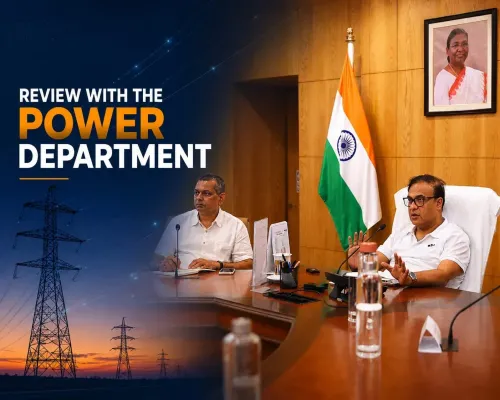
CM Himanta Targets 8,000 MW Power Boost for Assam
Synopsis
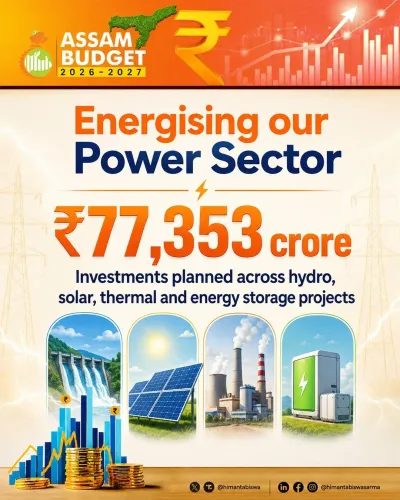
Assam Chief Minister Himanta Biswa Sarma has announced a ₹77,000-crore-plus investment in the power sector aimed at adding over 8,000 MW of generation capacity — a move framed as a 1,700% rise that would transform the historically power-deficit state under the Viksit Assam vision.
Key Takeaways
Assam CM Himanta Biswa Sarma announced a power sector investment of over ₹77,000 crore on 16 July 2026 .
The investment is projected to generate more than 8,000 MW of additional electricity capacity.
CM Sarma described this as a 1,700 per cent-plus rise in Assam's power generation capacity.
The expansion is framed under the Viksit Assam initiative, aligned with the central Viksit Bharat 2047 vision.
Assam has historically depended on inter-state power purchases due to low indigenous generation capacity.
Key beneficiaries include households, industries, and businesses across the state, with potential surplus for neighbouring North-Eastern states.
Assam Chief Minister Himanta Biswa Sarma on Thursday, 16 July 2026 announced a sweeping expansion of the state's power generation capacity, citing a planned investment of over ₹77,000 crore in the power sector that he said would add more than 8,000 MW of electricity — a figure he described as representing a rise of over 1,700 per cent in Assam's generation capacity.
Context
In his post on X, CM Sarma framed the announcement under the banner of 'Viksit Assam' — a state-level articulation of the central government's Viksit Bharat 2047 vision for a developed India. 'Today's Assam dreams big and delivers even bigger,' he wrote, signalling that the investment and capacity additions are intended to define a new trajectory for the state's energy landscape. The post was accompanied by a video, suggesting a formal presentation or campaign material underlining the scale of the ambition.
Policy Backdrop
Assam has historically been a power-deficit state, heavily reliant on electricity purchased from other states and central generating stations to meet its domestic and industrial demand. Successive state governments, and particularly the administration under CM Sarma since 2021, have sought to reduce this dependence by scaling up indigenous generation capacity as part of broader North-East infrastructure development efforts. The ₹77,000-crore-plus investment figure, if realised, would represent one of the largest single-sector capital commitments in Assam's recent history, spanning likely a mix of hydro, thermal, solar, and grid infrastructure projects aligned with national energy goals.
The 'Viksit Assam' framing mirrors the Centre's push to ensure that North-Eastern states are not left behind in India's broader economic growth story. Power sufficiency is widely regarded as a prerequisite for attracting industrial investment, and the state has been actively pitching itself to manufacturers and logistics players in recent years.
Stakeholders and Impact
The primary beneficiaries of an 8,000 MW addition would be Assam's households, small businesses, and industries — sectors that have long faced voltage fluctuations and supply shortfalls, particularly in rural and semi-urban districts. A more reliable and abundant power supply would directly reduce the cost of doing business in the state, potentially catalysing investment in manufacturing, agro-processing, and the emerging data-centre and logistics sectors. Neighbouring North-Eastern states, many of which are part of the North-East Democratic Alliance (NEDA) that CM Sarma convenes, could also benefit if surplus power becomes available for inter-state transfer under regional grid arrangements.
For the state government, achieving even a substantial fraction of the announced capacity would strengthen BJP's development narrative ahead of future electoral cycles in the region.
What's Next
The critical test will be implementation: translating investment announcements into commissioned generation units requires land acquisition, environmental clearances, equipment procurement, and grid integration — each carrying its own timeline and risk. Observers will track whether specific projects are reflected in upcoming state budgets, central assistance packages, or memoranda of understanding with power developers. CM Sarma's announcement sets a high bar, and the pace of project commissioning in the next two to three state budget cycles will determine whether the 1,700 per cent capacity vision moves from aspiration to grid reality.
Point of View
700 per cent capacity growth, he is setting a development benchmark that is both aspirational and measurable, making it a yardstick future administrations will be judged against. The Viksit Assam framing deliberately ties state ambition to the Centre's Viksit Bharat narrative, reinforcing BJP's governance identity in the North-East ahead of electoral cycles. For a region long characterised by infrastructure deficits, a credible power surplus would be transformative — but the gap between announced investment and commissioned capacity has historically been wide in large infrastructure programmes. The announcement's true significance will be determined not by the numbers stated today, but by the megawatts that actually flow into the grid in the years ahead.
NationPress
15 Oct 2026
Frequently Asked Questions
What is Assam's new power generation plan announced by CM Himanta?
Assam CM Himanta Biswa Sarma announced on 16 July 2026 that an investment of over ₹77,000 crore in the power sector will add more than 8,000 MW of electricity generation capacity, which he described as a 1,700 per cent-plus rise in the state's generation capacity.
What is Viksit Assam and how does it relate to this power plan?
Viksit Assam is the Assam government's development vision modelled on the central government's Viksit Bharat 2047 goal of a fully developed India. CM Sarma has positioned the power sector expansion as a key pillar of this vision, aimed at making Assam self-sufficient in electricity and attractive to investors.
Why is 8,000 MW significant for Assam?
Assam has historically been a power-deficit state dependent on electricity purchased from other states. An addition of 8,000 MW would dramatically increase indigenous generation, reduce import dependence, lower costs for industries and households, and potentially allow surplus power to be shared with neighbouring North-Eastern states.
How much is being invested in Assam's power sector?
According to CM Himanta Biswa Sarma's announcement, the planned investment in Assam's power sector exceeds ₹77,000 crore, which the state government says will fund projects adding over 8,000 MW of generation capacity.
What are the challenges in implementing Assam's power expansion plan?
Large power projects typically require land acquisition, environmental clearances, equipment procurement, and grid integration, all of which carry significant timelines and execution risks. Analysts will watch state budgets and central assistance packages to track whether the announced investment translates into commissioned capacity.