CM Himanta Targets 6-Hour Travel Across Assam via Expressways
Synopsis
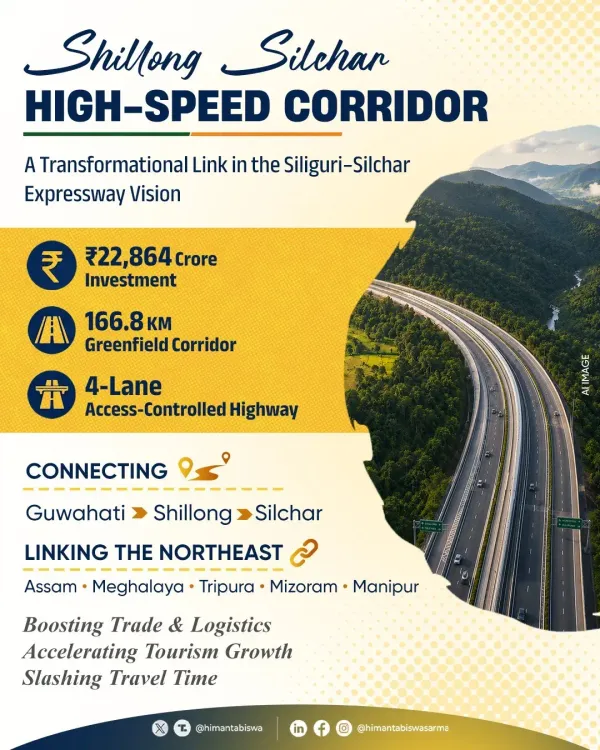
Assam Chief Minister Himanta Biswa Sarma has announced a state-wide expressway network targeting a 6-hour travel radius across all regions, down from 13–15 hours. Construction on the Silchar-Shillong section of the Siliguri-Silchar corridor is already underway.
Key Takeaways
Assam is building a network of expressways and high-speed corridors to reduce intra-state travel times.
The target is a 6-hour travel radius for every region, compared to current journey times of 13–15 hours .
Work on the Silchar-Shillong section is already underway as part of the Siliguri-Silchar corridor .
The corridor is aligned with the central government's Bharatmala Pariyojana and earlier SARDP-NE programmes.
Key beneficiaries include residents of the Barak Valley , Northeast traders, and commercial transporters.
Land acquisition and environmental clearances on remaining corridor sections remain critical milestones to watch.
Assam Chief Minister Himanta Biswa Sarma on Wednesday, 24 June 2026, announced that the state is developing a network of expressways and high-speed corridors aimed at bringing every region within a 6-hour travel radius — a significant reduction from current journey times that can stretch to 13–15 hours. The Chief Minister also confirmed that work on the Silchar-Shillong section is already underway as part of the broader Siliguri-Silchar corridor vision.
Context
Assam's geography — marked by river valleys, hills, and flood-prone plains — has historically made intra-state travel time-consuming and commercially burdensome. The Chief Minister's post frames the expressway push as a structural fix to this long-standing challenge, with the state targeting a unified travel-time benchmark of 6 hours across all regions.
The Silchar-Shillong section connects Silchar in Assam's southern Barak Valley with Shillong, the capital of neighbouring Meghalaya. Its active construction signals that at least one critical leg of the larger inter-regional corridor has moved beyond the planning stage.
Policy Backdrop
The corridor fits within a broader national push for Northeast connectivity. The central government's Bharatmala Pariyojana, launched in 2015, incorporated several greenfield expressways and highway upgrades across the Northeast, including components relevant to the Siliguri-Silchar corridor. An earlier initiative, the Special Accelerated Road Development Programme for North East (SARDP-NE), initiated in 2005, laid the groundwork for four-laning and connectivity improvements across Assam and adjacent states.
Since 2014, the pace of road infrastructure development in the Northeast has accelerated, with multiple corridor projects targeting reduced travel times between valleys, hill districts, and border areas. The Silchar-Shillong work is consistent with this pattern of connecting peripheral districts to regional hubs through expressway-grade roads.
Stakeholders and Impact
Assam's residents stand to benefit most directly from shorter travel times, particularly those in remote districts that currently face lengthy road journeys to reach state administrative or commercial centres. For Northeast traders and commercial transporters, faster road links translate into lower logistics costs and expanded market access.
The Barak Valley — geographically separated from upper Assam by hills and limited road access — has historically been among the most connectivity-deprived regions. An operational Siliguri-Silchar corridor would directly address this isolation, linking the valley to the national highway network via West Bengal's Siliguri.
What's Next
Key milestones to watch include the pace of land acquisition and environmental clearances on the remaining sections of the Siliguri-Silchar corridor beyond the Silchar-Shillong stretch. Progress on parallel rail and airport upgrades in the Barak Valley and Meghalaya will determine whether the road corridor becomes part of a multi-modal connectivity upgrade for the sub-region.
CM Sarma's public framing of the 6-hour travel radius as a measurable state-wide target sets a benchmark against which the expressway programme's delivery will likely be assessed in the years ahead.
Point of View
The Chief Minister signals execution rather than aspiration, distinguishing this from earlier Northeast highway announcements that stalled at the planning stage. The Siliguri-Silchar corridor, if completed, would be among the most consequential road projects in the sub-region, integrating the historically isolated Barak Valley into the national logistics network. The announcement also reinforces the BJP-led state government's positioning of infrastructure delivery as its primary electoral credential ahead of future assembly cycles.
NationPress
22 Sept 2026
Frequently Asked Questions
What is the Siliguri-Silchar corridor in Assam?
The Siliguri-Silchar corridor is a proposed high-speed road corridor linking Siliguri in West Bengal to Silchar in Assam's Barak Valley, forming a key part of Northeast India's highway upgrade programme under Bharatmala Pariyojana.
How will Assam's new expressways reduce travel time?
Assam's planned network of expressways and high-speed corridors aims to bring every region of the state within a 6-hour travel radius, compared to current journey times of 13–15 hours between distant districts.
Is the Silchar-Shillong highway under construction?
Yes, according to CM Himanta Biswa Sarma's announcement on 24 June 2026, work on the Silchar-Shillong section is already underway as part of the larger Siliguri-Silchar corridor project.
What is Bharatmala Pariyojana and how does it relate to Assam?
Bharatmala Pariyojana is a central government national highways programme launched in 2015 that includes several greenfield expressways and corridor upgrades across the Northeast, encompassing components of the Siliguri-Silchar corridor relevant to Assam.
Who benefits from Assam's expressway network?
The primary beneficiaries are Assam residents — especially those in remote districts like the Barak Valley — along with Northeast traders and commercial transporters who will gain faster, lower-cost road access to regional and national markets.