CM Himanta flags Assam's role in India's national security
Synopsis
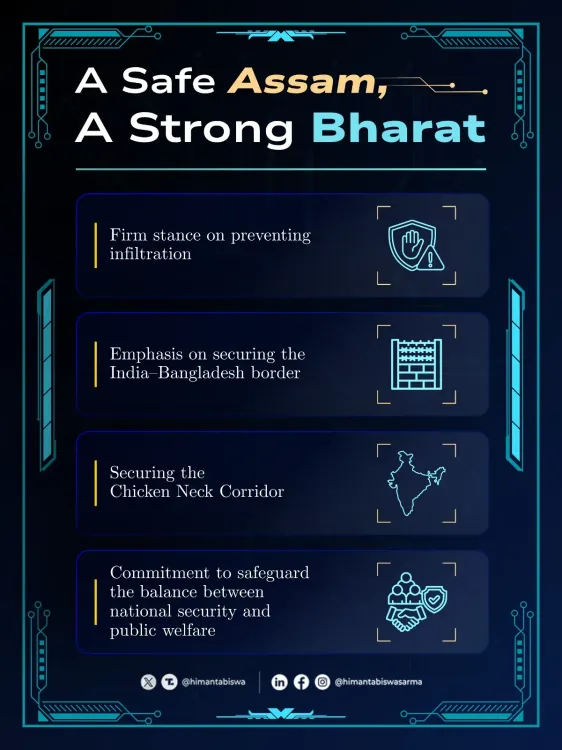
Assam Chief Minister Himanta Biswa Sarma on 25 May 2026 declared a secure Assam essential to India's national security, outlining four priorities: stopping infiltration, securing borders, protecting the Siliguri chicken-neck corridor, and advancing indigenous welfare alongside national security goals.
Key Takeaways
Himanta Biswa Sarma posted a four-point security agenda on 25 May 2026 , directly linking Assam's stability to India's national security.
The agenda explicitly names the Siliguri Corridor (chicken neck) — a critical 22-km land strip — as a priority for protection.
Infiltration prevention and border security are listed as top state priorities, consistent with the Assam Accord 1985 framework and ongoing India-Bangladesh border fencing.
The National Register of Citizens (NRC) , updated in 2019 , forms the citizenship-documentation backbone of Assam's anti-infiltration policy.
Sarma pairs national security with welfare of indigenous communities, framing both as inseparable policy objectives.
As convenor of NEDA , Sarma's security posture in Assam is likely to influence allied governments across the Northeast.
Assam Chief Minister Himanta Biswa Sarma on Monday, 25 May 2026, laid out a four-point security agenda for the state, asserting that 'a secure Assam is vital to Bharat's national security' and listing border protection, infiltration prevention, and indigenous welfare as the government's top priorities.
Context
In the post, Sarma identified four explicit priorities: preventing infiltration, securing Assam's borders, protecting the strategic 'chicken neck' corridor, and prioritising national security alongside the welfare of indigenous communities. The statement is notable for explicitly linking state-level governance to the country's broader defence calculus — a framing Sarma has consistently deployed since assuming office in 2021.
The Siliguri Corridor — a 22-kilometre land strip in West Bengal that connects mainland India with the entire Northeast — is commonly referred to as the 'chicken neck' because of its acute strategic vulnerability. Any disruption to this corridor would sever road and rail links to seven northeastern states, making its security a standing concern for defence planners since independence.
Policy Backdrop
Assam's border security challenges have deep legislative and administrative roots. The Assam Accord of 1985 established 24 March 1971 as the cut-off date for identifying and deporting foreigners — a provision directly tied to the mass displacement caused by the Bangladesh Liberation War. India's border-fencing programme along the India-Bangladesh boundary began in the 1980s and was significantly accelerated after 2000.
The National Register of Citizens (NRC), updated in 2019 under Supreme Court supervision, was designed specifically for Assam to distinguish Indian citizens from post-1971 illegal entrants. The exercise remains politically and legally contested, and its implementation status continues to be watched closely by civil society, legal bodies, and the central government alike.
Successive state governments — across party lines — have framed infiltration control as both a state imperative and a national security obligation, given Assam's long international borders with Bangladesh and proximity to Bhutan.
Stakeholders and Impact
The communities most directly affected by these priorities are the indigenous Assamese — including tribal and plains communities — who have historically raised concerns about demographic change driven by cross-border migration. Sarma's explicit pairing of 'national security' with 'welfare of the indigenous' signals that the government views these as inseparable policy goals rather than competing ones.
Border district administrations, the Border Security Force (BSF), and central agencies involved in fencing and road infrastructure are the operational stakeholders. Any escalation in security posture at the state level typically requires close coordination with New Delhi, given that border management is a concurrent responsibility under India's federal structure.
What's Next
Attention will now turn to whether this public articulation of priorities is followed by concrete executive or legislative action — including updates on pending border fencing stretches, road connectivity projects in border districts, or fresh directives on citizenship documentation. Sarma's role as convenor of the North-East Democratic Alliance (NEDA) also means that security postures adopted in Assam often set the tone for allied BJP-led governments across the region. A secure and well-governed Assam remains the pivot around which India's northeastern security architecture is built — and the Chief Minister's statement underscores that this reality will continue to drive policy in Dispur.
Point of View
Not separate portfolios. By foregrounding the chicken-neck corridor alongside infiltration and indigenous welfare, he is signalling to both domestic and central audiences that Assam's administration sees itself as a frontline security actor, not merely a recipient of central directives. The timing — mid-2026 — suggests an effort to consolidate political messaging around security credentials ahead of any potential electoral or legislative cycle in the region. The explicit mention of indigenous welfare alongside hard security measures also reflects a calibrated attempt to address the socio-political anxieties that have historically fuelled identity politics in Assam.
NationPress
9 Oct 2026
Frequently Asked Questions
Why does Assam matter for India's national security?
Assam is strategically critical because it borders Bangladesh and Bhutan and sits adjacent to the Siliguri Corridor — a narrow 22-km strip that is the only land link between mainland India and the seven northeastern states. Any security breakdown in Assam directly threatens troop movement and supply lines to the entire Northeast.
What is the chicken neck corridor?
The chicken neck refers to the Siliguri Corridor in West Bengal, a roughly 22-kilometre-wide strip of land flanked by Nepal, Bangladesh, and Bhutan. It is called the chicken neck because of how narrow and therefore vulnerable it is; it is the sole overland connection between mainland India and the Northeast.
What is the NRC in Assam?
The National Register of Citizens (NRC) is an Assam-specific exercise updated in 2019 under Supreme Court supervision to identify genuine Indian citizens and exclude those who entered after 24 March 1971, the cut-off date set by the Assam Accord of 1985.
Who is Himanta Biswa Sarma?
Himanta Biswa Sarma is the Chief Minister of Assam since May 2021 and a senior BJP leader. He also serves as convenor of the North-East Democratic Alliance (NEDA), a coalition of BJP-allied parties governing several northeastern states.
What is the Assam Accord and why is it relevant to infiltration?
The Assam Accord signed in 1985 ended a six-year agitation by setting 24 March 1971 as the cut-off date for detecting and deporting illegal foreigners from Assam. It remains the legal and political foundation for all subsequent anti-infiltration measures in the state, including the NRC.