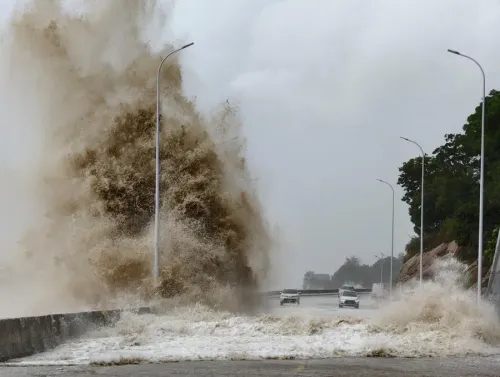
Top Asian climate scientist warns Earth is 'spiralling out of control'

Synopsis
Award-winning climate scientist Benjamin Horton of City University of Hong Kong says Earth is 'spiralling out of control' and sitting at the edge of its planetary boundary — a warning made viscerally real as Super Typhoon Bavi barrels toward Taiwan and eastern China, with humanity already having breached 7 of 9 critical environmental limits.
Key Takeaways
Benjamin Horton , dean at City University of Hong Kong , won the Asia Oceania Geosciences Society Axford Medal , the most prestigious honour in Asian climate and earth science.
Horton warned on 10 July 2026 that climate is 'accelerating far faster than we thought it would' and that Earth is 'spiralling out of control.' According to the Stockholm Resilience Centre , humanity has already crossed 7 of 9 planetary boundaries, including those for climate change, land use, and fresh water.
Super Typhoon Bavi is approaching Taiwan and eastern mainland China , demonstrating the rapid intensification patterns scientists warn are becoming harder to predict.
Typhoons can escalate from modest threats to major hazards within one to two days , driven by exceptionally warm ocean waters and favourable atmospheric conditions.
Benjamin Horton, dean of the school of energy and environment at City University of Hong Kong and the latest recipient of the Asia Oceania Geosciences Society Axford Medal — the most prestigious honour in Asian climate and earth science — has issued a stark warning that the planet has entered a period of dangerous volatility, as Super Typhoon Bavi churns toward Taiwan and eastern mainland China. Speaking on 10 July 2026, Horton said historical weather patterns can no longer be trusted as a guide to future risk.
A system at the edge
'Look at what is happening to the planet. It is spiralling out of control. Climate is accelerating far faster than we thought it would,' Horton said. He added: 'The Earth is incredibly sensitive. It has a planetary boundary, and we are right at the edge of it. That means that the system is prone to extremes, which we find very hard to predict exactly where and when.'
The warning carries particular weight given Horton's newly conferred recognition as the foremost climate scientist in the Asia-Pacific region. His remarks come as Bavi exemplifies the very unpredictability he describes.
Why it matters: Planetary boundaries already breached
The concept of planetary boundaries defines the environmental thresholds within which human civilisation can safely operate. According to the Stockholm Resilience Centre, humanity has already crossed seven of the nine critical limits, including those related to climate change, land use, and fresh water.
Once these boundaries are crossed, the risk of abrupt, self-reinforcing changes in the Earth system rises sharply — making extreme weather events both more frequent and harder to anticipate.
The Bavi threat: Rapid intensification and forecasting failures
Typhoons such as Bavi that undergo rapid intensification pose severe forecasting challenges, according to climate experts. Within just one to two days, a relatively modest storm can escalate into a major hazard as maximum sustained winds surge abruptly, often fuelled by exceptionally warm ocean waters and favourable atmospheric conditions.
This pattern of rapid intensification has been observed with increasing frequency across the Pacific, echoing the behaviour seen in Atlantic hurricanes such as Hurricane Sandy, and underscoring the global nature of the accelerating climate crisis.
The competitive backdrop: Science meets policy inaction
Despite repeated warnings from the scientific community, the gap between climate projections and policy response remains wide. Horton, who is based in Hong Kong and has previously worked in Philadelphia and the United States, has long argued that the window for manageable intervention is narrowing. Climate phenomena such as El Niño further amplify baseline warming, supercharging storm systems and drought cycles simultaneously.
The Stockholm Resilience Centre's planetary boundary framework, widely cited in international climate negotiations, now indicates that the margin for error is effectively gone in multiple critical systems.
What's next
As Super Typhoon Bavi makes its approach, emergency authorities across Taiwan, eastern China, and the broader Asia-Pacific region are on high alert. The storm's trajectory and intensity will serve as a real-time stress test of regional disaster-preparedness systems — and of whether the humanitarian warnings from scientists like Horton are being translated into meaningful infrastructure and policy responses.
Point of View
Hard-to-model shocks, a transition that exposes a fundamental flaw in how governments price and plan for disaster risk. The 'seven of nine planetary boundaries' figure from the Stockholm Resilience Centre is not new data, but its invocation by the region's most decorated climate scientist at the precise moment a major typhoon targets Taiwan gives it renewed geopolitical weight. What mainstream coverage often misses is that rapid intensification is not just a meteorological curiosity — it is a direct threat to the insurance, infrastructure, and supply-chain models that underpin Asian economic growth. The real story here is the widening gap between what climate science now knows and what disaster-preparedness budgets currently fund.
NationPress
8 Oct 2026
Frequently Asked Questions
Who is Benjamin Horton and why is his climate warning significant?
Benjamin Horton is the dean of the school of energy and environment at City University of Hong Kong and the recipient of the Asia Oceania Geosciences Society Axford Medal, the most prestigious honour in Asian climate and earth science. His warning that Earth is 'spiralling out of control' carries particular authority given this recognition. He argues that historical weather patterns are no longer a reliable guide to future risk.
What is Super Typhoon Bavi and where is it headed?
Super Typhoon Bavi is a powerful storm churning toward Taiwan and eastern mainland China as of 10 July 2026. It exemplifies the rapid intensification phenomenon that climate scientists warn is becoming more common. Within one to two days, such storms can escalate from modest threats into major hazards driven by warm ocean waters.
What are planetary boundaries and how many has humanity crossed?
Planetary boundaries are the environmental thresholds within which human civilisation can safely operate, as defined by the Stockholm Resilience Centre. Humanity has already crossed seven of the nine critical limits, including those for climate change, land use, and fresh water. Breaching these boundaries raises the risk of abrupt, self-reinforcing changes in the Earth system.
Why are typhoons becoming harder to forecast?
Typhoons that undergo rapid intensification can surge from relatively modest storms to major hazards within just one to two days, making accurate forecasting extremely difficult. Exceptionally warm ocean waters and favourable atmospheric conditions fuel these abrupt escalations. Scientists say this pattern is becoming more frequent across the Pacific as baseline ocean temperatures rise.
What should be watched next after these climate warnings?
The immediate focus is on Super Typhoon Bavi's impact on Taiwan and eastern China, which will test regional disaster-preparedness systems in real time. Longer term, the key question is whether policymakers translate scientific warnings into concrete infrastructure investment and emissions policy. The frequency of similar rapid-intensification events in coming seasons will indicate whether the climate system is accelerating as Horton warns.