White House: $125 Million Poured Into Trump Accounts in 5 Days
Synopsis
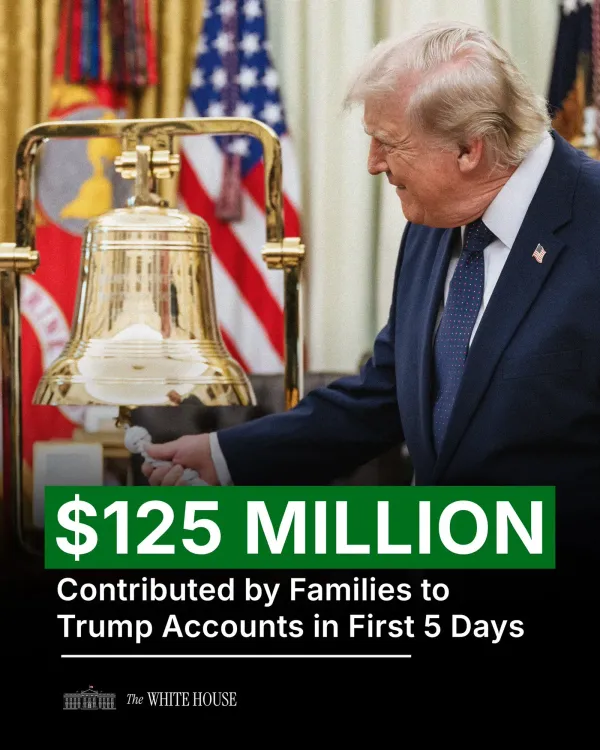
The White House announced that American families contributed nearly $125 million to Trump Accounts within five days of launch, positioning the new savings vehicle as a centrepiece of the administration's household-investment agenda.
Key Takeaways
The White House announced on July 10, 2026 that American families contributed nearly $125 million to Trump Accounts within five days of launch.
The administration framed the contribution milestone as evidence of strong public enthusiasm for the new savings programme.
Trump Accounts are positioned as a household-level investment vehicle, consistent with a long US policy tradition of tax-advantaged savings schemes.
The Tax Cuts and Jobs Act of 2017 from Trump's first term expanded similar savings vehicles, providing policy precedent for the new programme.
Key data points still awaited include total account numbers, average contribution size, demographic breakdown, and any associated tax incentives.
Congressional oversight hearings and independent verification of the $125 million figure will be critical to assessing the programme's actual reach.
The White House announced on Thursday, July 10, 2026, that American families have contributed nearly $125 million to so-called Trump Accounts within just five days of the programme's launch, hailing the early uptake as a sign of robust public enthusiasm for the new savings vehicle.
Context
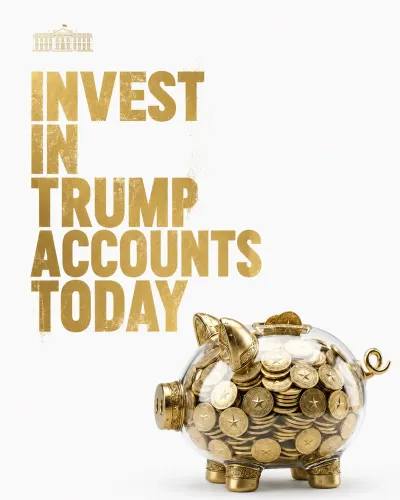
The official White House account posted on X, declaring: 'THIS is what investing in the future looks like. In just five days since launch, American families have contributed nearly $125 million to Trump Accounts.' The post was accompanied by an image and framed the contribution milestone as validation of the programme's early momentum.
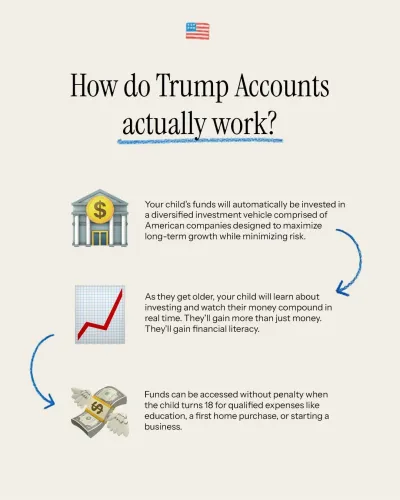
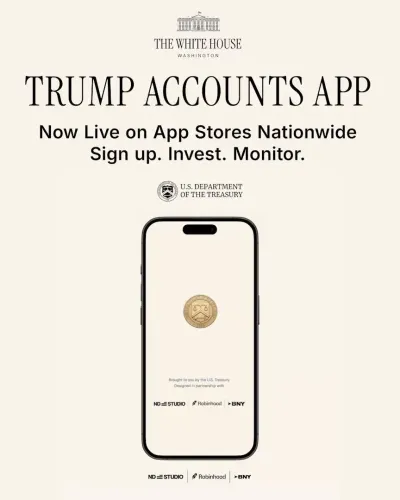
The term 'Trump Accounts' refers to a newly launched savings or investment product promoted under the current administration. The White House's framing positions the scheme as a household-level wealth-building tool, consistent with a long-running strand of US economic policy that uses named, tax-advantaged accounts to drive private savings.
Policy Backdrop
The United States has a well-established tradition of using branded, tax-advantaged savings vehicles — from 401(k) retirement plans to 529 education accounts — to encourage families to invest in their own futures. The Tax Cuts and Jobs Act of 2017, passed during Donald Trump's first term, expanded several such vehicles and introduced Opportunity Zones to channel private capital into underserved communities.
Rapid early contribution figures are a standard tool in official communications: they signal public buy-in, build political momentum, and pre-empt legislative or regulatory pushback. A $125 million total across American families in five days, if sustained, would point to significant retail-investor interest in the scheme.
Stakeholders and Impact
The primary beneficiaries cited by the White House are American families — retail savers and investors who have opted into the new accounts since launch. The framing deliberately emphasises household participation rather than institutional flows, positioning the programme as a grassroots savings movement.
Broader stakeholders include financial institutions administering the accounts, congressional oversight committees that will scrutinise the programme's structure and tax implications, and future participants who will watch early results before committing funds. For Indian observers, the scheme echoes domestic instruments such as the Public Provident Fund (PPF) and the National Savings Certificate (NSC), where government branding and tax incentives are used to mobilise household savings at scale.
What's Next
Analysts and policymakers will be watching for the release of official participation data beyond the initial five-day figure, including the number of account holders, average contribution size, and demographic breakdown. Any accompanying changes to tax rules — such as deductions or exemptions tied to Trump Accounts — will be scrutinised by Congress and financial regulators.
If early momentum holds, the White House is likely to use the contribution milestone as a legislative talking point to entrench the programme before the next budget cycle. The administration's willingness to publicise the $125 million figure this early suggests it views rapid uptake as central to the scheme's political durability.
Point of View
Designed to build narrative momentum before congressional scrutiny intensifies. Framing the scheme around 'American families' rather than institutional investors mirrors a populist savings-policy playbook that successive US administrations have used to insulate programmes from elite-capture criticism. The $125 million headline, if verified by independent data, would represent a credible early-adoption signal; if it is not followed by transparent participation metrics, it risks becoming a liability. For global observers, the episode underscores how governments increasingly use real-time financial data as political communication tools.
NationPress
10 Jul 2026
Frequently Asked Questions
What are Trump Accounts?
Trump Accounts are a savings or investment vehicle launched by the current US administration, designed to encourage American families to contribute funds toward long-term wealth building. The White House announced the programme attracted nearly $125 million in contributions within five days of launch.
How much money has been contributed to Trump Accounts?
According to the White House, American families contributed nearly $125 million to Trump Accounts in just five days since the programme's launch in early July 2026.
When were Trump Accounts launched?
Based on the White House announcement dated July 10, 2026, Trump Accounts were launched approximately five days earlier, placing the launch date around early July 2026.
Are Trump Accounts similar to India's PPF or NPS?
Conceptually, yes. Like India's Public Provident Fund or National Pension System, Trump Accounts appear to be a government-branded savings vehicle intended to mobilise household-level investment, potentially with tax advantages attached.
What happens next with Trump Accounts?
Observers will watch for official participation data including account numbers and average contributions, any tax-rule changes linked to the scheme, and congressional hearings on the programme's structure and oversight.