CM Himanta to release first instalment for 5.42 lakh Assam students
Synopsis
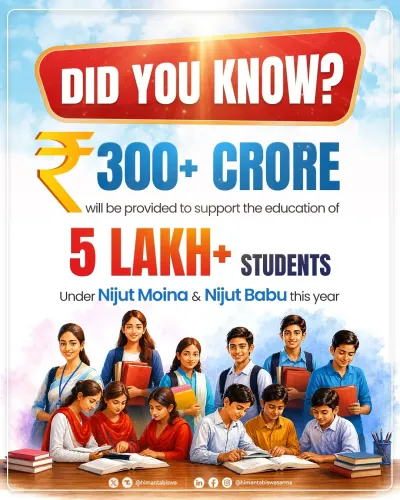
Assam CM Dr. Himanta Biswa Sarma will release the first instalment of the Nijut Moina and Nijut Babu student welfare schemes on 15 October 2026, benefiting 5.42 lakh higher education students across the state.
Key Takeaways
5.42 lakh students across Assam are set to receive financial assistance under two state schemes in October 2026 .
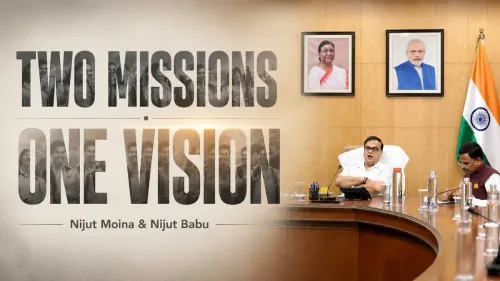
Himanta Biswa Sarma will personally release the first instalment on 15 October 2026 .
The schemes — Nijut Moina and Nijut Babu — are aimed at supporting students in higher education.
The initiative is part of the Assam government's broader push to reduce student dropout rates through direct financial transfers.
Disbursement timelines for subsequent instalments and uptake reports will be key indicators of the scheme's effectiveness.
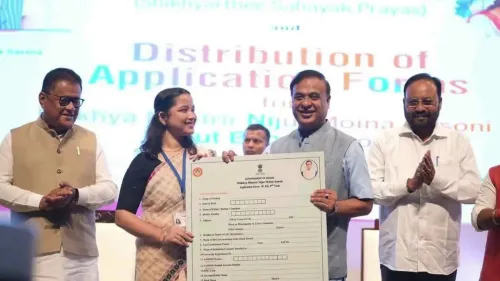
More than half a million students in Assam are about to receive direct financial support for their higher education — and the clock starts tomorrow. The Chief Minister's Office of Assam announced on Wednesday, 14 October 2026, that Chief Minister Dr. Himanta Biswa Sarma will release the first instalment under the state's flagship student-welfare schemes, marking October 2026 as the disbursement month for a combined beneficiary pool of 5.42 lakh students.
Nijut Moina and Nijut Babu: two schemes, one push
The announcement covers two distinct programmes — Nijut Moina and Nijut Babu — both designed to ease the financial burden on families and keep students enrolled in higher education. The schemes represent the Sarma administration's wider bet on direct benefit transfers as a tool to reduce dropout rates and widen access to colleges and universities across Assam. By combining both schemes into a single disbursal event, the government is signalling both scale and administrative efficiency.
Why direct transfers to students matter in Assam
Assam has historically grappled with high dropout rates at the higher-secondary and undergraduate levels, particularly among girls and students from economically weaker households. Direct financial assistance programmes — where money lands in a student's account rather than flowing through institutional intermediaries — have been a recurring feature of state welfare policy, designed to ensure the support actually reaches the intended beneficiary. 5.42 lakh beneficiaries in a single month is a significant throughput for any state-level scheme.
Dr. Himanta Biswa Sarma, who has served as Chief Minister since May 2021, has consistently positioned education access as a pillar of his administration's social agenda. The release of the first instalment in person underscores that framing — connecting the political leadership directly to the moment money moves.
What comes next for the 5.42 lakh beneficiaries
The immediate question is whether subsequent instalments will follow on schedule and whether institutions across the state have the verification infrastructure to flag discrepancies quickly. The government's own credibility on the scheme will be measured not just by this first release, but by the consistency of what follows. For the students themselves, the first instalment is the proof of concept — the moment a government promise becomes a bank-account reality.
Point of View
Maximum political capital. For the Sarma government, education welfare has served as a bridge between economic development optics and social equity commitments, particularly ahead of electoral cycles. Direct benefit transfers also sidestep institutional leakage risks, making them a politically safer delivery mechanism than infrastructure grants. The real test, as with every scheme of this scale, is whether the cadence of subsequent instalments holds — consistency converts a launch into a legacy.
NationPress
14 Oct 2026
Frequently Asked Questions
What is the Nijut Moina scheme in Assam?
Nijut Moina is an Assam government scholarship scheme providing direct financial assistance to students pursuing higher education, aimed at reducing dropout rates and easing household education costs.
What is the Nijut Babu scheme?
Nijut Babu is a companion student welfare scheme in Assam, also designed to offer direct financial support for higher education, running alongside the Nijut Moina programme.
How many students will benefit from Nijut Moina and Nijut Babu in October 2026?
A combined total of 5.42 lakh students are set to benefit from both schemes during October 2026 .
When will CM Himanta Biswa Sarma release the first instalment?
Chief Minister Dr. Himanta Biswa Sarma is scheduled to release the first instalment on 15 October 2026 .
Who is eligible for the Nijut Moina and Nijut Babu schemes?
The schemes target students in higher education across Assam, with the government focusing on reducing dropout rates and supporting access to colleges and universities in the state.