CM Himanta Reviews NEET Re-Exam Security Plan for Assam
Synopsis
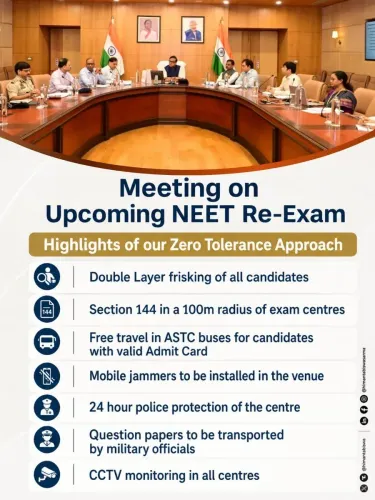
Assam Chief Minister Himanta Biswa Sarma on 18 June 2026 reviewed a three-tier security plan for the NEET re-examination, approving mobile jammers, CCTV surveillance, and double frisking at every exam centre in the state, following the 2024 NEET irregularities and Supreme Court directives.
Key Takeaways
CM Himanta Biswa Sarma reviewed Assam's security plan for the upcoming NEET re-examination on 18 June 2026 .
The plan includes mobile jammers to block signal-based malpractice at every examination centre.
CCTV surveillance will be deployed across all designated NEET centres in Assam.
Double frisking of candidates will be mandatory at every centre entry point.
The review aligns Assam with NTA and Ministry of Education guidelines issued after the 2024 NEET controversy.
The measures are intended to protect the interests of medical aspirants in Assam and restore credibility in high-stakes national examinations.
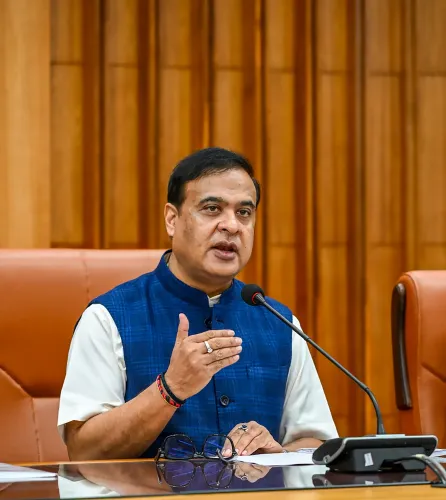
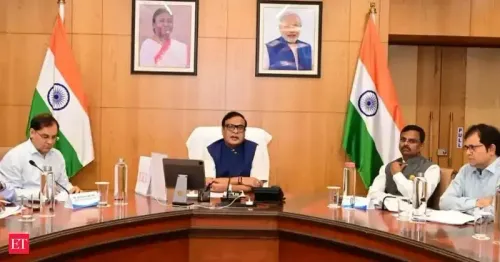
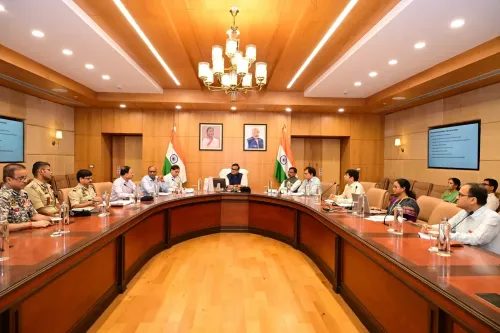
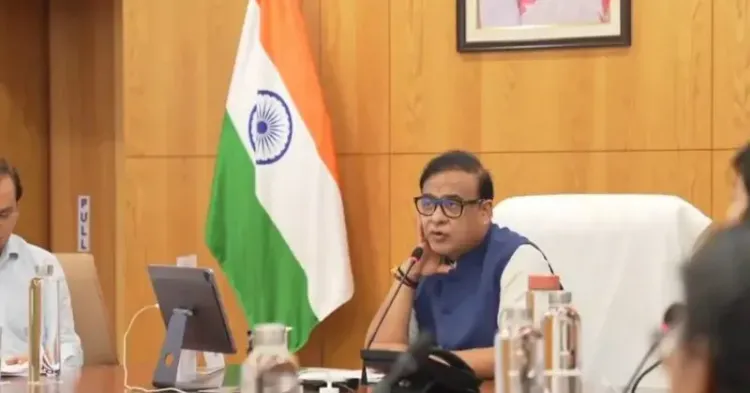
The Chief Minister's Office of Assam announced on Thursday, 18 June 2026 that Chief Minister Himanta Biswa Sarma has reviewed a comprehensive security plan for the upcoming NEET re-examination, with measures including mobile jammers, closed-circuit television surveillance, and double frisking at every examination centre across the state.
Context
The review comes amid heightened national scrutiny of the National Eligibility cum Entrance Test (NEET), conducted by the National Testing Agency (NTA) under the Ministry of Education for undergraduate medical admissions across India. Following documented irregularities in the 2024 NEET cycle and subsequent Supreme Court directives, state governments have been under pressure to demonstrate robust, on-ground security at designated exam centres. Assam's review reflects that broader national imperative.
CM Himanta Biswa Sarma, who has since May 2021 frequently engaged with state-level implementation of national examinations, convened the review to align Assam's protocols with central guidelines. The three-pronged approach — signal jamming, CCTV monitoring, and layered physical frisking — represents the state's response to systemic vulnerabilities exposed in earlier examination cycles.
Policy Backdrop
The 2024 NEET controversy triggered a nationwide reckoning with examination integrity, drawing intervention from the Supreme Court of India and prompting the NTA to issue revised standard operating procedures for re-examinations. States were directed to audit their designated centres and certify compliance with strengthened anti-malpractice norms. Assam's latest review is consistent with that compliance framework.
Indian states have progressively adopted layered security architectures at high-stakes examination venues — combining electronic countermeasures such as mobile signal jammers with physical surveillance infrastructure and multi-stage frisking. This shift represents a structural departure from earlier, more permissive centre-management practices that were identified as points of failure in documented paper-leak investigations.
Stakeholders and Impact
The measures directly affect medical aspirants in Assam who are scheduled to appear in the NEET re-examination. For students, the deployment of jammers and double frisking signals a more controlled and monitored environment, intended to level the playing field and deter any attempt at malpractice. Parents and coaching institutes in the state have consistently demanded stronger centre-level accountability following the 2024 irregularities.
Examination centre administrators and invigilating staff will bear the operational responsibility of implementing the multi-layer protocol. The NTA and the state's education department are the key institutional actors whose coordination will determine whether the announced measures translate into airtight execution on exam day.
What's Next
Attention will now turn to NTA notifications confirming re-examination dates and the finalised security standard operating procedures for all states. Any further hearings before the Supreme Court on the conduct of NEET will also shape how strictly the announced protocols are enforced and audited. Assam's early and public review of its security plan may set a reference point that other states are expected to match, reinforcing the principle that examination integrity requires verifiable, pre-announced safeguards rather than post-incident remediation.
Point of View
Pre-examination security review is a calculated political and administrative signal — it positions CM Himanta Biswa Sarma as proactive on examination integrity at a time when the credibility of national entrance tests remains a live political issue. By announcing specific technical and physical measures ahead of the re-exam, the state government pre-empts blame if irregularities recur while also applying indirect pressure on the NTA to match state-level diligence with robust central oversight. The move fits a broader pattern in which state chief ministers have stepped into a governance space traditionally occupied by central agencies, reflecting the reputational stakes that NEET controversy has created for elected leaders. Whether the announced measures are fully implemented and independently verified will ultimately determine whether this review translates into genuine reform or remains a well-publicised intent.
NationPress
18 Sept 2026
Frequently Asked Questions
Why is Assam holding a NEET re-examination in 2026?
A NEET re-examination has been necessitated following irregularities in earlier exam cycles and directions from the Supreme Court of India, which prompted the NTA and state governments to ensure a fresh, secure attempt for affected candidates. Assam is aligning its centre-level preparations with national guidelines for this re-exam.
What security measures has Assam announced for the NEET re-exam?
Assam CM Himanta Biswa Sarma has approved three key measures: deployment of mobile signal jammers, installation of CCTV cameras, and mandatory double frisking of candidates at every NEET examination centre in the state.
What are mobile jammers and why are they used at exam centres?
Mobile jammers are electronic devices that block cellular and wireless signals within a defined radius, preventing candidates from using smartphones or Bluetooth devices to communicate answers or receive external assistance during an examination. They have become a standard anti-malpractice tool at high-stakes test venues across India.
Who conducts NEET and who oversees exam centre security?
NEET is conducted by the National Testing Agency (NTA), an autonomous body under India's Ministry of Education. Physical security at examination centres is a shared responsibility between the NTA and the respective state governments, which designate and manage the centres.
What happened in the 2024 NEET controversy?
The 2024 NEET cycle was marred by allegations of paper leaks and irregularities at multiple centres across India, prompting Supreme Court intervention, NTA reviews, and demands for re-examinations. The controversy led to a nationwide push for stronger physical and technical security protocols at all NEET centres.