CM Himanta Revives Orunodoi, Key Welfare Schemes from August
Synopsis
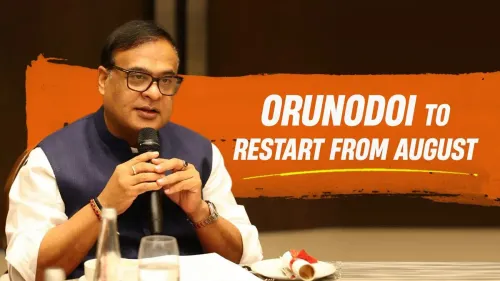
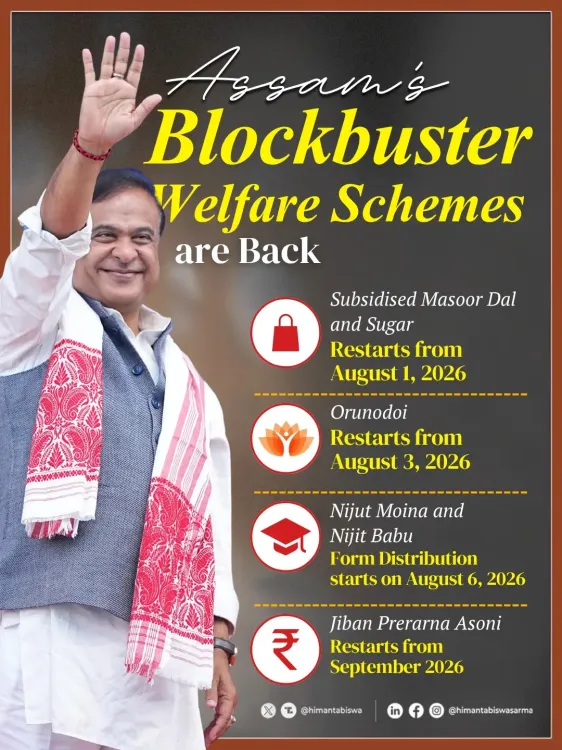
Assam Chief Minister Himanta Biswa Sarma has announced the resumption of the Orunodoi cash-transfer scheme, subsidised essential commodities, and student welfare programmes from August 2026, reviving direct benefits for women, low-income households, and students across the state.
Key Takeaways
Assam CM Himanta Biswa Sarma announced on 19 July 2026 that multiple welfare schemes will resume from August 2026 .
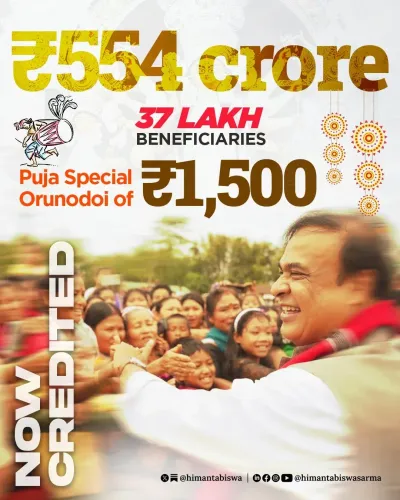
The Orunodoi scheme, launched in December 2020 , provides monthly cash transfers to eligible women for economic empowerment.
Three welfare streams are being revived simultaneously: Orunodoi , subsidised essentials, and student welfare schemes.
Primary beneficiaries include women, low-income households, and students across Assam .
District administrations are the expected delivery mechanism for the August rollout.
Revised beneficiary lists, subsidy quantum, and eligibility details are yet to be officially announced.
Assam Chief Minister Himanta Biswa Sarma announced on Sunday, 19 July 2026, that the state government will resume the flagship Orunodoi cash-transfer programme, subsidised essential commodities, and student welfare schemes starting August 2026. The announcement, made via a post on X, signals a formal restart of multiple direct-benefit initiatives that had been paused during administrative review cycles.
Context
Writing in a characteristically informal tone — 'Knock, knock... Some familiar names are back at your doorstep' — Chief Minister Sarma confirmed that three distinct welfare streams will simultaneously resume next month. The phrasing 'familiar names' is a deliberate nod to beneficiaries who previously received these benefits and are now being re-enrolled or reinstated. The announcement comes ahead of the academic year and the festive season, a period when welfare disbursements in Assam have historically been timed for maximum reach.
Policy Backdrop
The Orunodoi scheme was launched in December 2020 as a flagship direct-benefit transfer programme targeting economically vulnerable women across Assam. Under the programme, eligible women receive monthly cash transfers credited directly to their bank accounts, positioning it as a cornerstone of the BJP-led state government's social-protection architecture. Alongside Orunodoi, the government has run parallel tracks covering subsidised essential goods and student-centric welfare measures — together forming a layered safety net for low-income households.
Assam's welfare programmes have been subject to periodic pauses tied to annual budget cycles and beneficiary-list audits. Resumption announcements of this kind have become a recognisable feature of the state's governance calendar, typically preceding major administrative milestones or seasonal demand peaks. The BJP-led coalition, which has governed Assam since 2016, has consistently positioned these direct-transfer schemes as central to its electoral and governance identity in the northeast.
Stakeholders and Impact
The primary beneficiaries of the restart span three distinct groups: women enrolled under Orunodoi, low-income households dependent on subsidised essentials, and students covered under the state's welfare schemes. Together, these programmes touch a significant share of Assam's population, particularly in rural and semi-urban districts where household incomes remain below national averages. District administrations are expected to serve as the primary delivery mechanism once the rollout begins in August.
For women beneficiaries specifically, the monthly cash transfer under Orunodoi represents a direct, predictable income supplement that supports household consumption. Student welfare schemes, which can include scholarships, fee waivers, or material support, are especially time-sensitive given that the academic year in Assam typically resumes around this period. Any delay in disbursement can have downstream effects on enrolment and retention rates.
What's Next
The government is expected to release operational details in the coming weeks, including revised beneficiary lists, the quantum of cash transfers under Orunodoi, subsidy structures for essentials, and the specific student schemes being reactivated. District-level administrations across Assam will be tasked with last-mile delivery, and observers will watch for any changes to eligibility criteria or outreach mechanisms. The August 2026 timeline gives the administration roughly two to three weeks to operationalise the rollout, making the pace of follow-up announcements a key indicator of implementation readiness.
Point of View
Subsidies, and student support — ahead of the festive and academic season follows a well-established pattern in Assam's governance calendar, where welfare disbursements are timed to maximise visibility and reach. For Chief Minister Sarma, the announcement reinforces the BJP-led government's direct-benefit identity in the northeast, a region where state-sponsored welfare has become a primary political currency. The informal, conversational framing of the post ('Knock, knock') is a deliberate communication choice, designed to humanise a bureaucratic restart and signal continuity of care to beneficiaries who experienced a gap in services. The broader arc here is one of welfare-as-governance: in states like Assam, the credibility of a ruling dispensation is increasingly measured by the reliability and reach of its direct-transfer architecture.
NationPress
18 Oct 2026
Frequently Asked Questions
What is the Orunodoi scheme in Assam?
The Orunodoi scheme is a direct-benefit transfer programme launched by the Assam government in December 2020 that provides monthly cash transfers to eligible women from economically vulnerable households to support their financial empowerment.
When will Orunodoi payments resume in Assam?
Chief Minister Himanta Biswa Sarma announced on 19 July 2026 that Orunodoi payments and related welfare schemes will resume starting August 2026 .
Which welfare schemes is the Assam government restarting in August 2026?
The Assam government is restarting three welfare streams from August 2026 : the Orunodoi monthly cash-transfer scheme for women, subsidised essential commodities, and student welfare schemes.
Who benefits from the Orunodoi scheme?
The Orunodoi scheme primarily benefits women from low-income households in Assam , providing them with monthly direct cash transfers credited to their bank accounts.
Why were Assam welfare schemes paused?
Assam's welfare programmes, including Orunodoi , have periodically been paused due to annual budget cycles and administrative reviews of beneficiary lists, a pattern common to state-level direct-transfer programmes. Specific details of the most recent interruption have not been officially disclosed.