CM Himanta Outlines 5-Year Agenda for Assam Land, Culture

Synopsis
Chief Minister Himanta Biswa Sarma has presented a five-year agenda at the Assam Assembly to enforce the Immigrants (Expulsion from Assam) Act, 1950, clear illegal encroachments, and accelerate balanced development across Karbi Anglong, Dima Hasao, Barak Valley, and BTR, with a focus on youth and women's security.
Key Takeaways
CM Himanta Biswa Sarma outlined a five-year governance agenda at the Assam Assembly on 26 May 2026 .
The agenda centres on strict enforcement of the Immigrants (Expulsion from Assam) Act, 1950 and clearing illegal encroachments on indigenous land.
Balanced development is promised across Karbi Anglong , Dima Hasao , Barak Valley , and the Bodoland Territorial Region (BTR) .
Security of youth and women has been explicitly named as a priority alongside land and cultural protection.
The agenda builds on the policy lineage of the Assam Accord of 1985 , the 2003 BTC Accord , and the 2019 NRC update.
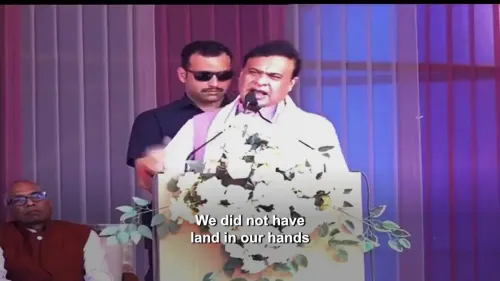
The Chief Minister's Office of Assam announced on Tuesday, 26 May 2026 that Chief Minister Dr. Himanta Biswa Sarma has outlined a decisive five-year agenda focused on protecting indigenous land, language, and culture — anchored on strict enforcement of the Immigrants (Expulsion from Assam) Act, 1950 and the removal of illegal encroachments across the state.
Context
Speaking at the Assam Assembly, CM Himanta reaffirmed the state government's commitment to clearing encroachments on indigenous land while enforcing the 1950 Act — a central legislation that empowers authorities to identify and expel illegal immigrants from Assam. The announcement positions the next five years as a period of decisive administrative action on an issue that has defined Assam's political landscape for decades.
The Chief Minister also reaffirmed the state's commitment to 'accelerating balanced development' across Karbi Anglong, Dima Hasao, Barak Valley, and the Bodoland Territorial Region (BTR), while simultaneously prioritising the security of youth and women in these areas.
Policy Backdrop
Assam's immigration debate is rooted in the Assam Accord of 1985, which established 24 March 1971 as the cut-off date for citizenship and mandated the detection and deportation of post-1971 illegal immigrants. The Immigrants (Expulsion from Assam) Act, 1950 predates the Accord and remains one of the oldest legislative tools available to the state for addressing illegal migration.
The National Register of Citizens (NRC), whose update was completed in 2019, was a landmark exercise to identify undocumented immigrants in Assam. The Bodoland Territorial Council Accord of 2003 created the BTR framework to address Bodo community demands for autonomy and land protection — making it a key pillar of any balanced-development strategy in the region.
Assam governments have historically pursued a dual track: strict immigration enforcement alongside targeted development spending in tribal autonomous areas, responding to demographic anxieties and regional imbalances linked to decades of cross-border migration.
Stakeholders and Impact
The agenda directly concerns indigenous communities across Assam's hill districts and plains, particularly in Karbi Anglong — an autonomous district with significant tribal populations and longstanding land-rights demands — and the BTR, home to the Bodo community. Barak Valley, Assam's Bengali-speaking southern region, is also named as a development priority, signalling an intent to address regional imbalances without sidelining linguistic minorities.
The explicit mention of youth and women's security as a priority suggests the agenda will encompass law-and-order and social welfare dimensions alongside the land and immigration focus. Encroachment removal on indigenous land has historically been a politically sensitive issue, with implications for both tribal communities and long-settled migrant populations.
What's Next
Legislative and executive follow-up in the Assam Assembly will be closely watched, including any new bills, orders, or task forces tied to the enforcement of the 1950 Act and encroachment removal. Development packages for Karbi Anglong, Dima Hasao, Barak Valley, and BTR are expected to be detailed in subsequent budget and policy announcements.
The five-year framing aligns with the current assembly term, suggesting the government intends this agenda to serve as its defining governance mandate — one that will be tested against both administrative delivery and the complex demographic realities on the ground.
Point of View
Identity, and migration. By invoking the Immigrants (Expulsion from Assam) Act, 1950 — a pre-Accord instrument rarely at the centre of political messaging — the Chief Minister is signalling administrative intent that goes beyond the NRC debate. The simultaneous emphasis on development in BTR, Karbi Anglong, and Barak Valley reflects a calibrated attempt to hold together a diverse coalition of tribal, plains-indigenous, and linguistic-minority constituents. Whether enforcement action and development spending can be delivered in tandem, without triggering inter-community tensions, will define the credibility of this agenda.
NationPress
10 Oct 2026
Frequently Asked Questions
What is the Immigrants (Expulsion from Assam) Act, 1950?
The Immigrants (Expulsion from Assam) Act, 1950 is a central legislation that empowers authorities to identify and expel illegal immigrants from Assam. It is one of the oldest legal instruments for immigration enforcement in the state and predates the Assam Accord of 1985.
What is CM Himanta Biswa Sarma's five-year agenda for Assam?
CM Himanta Biswa Sarma has outlined a five-year agenda to protect indigenous land, language, and culture through strict enforcement of the 1950 Act and removal of illegal encroachments, alongside accelerating balanced development in Karbi Anglong, Dima Hasao, Barak Valley, and BTR.
What is BTR in Assam?
BTR stands for Bodoland Territorial Region, an autonomous administrative area in Assam created under the Bodoland Territorial Council Accord of 2003 to provide the Bodo community with self-governance and address their land-rights demands.
What is the Assam Accord and how does it relate to illegal immigration?
The Assam Accord of 1985 was a political agreement that set 24 March 1971 as the cut-off date for citizenship in Assam, mandating the detection and deportation of all illegal immigrants who entered after that date, primarily from Bangladesh.
Why is Barak Valley significant in Assam's politics?
Barak Valley is a Bengali-speaking region in southern Assam that is often at the centre of debates around linguistic identity, development disparities, and demographic change, making its inclusion in any state-wide agenda politically significant.