CM Himanta Thanks Odisha CM for Solidarity on Assam Floods

Synopsis
Assam CM Himanta Biswa Sarma on 26 July 2026 thanked Odisha CM Mohan Majhi for prayers and solidarity as the state government works round the clock on flood relief. The exchange highlights India's cooperative federalism in action during recurring monsoon disasters.
Key Takeaways
Assam CM Himanta Biswa Sarma publicly thanked Odisha CM Mohan Majhi on 26 July 2026 for his message of solidarity during the ongoing Assam floods .
The Assam government stated it is working 'round the clock' to support those affected by the floods.
Assam faces severe monsoon flooding annually, driven by the Brahmaputra River and its tributaries.
Both Assam and Odisha are disaster-prone states governed by the BJP , and the exchange reflects inter-state cooperative federalism.
The National Disaster Response Force (NDRF) has historically been deployed to Assam during major flood events, including in 2017 and 2020 .
Central government relief packages and long-term Brahmaputra river management remain key policy issues to watch.
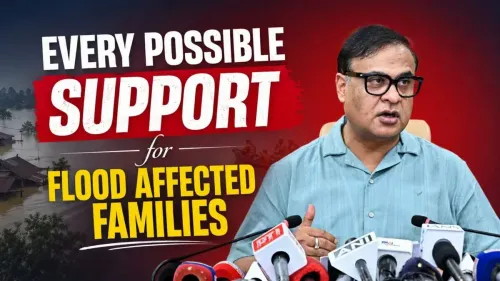
Assam Chief Minister Himanta Biswa Sarma on Sunday, 26 July 2026, publicly acknowledged Odisha Chief Minister Mohan Majhi's message of support, expressing gratitude for the solidarity extended by the people of Odisha as flood relief operations continue across Assam.
Context
In his post, CM Sarma stated that his administration is working 'round the clock to support those affected by the #AssamFloods,' signalling the ongoing intensity of relief operations. The acknowledgement came in direct response to a message from Odisha CM Mohan Majhi, who conveyed prayers and solidarity from his state. Such inter-state gestures reflect the human dimension of cooperative disaster response in India.
Assam faces severe flooding almost every monsoon season, driven primarily by the Brahmaputra River and its tributaries swelling under heavy rainfall. The floods displace hundreds of thousands of people, damage standing crops, and strain state infrastructure and emergency services each year.
Policy Backdrop
India's disaster response framework operates on a dual axis of central and state coordination. The National Disaster Response Force (NDRF) has been deployed to Assam during major flood events in previous years, including 2017 and 2020, working alongside the State Disaster Response Force and civil administration. Relief funding flows through the State Disaster Response Fund (SDRF) and, in severe cases, the National Disaster Response Fund (NDRF).
Both Assam and Odisha are among India's most disaster-prone states — Assam for riverine flooding and Odisha for cyclones and coastal inundation. This shared vulnerability has fostered an informal culture of inter-state empathy and experience-sharing during calamities, embedded within India's cooperative federalism structure.
Stakeholders and Impact
The most immediate stakeholders are the flood-affected communities across Assam, whose displacement, livelihood loss, and access to relief depend on the efficiency of state-led operations. CM Sarma's reference to working 'round the clock' underscores the administrative pressure on the state government during active flood emergencies.
For Odisha, the gesture by CM Majhi reinforces a pattern of solidarity that has political as well as humanitarian dimensions. Both states are governed by the Bharatiya Janata Party (BJP), and the exchange also reflects the cohesion within the party's network of state governments, including CM Sarma's role as convenor of the North-East Democratic Alliance (NEDA).
What's Next
Attention will now focus on the scale of central government support, including potential announcements of additional flood relief packages and expedited deployment of NDRF teams to the worst-affected districts of Assam. Longer-term, progress on Brahmaputra river management projects — including embankment reinforcement and flood forecasting infrastructure — remains a critical policy question that recurs after every major flood season.
As relief operations continue, the coordination between the Assam state government, central agencies, and neighbouring states will be closely watched as a test of India's evolving inter-governmental disaster response architecture.
Point of View
But it also points to a broader pattern of Northeast-East India coordination on climate disasters that transcends party lines. The post signals that the Assam government is in active crisis mode, which carries its own political weight ahead of any central review of relief adequacy. Longer term, such exchanges do little to address the structural vulnerability of the Brahmaputra basin, keeping the pressure on New Delhi for durable river management solutions.
NationPress
25 Oct 2026
Frequently Asked Questions
What did Assam CM Himanta Biswa Sarma say about the Assam floods?
CM Himanta Biswa Sarma said his government is working round the clock to support those affected by the Assam floods and thanked Odisha CM Mohan Majhi for his message of solidarity and prayers.
Why does Assam flood every year?
Assam floods almost every monsoon season primarily because the Brahmaputra River and its tributaries swell significantly under heavy rainfall, breaching embankments and inundating low-lying areas across the state.
Who is Mohan Majhi and why did he message Himanta Sarma?
Mohan Majhi is the Chief Minister of Odisha. He sent a message of prayers and solidarity to CM Himanta Biswa Sarma in response to the ongoing flood crisis in Assam in July 2026.
What is India's disaster response system during state floods?
India's disaster response operates through the National Disaster Response Force at the central level and State Disaster Response Forces at the state level, funded through the SDRF and NDRF mechanisms, with inter-state coordination as needed.
What is NEDA and what is Himanta Biswa Sarma's role in it?
NEDA, or the North-East Democratic Alliance, is a political alliance of BJP and allied parties in northeastern India. Himanta Biswa Sarma serves as its convenor alongside his role as Chief Minister of Assam.