CM Himanta's Book Quotes Bishnu Rabha on Krishna and Sankaradeva
Synopsis
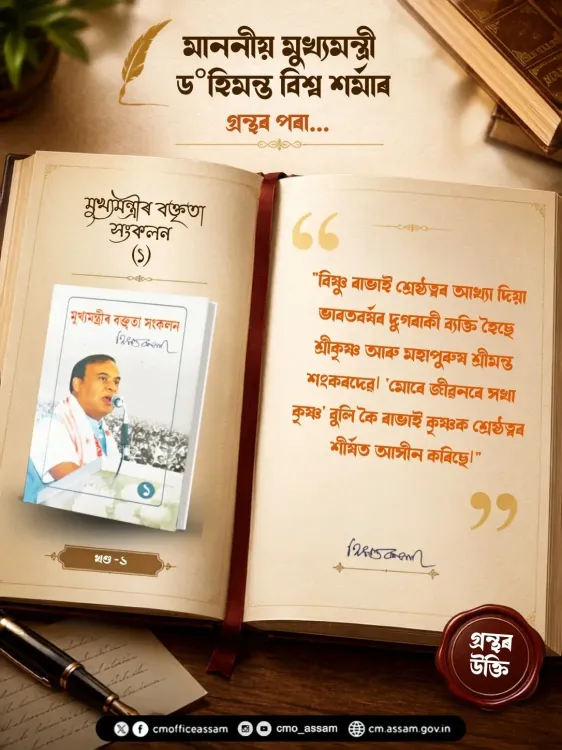
The Chief Minister's Office of Assam shared a passage from CM Himanta Biswa Sarma's speech collection noting that Assamese polymath Bishnu Rabha regarded Lord Krishna and Mahapurush Srimanta Sankaradeva as the two highest embodiments of greatness, citing Rabha's own line 'Mure Jibonore Sokha Krishna'.
Key Takeaways
The Chief Minister's Office of Assam posted the excerpt on 14 July 2026 , drawn from Mukhyamantrir Boktrita Sankalan (Vol.
Bishnu Rabha recognised only Lord Krishna and Mahapurush Srimanta Sankaradeva as the highest embodiments of greatness in India.
Rabha's line 'Mure Jibonore Sokha Krishna' ('Krishna, the companion of my life') is cited as the defining expression of his devotion.
Srimanta Sankaradeva (c.
1449–1568) founded Ekasarana Dharma and created the Borgeet and Sattriya traditions central to Assamese identity.
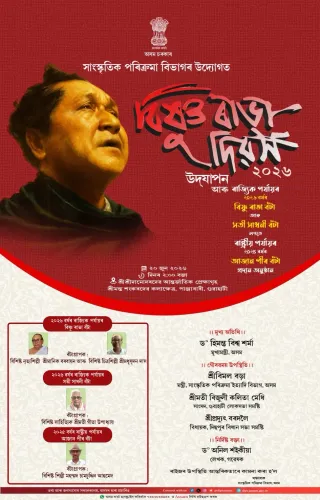
Assam observes Bishnu Rabha Divas on 20 June annually through state-sponsored cultural programmes.
The publication is part of the Assam government's broader practice of documenting and disseminating CM Sarma's public discourse on regional heritage.
The Chief Minister's Office of Assam on Tuesday, 14 July 2026, shared an excerpt from Chief Minister Dr. Himanta Biswa Sarma's official speech compilation, highlighting how the legendary Assamese polymath Bishnu Rabha placed Lord Krishna and Mahapurush Srimanta Sankaradeva at the apex of his spiritual and artistic universe.
Context
The excerpt is drawn from Mukhyamantrir Boktrita Sankalan (Vol. 1), a published collection of Chief Minister Dr. Himanta Biswa Sarma's speeches. In the passage, the Chief Minister recalls that Bishnu Rabha recognised only two personalities as the highest embodiments of greatness in India — Lord Krishna and Mahapurush Srimanta Sankaradeva. The post quotes Rabha's own immortal line: 'Mure Jibonore Sokha Krishna' ('Krishna, the companion of my life'), underscoring the depth of his devotion.
Who Were Bishnu Rabha and Sankaradeva?
Bishnu Rabha (1909–1969) was a towering 20th-century Assamese polymath — singer, lyricist, dancer, and writer — who wove folk traditions, social reform, and leftist thought into a singular artistic identity. He remains one of Assam's most beloved cultural figures, and the state observes Bishnu Rabha Divas on 20 June every year through government-sponsored cultural programmes. His invocation of Krishna was not merely devotional but deeply personal, embedded in his creative output across poetry and song.
Mahapurush Srimanta Sankaradeva (c. 1449–1568) was the 15th–16th century Assamese saint-scholar who founded the Ekasarana Dharma movement, created the classical traditions of Borgeet and Sattriya, and remains the single most formative influence on modern Assamese cultural and religious identity. That Rabha placed Sankaradeva alongside Krishna speaks to the saint's enduring stature as both a spiritual and civilisational anchor for Assam.
Policy Backdrop
Successive Assam governments have long invoked Sankaradeva and Bishnu Rabha to reinforce a composite regional identity that merges local neo-Vaishnavite traditions with pan-Indian devotional themes. The current administration under CM Himanta Biswa Sarma, who assumed office in May 2021, has continued and expanded this practice — frequently citing cultural forebears in official publications and public addresses to draw a line of continuity between Assam's heritage and contemporary governance priorities. The publication of Mukhyamantrir Boktrita Sankalan is part of that broader administrative effort to document and disseminate the Chief Minister's public discourse.
Stakeholders and Impact
The excerpt resonates most directly with Assamese artists, Vaishnavite institutions, and cultural organisations that draw inspiration from both Rabha and Sankaradeva. By placing this reflection in an official speech compilation, the Chief Minister's Office signals that the government views the legacies of these icons not merely as historical footnotes but as living reference points for public life in Assam. Scholars of Assamese literature and the broader Bhakti tradition will also find the framing — linking a 20th-century artist's devotion to a 15th-century saint — noteworthy as a statement of cultural continuity.
What's Next
Further volumes of Mukhyamantrir Boktrita Sankalan are expected, which may offer additional windows into how the Chief Minister frames Assam's cultural heritage in official discourse. State-level events marking cultural anniversaries through 2026–27 are also likely to feature similar invocations of Rabha and Sankaradeva as the government continues to anchor its public messaging in regional identity.
Point of View
Signalling that heritage is not incidental but central to the administration's self-presentation. The move also reinforces a pan-Indian devotional thread — Krishna as a unifying figure — within a distinctly Assamese cultural frame, a balance that has political utility in a state with diverse religious communities. Watching how subsequent volumes of the compilation are received will reveal whether this cultural messaging finds broader resonance beyond the Vaishnavite constituency.
NationPress
14 Jul 2026
Frequently Asked Questions
Who was Bishnu Rabha and why is he important in Assam?
Bishnu Rabha (1909–1969) was an Assamese polymath — singer, lyricist, dancer, and writer — celebrated for blending folk traditions, social reform, and leftist thought. Assam observes Bishnu Rabha Divas on 20 June every year in his honour.
What did Bishnu Rabha say about Lord Krishna?
Bishnu Rabha described Lord Krishna as the companion of his life in the Assamese phrase 'Mure Jibonore Sokha Krishna' , which translates to 'Krishna, the companion of my life.' He regarded Krishna as one of only two personalities who represented the highest embodiment of greatness in India.
Who is Mahapurush Srimanta Sankaradeva?
Srimanta Sankaradeva (c. 1449–1568) was a 15th–16th century Assamese saint-scholar who founded the Ekasarana Dharma movement and created the Borgeet and Sattriya traditions, making him the most formative influence on modern Assamese cultural and religious identity.
What is Mukhyamantrir Boktrita Sankalan?
Mukhyamantrir Boktrita Sankalan is an official published collection of speeches by Assam Chief Minister Dr. Himanta Biswa Sarma . The excerpt shared on 14 July 2026 is from Vol. 1 of this compilation.
Why does the Assam government frequently reference Sankaradeva and Bishnu Rabha?
Successive Assam governments have invoked Sankaradeva and Bishnu Rabha to reinforce a composite regional identity that merges local neo-Vaishnavite traditions with pan-Indian devotional themes, using these cultural forebears to draw continuity between heritage and contemporary governance.