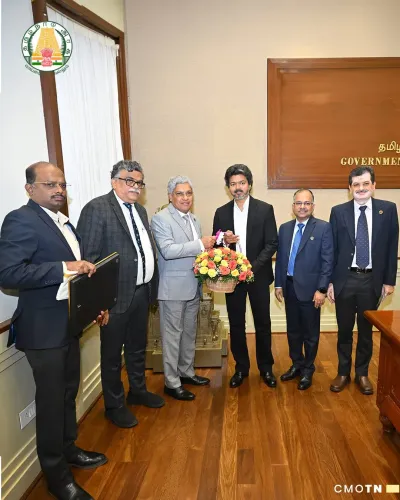
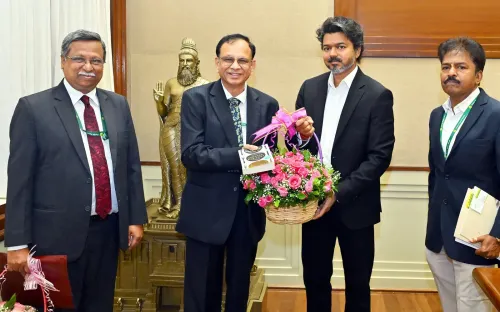
CM Joseph Vijay meets Karur textile exporters at Secretariat

Synopsis
Tamil Nadu Chief Minister C. Joseph Vijay met the Karur Textile Manufacturers and Exporters Association at the State Secretariat on 1 July 2026. The delegation, led by president P. Gopal Krishnan, discussed issues affecting one of Tamil Nadu's most important textile export clusters. Follow-up policy measures are awaited.
Key Takeaways
Joseph Vijay met the Karur Textile Manufacturers and Exporters Association at the Tamil Nadu State Secretariat on 1 July 2026 .
The delegation was led by association president P.
Gopal Krishnan , with secretary S.
Sukumar and vice-president K.G.
Prithvi also present.
Karur is a major textile and home-furnishings export hub in western Tamil Nadu, supplying markets in Europe, the US, and the Middle East.
Tamil Nadu's textile clusters — spanning Karur, Tiruppur, and Coimbatore — account for a large share of India's textile output and exports.
The meeting could precede policy announcements on export incentives, power tariffs, or cluster infrastructure in the state's upcoming budget or industrial policy update.
The Chief Minister's Office of Tamil Nadu announced on Wednesday, 1 July 2026 that Chief Minister C. Joseph Vijay met a delegation from the Karur Textile Manufacturers and Exporters Association at the Tamil Nadu State Secretariat in Chennai, marking a direct consultation between the state's top executive and one of its key industrial clusters.
The delegation was led by association president P. Gopal Krishnan, accompanied by secretary S. Sukumar, vice-president K.G. Prithvi, and other office-bearers. The meeting, held at the Chief Secretariat (Thalaimai Cheyalagam), signals the new administration's intent to engage directly with regional industry stakeholders early in its tenure.
Context
Karur, located in western Tamil Nadu, is one of India's most concentrated textile manufacturing and export hubs, particularly known for home furnishings, bed linen, and kitchen textiles. The district's exporters supply to markets across Europe, the United States, and the Middle East, making it a significant contributor to the state's foreign exchange earnings.
The Karur Textile Manufacturers and Exporters Association functions as the primary representative body for producers and traders in the region, regularly engaging with state and central government bodies on issues ranging from power tariffs to logistics and export incentives.
Policy Backdrop
Tamil Nadu has long been one of India's leading textile-producing states, with major clusters spread across Karur, Tiruppur, and Coimbatore. State governments have periodically rolled out modernisation schemes, power subsidies, and export promotion measures for these clusters since the early 2000s.
Consultations of this kind typically precede announcements on infrastructure upgrades, credit access, or revised industrial policy — particularly when timed ahead of state budget deliberations or a new industrial policy framework. The textile sector is also sensitive to fluctuations in global demand and competing exports from neighbouring states and countries.
Stakeholders and Impact
The Karur textile cluster employs a significant number of workers, both directly in manufacturing units and indirectly through ancillary trades such as dyeing, packaging, and logistics. Any policy outcome from this consultation — whether on power costs, export incentives, or cluster infrastructure — would have a direct bearing on livelihoods across the district.
For exporters, market-access concerns, shipping costs, and competition from lower-cost producers abroad are perennial pressure points. Industry bodies typically use such high-level meetings to place specific demands before the government, including requests for enhanced export credit, technology upgradation funds, and dedicated textile parks.
What's Next
Observers will watch for any follow-up announcements from the Tamil Nadu government in the form of export incentives, infrastructure allocations, or policy measures for the textile sector in the coming weeks. Such consultations often feed into budget proposals or industrial policy updates.
The meeting also sets a precedent for CM Joseph Vijay's style of governance — direct engagement with sectoral industry bodies — which could signal a broader outreach to other manufacturing clusters across the state in the near term.
Point of View
Vijay is projecting personal ownership of industrial outreach. The outcome of this consultation will be a telling early indicator of the administration's economic priorities.
NationPress
1 Jul 2026
Frequently Asked Questions
Who did Tamil Nadu CM Joseph Vijay meet on 1 July 2026?
CM Joseph Vijay met the leadership of the Karur Textile Manufacturers and Exporters Association, including president P. Gopal Krishnan, secretary S. Sukumar, and vice-president K.G. Prithvi, at the Tamil Nadu State Secretariat.
What is the Karur Textile Manufacturers and Exporters Association?
It is the primary industry body representing textile producers and exporters based in Karur, a major home-furnishings and textile export cluster in western Tamil Nadu.
Why is Karur important for Tamil Nadu's textile industry?
Karur is one of India's leading hubs for home textiles such as bed linen and kitchen furnishings, exporting to Europe, the United States, and the Middle East, making it a key source of foreign exchange for the state.
What issues do Karur textile exporters typically raise with the Tamil Nadu government?
Exporters in Karur commonly raise concerns about power tariffs, export credit availability, logistics costs, technology upgradation support, and competition from lower-cost producing countries.
What policy announcements could follow the CM's meeting with Karur textile exporters?
Analysts expect possible announcements on export incentives, cluster infrastructure investment, or revised power tariff policies for the textile sector, potentially in the next state budget or industrial policy update.