CM Karnataka Office Honours Dr. Kota Shivaram Karanth on Birth Anniversary
Synopsis
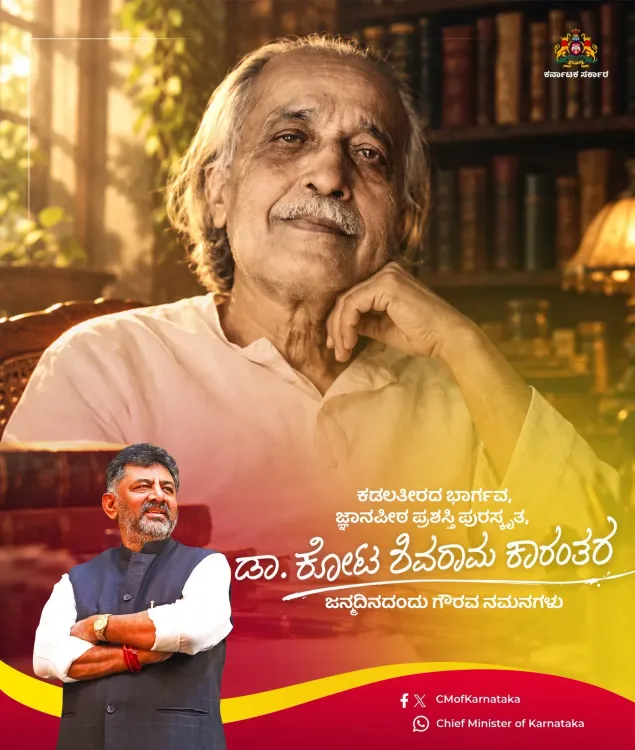
The Chief Minister's Office of Karnataka honoured Dr. Kota Shivaram Karanth on his birth anniversary, celebrating the Jnanpith laureate's monumental contributions to Kannada literature, Yakshagana, environmental activism, and scientific thought.
Key Takeaways
The Chief Minister's Office of Karnataka posted a tribute to Dr.
Kota Shivaram Karanth on his birth anniversary on 10 October 2026 .
Karanth was called a 'walking encyclopaedia' who excelled in novels, theatre, Yakshagana, cinema, education, environmental conservation, and science.
The CMO highlighted three landmark novels: 'Mookajjiya Kanasugalu' , 'Chomana Dudi' , and 'Bettada Jeeva' .
Karanth received the Jnanpith Award in 1977 — Kannada literature's most prestigious international recognition — and returned the Padma Bhushan in 1983 in protest against the Kaiga nuclear project's environmental impact.
Born on 10 October 1902 in Kota village, Udupi district , Karanth authored over 500 books and lived to the age of 97 .
A novelist, playwright, Yakshagana revivalist, filmmaker, educator, environmentalist, and scientist — Dr. Kota Shivaram Karanth was, in the truest sense, a man who turned everything he touched to gold. On Saturday, 10 October 2026, the Chief Minister's Office of Karnataka paid tribute to the legendary polymath on his birth anniversary, calling him a 'walking encyclopaedia' whose people-first vision remains as urgent today as it ever was.
The Man Who Gave Voice to the Voiceless of the Coast
The CMO's tribute singled out three of Karanth's most celebrated Kannada novels — 'Mookajjiya Kanasugalu' ('Mookajji's Dreams'), 'Chomana Dudi' ('Choma's Drum'), and 'Bettada Jeeva' ('Life on the Hill') — as works that carried the inner torment of human beings, the natural rhythms of coastal life, and the cry of society's oppressed to the world. Each title is a landmark: 'Chomana Dudi' was later adapted into a critically acclaimed Kannada film, while 'Mookajjiya Kanasugalu' earned Karanth the Jnanpith Award in 1977, India's highest literary honour.
Beyond Literature: Yakshagana, Science, and a Forest He Refused to Let Fall
What set Karanth apart from other literary giants was his refusal to stay in one lane. He modernised Yakshagana — the traditional coastal Karnataka theatre form — without stripping it of its soul, and produced science-education books aimed at young readers at a time when scientific temper was a radical idea. He was also an early and fearless environmentalist, standing against the destruction of natural ecosystems long before it became fashionable. The CMO post described his pro-people concern — his janapara kaagali — as something worthy of daily remembrance.
A Legacy Karnataka Keeps Coming Back To
Born on 10 October 1902 in Kota village, Udupi district on the Karnataka coast, Karanth lived to 97, producing over 500 books across fiction, travelogue, drama, children's literature, and science writing in Kannada. He returned the Padma Bhushan in 1983 to protest the Kaiga nuclear plant's threat to the Western Ghats — a gesture of principle that defined his legacy as powerfully as any literary prize. Karnataka's government has repeatedly invoked his name when articulating the state's composite cultural identity, and today's tribute from the CMO is part of that continuing conversation.
In a state that takes its literary heritage seriously, honouring Karanth is never merely ceremonial. It is a reminder that Karnataka's greatest storyteller was also its most restless conscience.
Point of View
The CMO subtly aligns the government with progressive, people-first values. The choice to post in Kannada underscores the administration's commitment to the language as a living political currency, not merely a ceremonial one. Karanth's legacy — pluralist, rational, fiercely independent — is a banner that transcends party lines, making him a safe but genuinely meaningful icon for any Karnataka government to invoke.
NationPress
10 Oct 2026
Frequently Asked Questions
Who was Dr. Kota Shivaram Karanth?
Dr. Kota Shivaram Karanth was a celebrated Kannada polymath born on 10 October 1902 in Kota village, Udupi district, Karnataka. He was a novelist, playwright, Yakshagana innovator, filmmaker, educator, and environmentalist who authored over 500 books and received the Jnanpith Award in 1977.
What is Karanth's most famous novel?
'Mookajjiya Kanasugalu' (Mookajji's Dreams) is among his most celebrated works and won him the Jnanpith Award in 1977. 'Chomana Dudi' and 'Bettada Jeeva' are also widely regarded as masterpieces of Kannada literature.
Why did Karanth return his Padma Bhushan?
Karanth returned the Padma Bhushan in 1983 to protest the Indian government's plan to set up the Kaiga nuclear power plant in the Western Ghats, which he believed posed a serious threat to the region's environment and biodiversity.
What is the Karnataka CM Office tribute to Karanth about?
On 10 October 2026, the Chief Minister's Office of Karnataka posted a tribute in Kannada on X honouring Dr. Karanth on his birth anniversary, describing him as a 'walking encyclopaedia' and remembering his contributions to literature, Yakshagana, science education, and environmental conservation.
What is Yakshagana and what was Karanth's contribution to it?
Yakshagana is a traditional theatre-dance form originating from the coastal Karnataka region. Karanth is credited with modernising and popularising it, bringing it to wider audiences while preserving its cultural essence.