CM Pema Khandu Flags New School Building in Boleng
Synopsis
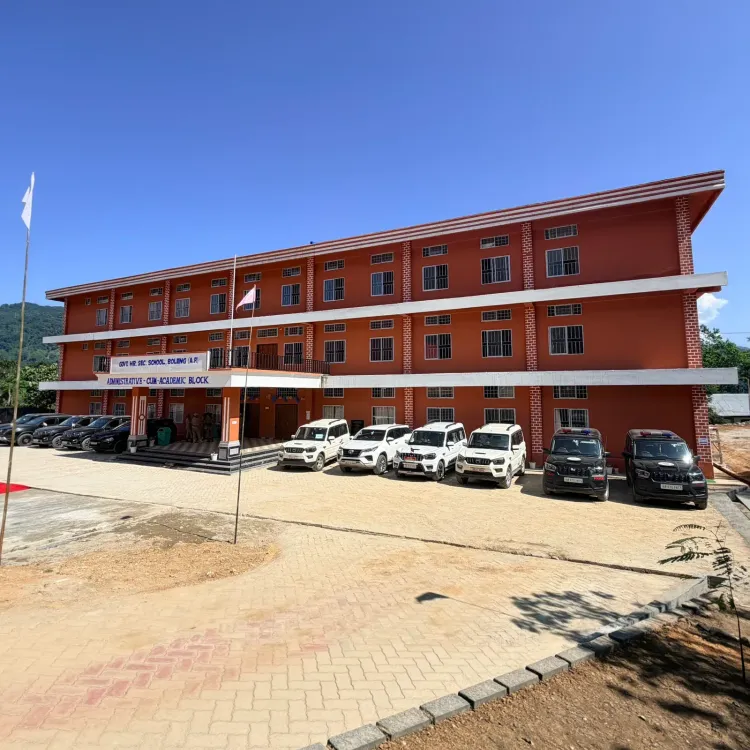
Chief Minister Pema Khandu spotlighted the newly built Government Higher Secondary School at Boleng in Siang district, calling it part of Arunachal Pradesh's ongoing drive to replace unsafe, ageing school buildings with modern infrastructure for children.
Key Takeaways
CM Pema Khandu highlighted the Government Higher Secondary School at Boleng , Siang district, on September 29, 2026 .
The CM framed the project as part of a continued state effort to replace old, dilapidated school buildings with modern, safe structures.
Boleng is the headquarters of Siang district , a remote valley town in Arunachal Pradesh.
State school infrastructure upgrades are aligned with the Samagra Shiksha Abhiyan , the central integrated school education scheme launched in 2018 .
Arunachal Pradesh's difficult terrain has historically made school construction costly; government schools are often the only schooling option in remote districts.
Three photographs of the completed structure were shared alongside the post.
Brick by brick, Arunachal Pradesh is rebuilding the classrooms its children deserve. Arunachal Pradesh Chief Minister Pema Khandu on Tuesday, September 29, 2026, highlighted the construction of a modern Government Higher Secondary School at Boleng — the headquarters of Siang district — calling it a direct reflection of the state's drive to retire crumbling school buildings and replace them with safe, contemporary infrastructure.
Old walls down, new classrooms rising in Siang
Boleng, a remote riverine town tucked deep in the Siang valley, is not where most infrastructure spotlights fall. That is precisely what makes CM Khandu's post notable. 'It feels good to see government schools like this taking shape in our districts,' he wrote, framing the project not as an isolated event but as part of a 'continued effort' to replace 'old, dilapidated school buildings with modern, safe and better infrastructure for our children.'
The challenge is real. Arunachal Pradesh's terrain — deep gorges, seismic-zone ridgelines, monsoon-battered valleys — has historically made school construction costly and slow. Many older school buildings across remote districts were built decades ago with materials and standards that have long since become unsafe.
Central funding and the Samagra Shiksha framework
The state has aligned these upgrades with Samagra Shiksha Abhiyan, the integrated central school education scheme launched in 2018 that pools funding for infrastructure improvement, quality enhancement, and teacher training across all states. For a frontier state like Arunachal Pradesh, where private school alternatives are scarce, the government school is often the only school — which makes the condition of every building a direct equity issue.
District administrations and the state education department have been executing phased replacements under this framework, with Boleng's new higher secondary school appearing to be among the more recent completions under that pipeline.
What the Boleng school signals for Northeast education
The broader Northeast has seen a push over the past several years to close the infrastructure gap between its remote districts and the national average. CM Khandu, who has led the state since 2016, has consistently positioned education infrastructure as a foundation for longer-term development — the logic being that no amount of curriculum reform lands if the roof leaks or the walls are unsafe.
Three images shared alongside the post show the completed structure, giving residents and policymakers a concrete marker against which future progress — or stagnation — can be measured.
The real test now is replication: whether the pace and quality visible at Boleng can reach the dozens of other remote district schools still waiting for the same upgrade.
Point of View
He is reinforcing his administration's equity-in-education narrative ahead of future budget cycles and state elections. The choice of Boleng — a remote Siang valley town far from the state capital — is not incidental; it speaks to the political calculus of visibly delivering in peripheral constituencies. More substantively, it points to the tension at the heart of Northeast development policy: central scheme funding exists, but terrain, logistics, and local capacity consistently slow delivery, meaning any visible completion carries outsized symbolic weight. The real policy question is whether these individual completions aggregate into a systemic shift in school infrastructure quality — or remain islands of improvement in a still-fragile network.
NationPress
29 Sept 2026
Frequently Asked Questions
Where is the Government Higher Secondary School that CM Pema Khandu highlighted?
The school is located in Boleng , the headquarters of Siang district in Arunachal Pradesh.
What scheme funds school infrastructure upgrades in Arunachal Pradesh?
Samagra Shiksha Abhiyan , the central integrated school education scheme launched in 2018 , supports infrastructure upgrades including building replacements across states like Arunachal Pradesh.
Why is school infrastructure a priority in Arunachal Pradesh?
Many school buildings in Arunachal Pradesh were built decades ago and have deteriorated; the state's difficult terrain makes government schools the only option for children in remote areas, making building quality a direct equity concern.
How long has Pema Khandu been Chief Minister of Arunachal Pradesh?
Pema Khandu has served as Chief Minister of Arunachal Pradesh since 2016 and is a senior BJP leader.
What did CM Pema Khandu say about the Boleng school?
He said it 'feels good to see government schools like this taking shape' and called it a reflection of the state's 'continued efforts to replace old, dilapidated school buildings with modern, safe and better infrastructure' for children.