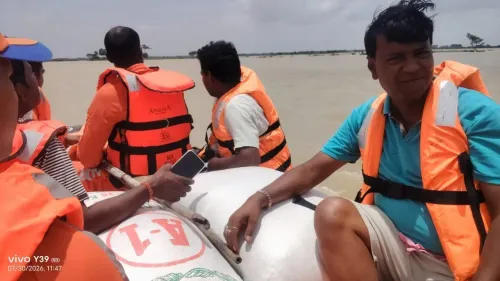
CM Majhi: 13,221 Evacuated as Odisha Battles Monsoon Floods

Synopsis
Odisha Chief Minister Mohan Charan Majhi says 43 rescue teams have evacuated 13,221 people and 49 relief camps are operational as monsoon floods hit the state. The government has maintained 24x7 monitoring while conditions begin to improve.
Key Takeaways
43 rescue teams are deployed across flood-affected areas of Odisha as of 29 September 2026 .
13,221 people have been evacuated to safer locations by state authorities.
49 relief camps are operational, providing food, shelter, and emergency aid to displaced residents.
CM Mohan Charan Majhi confirmed that rainfall is easing and conditions are improving, but operations continue.
The government has instituted 24x7 monitoring of the flood situation across all affected districts.
Odisha's disaster response is backed by the Odisha State Disaster Management Authority , established in 2000 after the 1999 super cyclone.
As monsoon rains batter Odisha, Chief Minister Mohan Charan Majhi has deployed 43 rescue teams across flood-hit districts, evacuating 13,221 people to safety while 49 relief camps provide emergency support to those displaced — and his government is signalling that round-the-clock vigilance will not ease until the crisis is fully contained.
Posting in Odia on 29 September 2026, CM Majhi stated: 'Lokanka sarkarare janasurakshaaku milucha sarbochcha prathamikta' — 'In the people's government, public safety receives the highest priority.' He confirmed that while rainfall intensity has begun to subside and conditions are improving, relief, evacuation, and emergency operations continue uninterrupted in all affected areas. A 24x7 monitoring mechanism remains in place.
43 Teams, 49 Camps: The Scale of the Response
The numbers frame the urgency clearly. 13,221 residents have been moved from vulnerable zones to safer ground, with rescue teams navigating flooded roads and swollen rivers to reach isolated communities. The 49 relief camps are the frontline of a wider support network providing food, shelter, and medical aid to those who cannot return home. The government's message: no affected person is left without assistance.
Odisha's Long Road to Flood Readiness
This mobilisation did not happen overnight. Odisha built its disaster-response architecture the hard way — after the catastrophic 1999 super cyclone that killed nearly 10,000 people, the state established the Odisha State Disaster Management Authority in 2000, creating one of India's most institutionalised emergency response systems. Successive governments have maintained and expanded those standing protocols for evacuation corridors, pre-positioned relief, and multi-agency coordination.
The state sits at the intersection of three river basins and faces the full fury of Bay of Bengal systems every monsoon season. Recurring floods — particularly along the Mahanadi river system — have made rapid, large-scale evacuation a practised muscle, not an improvised reaction.
What Comes Next for Affected Districts
With rainfall easing, the immediate priority will shift from rescue to rehabilitation: restoring connectivity to cut-off villages, assessing agricultural damage, and disbursing relief to affected households. The state revenue and disaster management department's daily situation reports will be the key metric to watch. If a fresh low-pressure system forms over the Bay of Bengal, the government may need to reassess whether central assistance — including NDRF battalions beyond what is already deployed — will be required.
For now, CM Majhi's administration is projecting control: a state that has been through this before, is responding at scale, and is watching every district around the clock until the waters recede.
Point of View
While signalling that the BJP-led state government can match Odisha's historically strong disaster-response institutional legacy. The specific figures (43 teams, 13,221 evacuees, 49 camps) are chosen to project precision and scale rather than vague reassurance. This matters politically: Odisha voters have long benchmarked governments on disaster performance, and the BJP, in power since June 2024, is still building its credibility on that metric. If rainfall intensifies again, the test of whether a central assistance request follows will be the clearest signal of how stretched the state machinery actually is.
NationPress
29 Sept 2026
Frequently Asked Questions
How many people have been evacuated in the Odisha floods in September 2026?
13,221 people have been evacuated to safety, according to Chief Minister Mohan Charan Majhi's post on 29 September 2026 .
How many relief camps are operational in Odisha due to flooding?
49 relief camps are currently operational across flood-affected areas of Odisha, providing emergency aid to displaced residents.
How many rescue teams are deployed in Odisha flood relief?
43 rescue teams have been deployed by the Odisha government to assist with evacuations and emergency operations in flood-hit districts.
What is the Odisha State Disaster Management Authority?
The Odisha State Disaster Management Authority was established in 2000 following the devastating 1999 super cyclone, and it coordinates the state's emergency preparedness, evacuation protocols, and disaster response operations.
Is the Odisha flood situation improving?
CM Majhi stated on 29 September 2026 that rainfall intensity is easing and conditions are improving, though relief and rescue operations remain fully active in all affected areas with 24x7 monitoring in place.