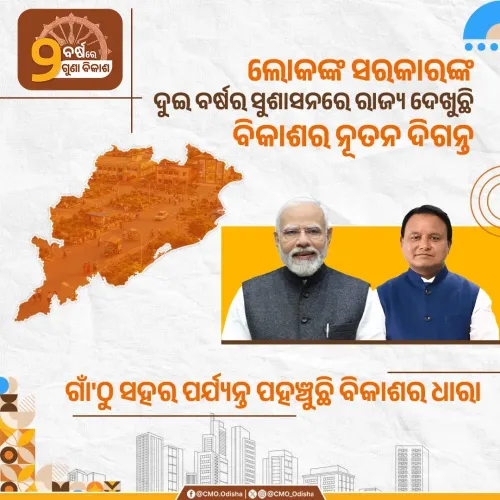
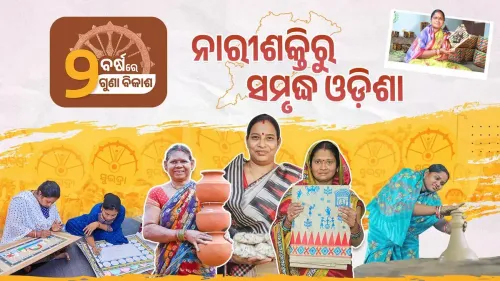
CM Majhi marks 2 years governing for poor, women, farmers, youth
Synopsis
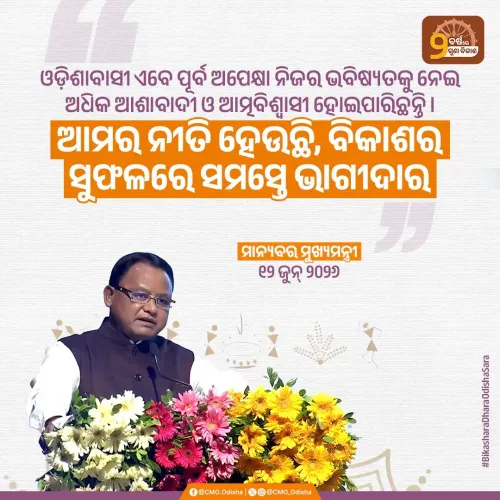
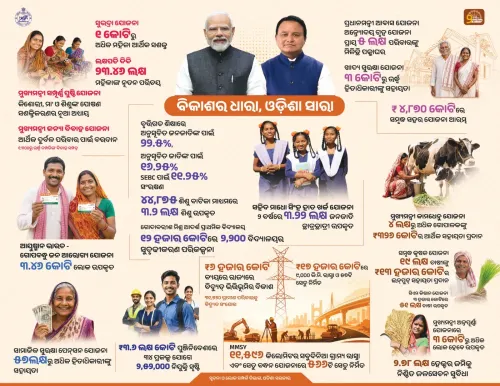
Chief Minister Mohan Charan Majhi marks two years of BJP rule in Odisha by reaffirming commitment to PM Modi's four priority groups — the poor, women, farmers and youth — as the state government reviews its governance record under the #2YearsofLokankaSarakar banner.
Key Takeaways
CM Mohan Charan Majhi quoted directly reaffirming priority-basis work for four groups: poor, women, farmers (Annadata), and youth .
The statement marks the second anniversary of the BJP government in Odisha , sworn in on 12 June 2024 — the party's first-ever assembly majority in the state.
The four-group framework was explicitly credited to Prime Minister Narendra Modi , aligning state governance messaging with the central BJP template.
The post was tagged #2YearsofLokankaSarakar (Two Years of the People's Government) and #BikasharaDharaOdishaSara (Stream of Development for All of Odisha).
The priority groups collectively cover the majority of Odisha's approximately 4.6 crore population , spanning rural farmers, women beneficiaries, poor households and unemployed youth.
State budget allocations and scheme implementation reports for these groups in the coming fiscal cycle will be a key measure of delivery against the stated priorities.
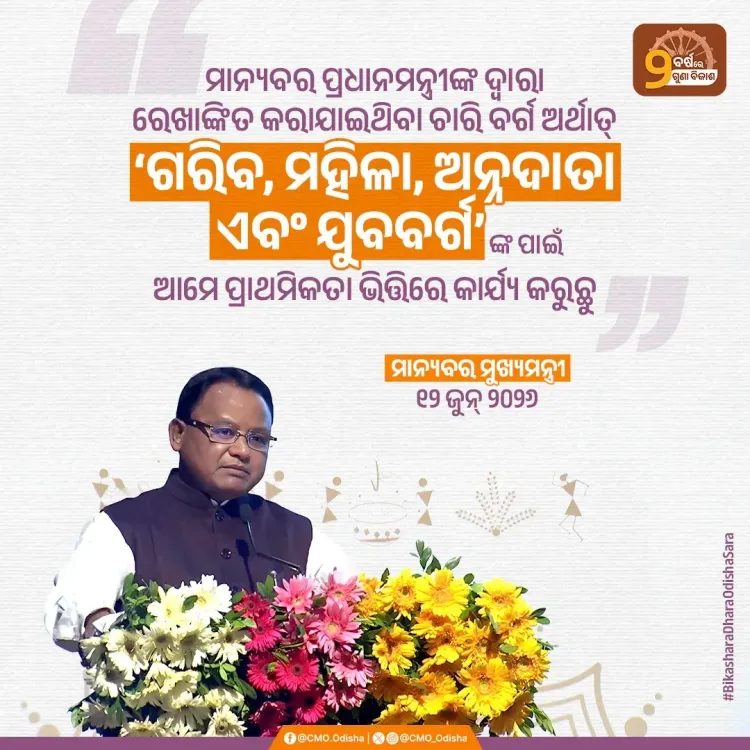
The Chief Minister's Office of Odisha on Friday, 12 June 2026 shared a statement from Chief Minister Mohan Charan Majhi reaffirming the state government's commitment to Prime Minister Narendra Modi's four identified priority groups — the poor, women, farmers, and youth — as the BJP-led Odisha government marks two years in office.
Context
The post, tagged #2YearsofLokankaSarakar (Two Years of the People's Government) and #BikasharaDharaOdishaSara (Stream of Development for All of Odisha), quotes CM Majhi directly: 'ଗରିବ, ମହିଳା, ଅନ୍ନଦାତା ଏବଂ ଯୁବବର୍ଗ' — 'the poor, women, the food-givers (farmers), and the youth' — as the four segments for whom the government works 'on a priority basis.' The statement explicitly credits Prime Minister Narendra Modi with having outlined this four-group framework.
The BJP won its first-ever assembly majority in Odisha in June 2024, ending over two decades of Biju Janata Dal rule. Majhi, a tribal leader from the Keonjhar region, was sworn in as Chief Minister on 12 June 2024, making this week the government's second anniversary.
Policy Backdrop
Prime Minister Modi has consistently invoked the quartet of Garib, Mahila, Annadata and Yuva in national policy addresses and Union Budget frameworks since 2014, anchoring flagship central schemes — from direct benefit transfers and the PM-KISAN income-support programme to the Pradhan Mantri Awas Yojana and skill-development missions — around these four demographic pillars.
The Odisha government's adoption of the same framing signals an intentional alignment between state-level delivery and the central BJP template, a pattern visible across other BJP-governed states where welfare messaging mirrors New Delhi's vocabulary. For Odisha, which has a significant share of Below Poverty Line households, a large agrarian workforce, and one of the higher proportions of Scheduled Tribe population in India, the four categories carry particular demographic weight.
Stakeholders and Impact
The four priority groups together encompass the vast majority of Odisha's approximately 4.6 crore population. Farmers and agricultural labourers dominate the rural economy, while women-centric schemes such as self-help group financing and direct cash transfers have been central to state welfare delivery under successive governments. Youth unemployment and skill gaps remain persistent challenges in a state that has historically seen significant out-migration to other states for work.
Poor households stand to be the most direct beneficiaries of targeted subsidy and housing programmes, and the government's two-year mark provides a natural moment for stakeholders — including civil society groups, opposition parties, and beneficiary communities — to assess whether allocations have translated into on-ground outcomes.
What's Next
The anniversary hashtag campaign is likely to be followed by a formal review of the government's two-year record, including state budget performance data for schemes targeting these four groups. Analysts and opposition leaders will watch closely whether the Odisha government publishes a detailed account of scheme coverage, fund utilisation, and beneficiary counts for the period ending June 2026. The next state budget cycle will be a key test of whether the priority-group framing is matched by commensurate fiscal commitments.
Point of View
The Majhi government signals ideological continuity with New Delhi and positions Odisha as a model BJP state after its landmark 2024 victory. The move also sets a measurable accountability benchmark: having publicly committed to these four groups as priorities, the government will now face sharper scrutiny on whether budgetary allocations and scheme outcomes reflect that commitment. The two-year mark is strategically chosen — early enough to claim momentum, late enough to show initial results.
NationPress
26 Oct 2026
Frequently Asked Questions
Why is the Odisha government celebrating 2 years in June 2026?
The BJP-led Odisha government under Chief Minister Mohan Charan Majhi completed two years in office on 12 June 2026, having been sworn in on 12 June 2024 after the party won its first-ever assembly majority in the state.
What are the four priority groups mentioned by CM Majhi?
CM Majhi cited the four groups identified by PM Modi: the poor (Garib), women (Mahila), farmers (Annadata), and youth (Yuva), stating the government works for them on a priority basis.
What does 'Annadata' mean in the context of Indian politics?
'Annadata' literally means 'food-giver' in Sanskrit and is widely used in Indian political discourse to refer to farmers and agricultural workers who produce the nation's food supply.
What is the significance of #2YearsofLokankaSarakar?
The hashtag translates to 'Two Years of the People's Government' and was used by the CMO Odisha to mark the BJP government's second anniversary in power, highlighting its welfare and development agenda.
How does Odisha's governance framework align with central BJP policy?
The Odisha government has adopted PM Modi's four-priority-group framework — poor, women, farmers, youth — mirroring the structure of central flagship schemes such as PM-KISAN, Pradhan Mantri Awas Yojana, and direct benefit transfer programmes.