CM Majhi Reaffirms BJP's Commitment to Tribal Welfare in Odisha
Synopsis
Odisha Chief Minister Mohan Charan Majhi marked two years of the BJP government by reaffirming its commitment to tribal welfare — covering land, water and forest rights alongside education, health and employment — positioning the pledge within the party's 'double engine' governance framework.
Key Takeaways
CM Mohan Charan Majhi posted in Odia on 20 June 2026 reaffirming the BJP government's commitment to tribal socio-economic empowerment.
The post explicitly covers rights over water, forests, and land ( jal, jangal, zameen ), education, health, and employment for tribal communities.
The hashtag #2YearsofLokankaSarakar marks what appears to be a two-year milestone for the current Odisha BJP government .
Odisha hosts one of India's largest tribal populations; Majhi became the state's first BJP Chief Minister after the 2024 assembly elections .
The 'double engine' framing links central schemes such as the Vanbandhu Kalyan Yojana and the Forest Rights Act, 2006 to state-level delivery.
Focus areas going forward include settlement of forest rights claims and expanded schemes for Particularly Vulnerable Tribal Groups (PVTGs) .
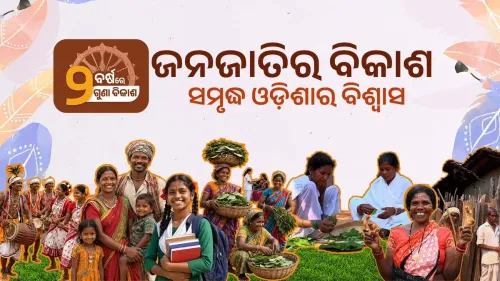
Odisha Chief Minister Mohan Charan Majhi on Saturday, 20 June 2026 reaffirmed the BJP government's commitment to the holistic development, cultural heritage protection, and socio-economic empowerment of tribal communities in Odisha, posting his pledge in Odia on X under the hashtag #2YearsofLokankaSarakar.
Context
The post, shared to mark what the hashtag suggests is a two-year milestone of the current government, states in Odia: 'Janajati samajara samagrika bikasha, sanskrutika aitihjara suraksha ebam semananka samajika-arthika sashaktikaran paain BJP sarkar sadasarbada sankalpabadhha' — translated: 'The BJP government is always committed to the overall development of tribal society, protection of cultural heritage, and their socio-economic empowerment.' CM Majhi added that continuous efforts are under way to ensure rights over water, forests, and land (jal, jangal, jameen) and to create wider opportunities in education, health, and employment, so that the fruits of progress reach every tribal brother and sister at the last row of society — paving the way for a prosperous and empowered India.
Policy Backdrop
The reference to jal, jangal, zameen rights aligns directly with the Scheduled Tribes and Other Traditional Forest Dwellers (Recognition of Forest Rights) Act, 2006, the central legislation that grants legal title to tribal communities over land, water bodies, and forest resources they have traditionally depended upon. At the national level, the Vanbandhu Kalyan Yojana, launched in 2014, has been the flagship framework directing investment in education, health, and livelihoods across tribal districts, and Odisha's tribal belt falls within its ambit.
Odisha is home to one of India's largest tribal populations, including several Particularly Vulnerable Tribal Groups (PVTGs). The BJP came to power in the state following the 2024 assembly elections, ending decades of BJD rule, with Mohan Charan Majhi becoming the state's first BJP Chief Minister. The 'double engine' formulation — referenced in the hashtag #DoubleEngineDoubleVikas — is the party's standard framing for coordinated central and state governance in BJP-ruled states.
Stakeholders and Impact
The primary beneficiaries named in the post are Odisha's tribal communities — Scheduled Tribes and forest-dwelling households whose access to land titles, healthcare, schooling, and formal employment has historically lagged behind the state average. The emphasis on reaching those 'at the last row of society' signals a focus on the most marginalised sub-groups within the tribal population, including PVTGs.
For the BJP government, the post serves as a public accountability marker at what appears to be a two-year milestone in office, framing tribal welfare delivery as a core plank of its Odisha governance record. Tribal voters constitute a significant share of the electorate in several Odisha assembly segments, making this a politically as well as administratively salient constituency.
What's Next
Attention will now turn to the Odisha tribal welfare department's forthcoming reports and the state's next budget cycle for concrete announcements — particularly on the settlement of pending forest rights claims, expansion of residential school infrastructure for tribal children, and new livelihood schemes for PVTGs. The trajectory of #BikasharaDharaOdishaSara — loosely translated as 'the stream of development for all of Odisha' — as a campaign theme will also be watched as the government approaches the midpoint of its term.
Point of View
Using the two-year anniversary to anchor BJP's Odisha governance narrative around tribal welfare — a constituency that proved decisive in the 2024 assembly result. By invoking jal, jangal, zameen, a phrase historically associated with tribal rights movements, the BJP signals ideological ownership of an agenda long claimed by the Left and regional parties. The 'double engine' framing is doing dual work: crediting central schemes while attributing delivery credit to the state government. Whether the pledge translates into measurable outcomes — particularly on pending forest rights claims — will determine its political durability ahead of the government's midterm stretch.
NationPress
19 Sept 2026
Frequently Asked Questions
What did Odisha CM Mohan Charan Majhi say about tribal welfare?
CM Majhi reaffirmed on 20 June 2026 that the BJP government is committed to the overall development of tribal society, protection of their cultural heritage, and ensuring rights over water, forests, and land, alongside expanded opportunities in education, health, and employment.
What is the Forest Rights Act and how does it relate to Odisha tribals?
The Scheduled Tribes and Other Traditional Forest Dwellers (Recognition of Forest Rights) Act, 2006 grants legal title to tribal communities over land, water, and forests they have traditionally used. Odisha, with one of India's largest tribal populations, is a key state for its implementation.
What does 'double engine government' mean for tribal development in Odisha?
'Double engine' is the BJP's term for coordinated governance between the central government and a BJP-ruled state, meant to accelerate delivery of central tribal welfare schemes — such as the Vanbandhu Kalyan Yojana — through aligned state implementation.
When did Mohan Charan Majhi become Chief Minister of Odisha?
Mohan Charan Majhi became Chief Minister of Odisha in June 2024 following the BJP's victory in the state assembly elections, making him the first BJP Chief Minister of Odisha after the end of BJD rule.
What are PVTGs and why are they significant in Odisha?
Particularly Vulnerable Tribal Groups (PVTGs) are the most marginalised sub-groups within India's tribal communities, characterised by declining or stagnant populations, pre-agricultural technology, and extreme poverty. Odisha is home to several PVTGs, making them a key focus of state tribal welfare policy.