Dr. Jitendra Singh flags new seismic observatory in Kishtwar

Synopsis
Union Minister Dr. Jitendra Singh announced a new modern seismic observatory in Kishtwar, J&K, established by the Ministry of Earth Sciences to provide 24x7 earthquake monitoring and strengthen disaster preparedness in the seismically active Himalayan region.
Key Takeaways
The Ministry of Earth Sciences has established a modern seismic observatory in Kishtwar, Jammu and Kashmir .
The facility will operate 24x7 , providing continuous scientific monitoring of Himalayan seismic activity.
The announcement was made by Union Minister Dr.
Jitendra Singh on 4 November 2026 .
The initiative is framed as part of PM Narendra Modi's Viksit Bharat development and resilience vision.
Kishtwar lies in the high-vulnerability Himalayan seismic belt , historically exposed to significant earthquake risk.
The station extends the National Centre for Seismology's expanding sensor network across the Himalayas.
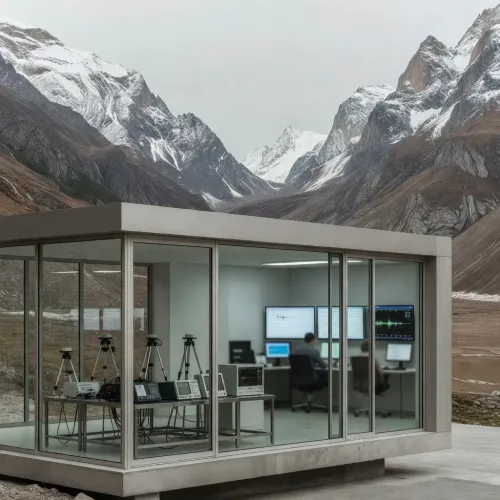
A seismically volatile stretch of the Himalayas just got a permanent scientific eye on it. Union Science and Technology Minister Dr. Jitendra Singh announced on Wednesday, 4 November 2026 that the Ministry of Earth Sciences has established a modern seismic observatory in Kishtwar, Jammu and Kashmir, designed to provide round-the-clock geophysical surveillance and strengthen disaster-management capacity in the high-risk Himalayan region.
Posting in Hindi, the Minister described the facility as 'ek mahatvapurn pahel' — 'an important initiative' — toward a safe and disaster-resilient future for Kishtwar. He framed it squarely within Prime Minister Narendra Modi's #ViksitBharat vision, underscoring that the observatory will help ensure the safety of local communities and improve pre-disaster preparedness in one of India's most seismically exposed districts.
Why Kishtwar sits at the centre of India's seismic concern
Kishtwar lies in the core of the Himalayan seismic belt, a zone where the Indian tectonic plate continues its slow, relentless push beneath the Eurasian plate. The district has historically recorded significant earthquake activity, and its rugged terrain makes post-disaster access — and therefore early warning — unusually critical. A permanent, automated observatory changes the response equation: real-time data can reach disaster agencies in seconds rather than hours.
The Ministry of Earth Sciences has been systematically expanding the National Centre for Seismology's sensor network across the Himalayas since the mid-2010s. The Kishtwar station continues that arc, adding a node in a district that had remained a monitoring gap despite its vulnerability. The 24x7 observational capacity is what sets this facility apart from older, manually operated stations in the region.
Science as a shield for Himalayan communities
The practical stakes for residents are direct. Early, precise seismic data feeds into Jammu and Kashmir's disaster management machinery, enabling faster evacuation advisories, better infrastructure siting, and more accurate hazard mapping for the district's valleys and mountain passes. For a population that has repeatedly faced both earthquake damage and cascading hazards like landslides, that data pipeline is a lifeline.
The Ministry's decision to anchor the announcement in the #ViksitBharat framework is deliberate: it positions scientific infrastructure not merely as academic investment but as a direct deliverable of the government's development-and-resilience agenda, making the observatory legible to a broader public audience beyond the scientific community.
With similar high-vulnerability pockets scattered across Uttarakhand, Himachal Pradesh and the Northeast, the Kishtwar station's performance will be watched closely — both by disaster managers and by advocates pressing for the next observatory in the chain.
Point of View
Not just a technical asset. For the current administration, embedding disaster-resilience projects within the flagship development narrative broadens their electoral and communicative reach beyond specialist audiences. The real test, however, will be whether the Kishtwar station catalyses a faster roll-out of similar facilities in equally vulnerable but less politically visible Himalayan districts. Analysts tracking the Ministry will watch for integration with the National Disaster Management Authority's alert systems as the clearest measure of operational impact.
NationPress
4 Nov 2026
Frequently Asked Questions
What is the new seismic observatory in Kishtwar?
It is a modern earthquake monitoring facility established by India's Ministry of Earth Sciences in Kishtwar, Jammu and Kashmir, designed to operate 24 hours a day, 7 days a week to provide real-time seismic data for the Himalayan region.
Why is Kishtwar considered seismically vulnerable?
Kishtwar is located within the Himalayan seismic belt, where the Indian tectonic plate pushes against the Eurasian plate, making the district prone to earthquakes and related hazards such as landslides.
Which ministry is behind the Kishtwar seismic observatory?
The Ministry of Earth Sciences, headed by Union Minister of State (Independent Charge) Dr. Jitendra Singh, established the observatory as part of the National Centre for Seismology's expanding Himalayan network.
How does the observatory help with disaster management?
By providing continuous, real-time seismic data, the observatory enables faster issuance of evacuation advisories, more accurate hazard mapping, and better pre-disaster preparedness for local communities and disaster agencies in Jammu and Kashmir.
What is the Viksit Bharat connection to this project?
Union Minister Dr. Jitendra Singh linked the observatory to Prime Minister Narendra Modi's Viksit Bharat vision, positioning science and technology infrastructure as a direct instrument of community safety and national development resilience.