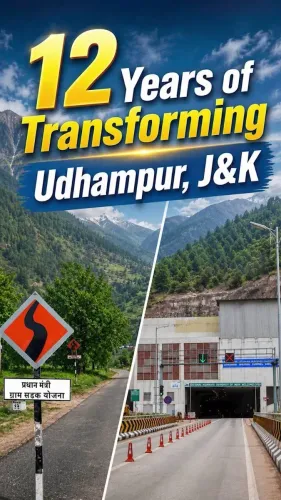
Dr. Jitendra Singh marks 12 years of Ramban's transformation

Synopsis
Union Minister Dr. Jitendra Singh on June 2, 2026, marked 12 years of infrastructure growth in Ramban, J&K, citing highways, tunnels, schools, disaster preparedness tools and India's first Atmospheric Moisture Monitor at Natha Top under PM Modi's tenure.
Key Takeaways
Jitendra Singh posted on June 2, 2026 , marking 12 years of development in Ramban district , Jammu and Kashmir.
Projects cited include highways, tunnels, bridges, Kendriya Vidyalayas , and colleges in remote areas such as Ukhral .
A Tulip Garden at Sanasar and a Radio Relay Station at Natha Top are among the newer tourism and communication installations listed.
India's first and the world's second Atmospheric Moisture Monitor has been established at Natha Top , under the Ministry of Earth Sciences .
Automated Weather Stations in the upper reaches of Banihal are part of enhanced disaster preparedness in the landslide-prone Ramban sector.
The post is part of the #12YearsofSeva campaign marking 12 years of the NDA government at the Centre since May 2014 .
Union Science and Technology Minister Dr. Jitendra Singh on Tuesday, June 2, 2026, took to X to mark 12 years of infrastructure and institutional development in Ramban district of Jammu and Kashmir, listing a range of projects spanning highways, tunnels, schools, weather monitoring stations and tourism facilities as evidence of the region's transformation under Prime Minister Narendra Modi.
Context
In his post, Dr. Singh described the changes as reshaping a once-remote hill district, citing 'modern infrastructure, enhanced connectivity, highways, tunnels, bridges, Kendriya Vidyalayas, colleges in remote hilly areas like Ukhral, enhanced disaster preparedness, Automated Weather Stations in upper reaches of Banihal, a Tulip Garden in Sanasar, a Radio Relay Station at Natha Top, and India's first and world's second Atmospheric Moisture Monitor at Natha Top.' He characterised the outcome as 'Naya Ramban of Naya Jammu and Kashmir' — a framing aligned with the ruling dispensation's broader political messaging on the Union Territory.
The post was tagged #12YearsofSeva, placing it within a coordinated campaign marking 12 years of the Bharatiya Janata Party-led National Democratic Alliance government at the Centre, which came to power in May 2014. Dr. Singh, who represents the Udhampur constituency in Jammu division, has consistently highlighted Ramban's development trajectory in his public communications.
Policy Backdrop
Ramban district, situated in the Pir Panjal range along the Jammu-Srinagar National Highway (NH-44), has been a focal point of central investment due to its strategic location on the only road corridor linking the Kashmir Valley with the rest of India for much of the year. The Bharatmala Pariyojana, launched in 2015, sanctioned several tunnel and expressway packages on this axis, with work on multiple stretches progressing through the Ramban sector.
The Jammu and Kashmir Reorganisation Act, 2019, which converted the former state into two Union Territories, enabled direct central funding for infrastructure, education and institutional expansion without requiring state government concurrence. Since then, the central government has accelerated road, tunnel and bridge projects in the Pir Panjal sector, alongside investments in central schools and weather-monitoring infrastructure. The Atmospheric Moisture Monitor at Natha Top falls under the Ministry of Earth Sciences, which Dr. Singh also heads, making the installation directly relevant to his ministerial portfolio.
Stakeholders and Impact
Residents of Ramban district and hill communities across Jammu division are the primary beneficiaries of the projects cited. Improved all-weather connectivity reduces the economic and social cost of the district's historic isolation, while Kendriya Vidyalayas and colleges in areas such as Ukhral expand access to formal education for students who previously had to travel long distances or forgo higher schooling.
Enhanced disaster preparedness infrastructure and Automated Weather Stations in the upper reaches of Banihal are of particular significance given that the Ramban sector is prone to landslides, flash floods and road blockages that have historically cut off the valley for days at a time. Improved meteorological data from high-altitude stations can reduce response times for disaster management agencies.
The Tulip Garden at Sanasar and the broader tourism narrative signal an attempt to diversify Ramban's economic profile beyond its role as a transit corridor, positioning the district as a destination in its own right within the Jammu region's tourism circuit.
What's Next
Attention will now focus on completion timelines for remaining tunnel packages on the Jammu-Srinagar highway — including stretches in the Ramban sector — and the rollout of additional Automated Weather Stations in the upper Chenab catchment. The #12YearsofSeva campaign is expected to continue through June 2026, with ministers and party functionaries amplifying district-level development narratives across social media platforms. For Ramban, the political emphasis on transformation is likely to intensify as the Union Territory prepares for its next electoral cycle.
Point of View
Using Ramban — a historically underserved and strategically critical district — as a microcosm of the broader 'Naya Jammu and Kashmir' narrative. The enumeration of projects spanning connectivity, education, meteorology and tourism is notable because it draws on Dr. Singh's dual portfolio in Science and Technology and Earth Sciences, lending institutional credibility to the claims around the Atmospheric Moisture Monitor and weather stations. The framing of Ramban's transformation as inseparable from PM Modi's tenure is consistent with the BJP's strategy of personalising development outcomes ahead of electoral cycles in the Union Territory. Analysts will note that the post, while politically motivated, reflects a genuine acceleration of central investment in J&K's Jammu division since 2019 — a pattern that cuts across the political messaging to have tangible on-ground dimensions.
NationPress
18 Oct 2026
Frequently Asked Questions
What is the Atmospheric Moisture Monitor at Natha Top?
The Atmospheric Moisture Monitor at Natha Top is a scientific instrument installed at the high-altitude pass near Banihal in Jammu and Kashmir; Dr. Jitendra Singh's post describes it as India's first and the world's second such installation, falling under the Ministry of Earth Sciences which he heads.
What is the #12YearsofSeva campaign?
The #12YearsofSeva hashtag marks 12 years of the Narendra Modi-led NDA government at the Centre since May 2014, with ministers and party leaders using it to highlight development achievements in their respective constituencies and sectors.
Why is Ramban district significant for infrastructure development?
Ramban district lies on the Jammu-Srinagar National Highway in the Pir Panjal range and is the only major road corridor linking the Kashmir Valley to the rest of India, making its connectivity infrastructure strategically critical; the district is also prone to landslides and flash floods, necessitating disaster preparedness investments.
What is the Bharatmala Pariyojana and how does it affect Ramban?
Bharatmala Pariyojana is a central highway development programme launched in 2015 that sanctioned multiple tunnel and expressway packages on the Jammu-Srinagar axis, with several packages passing through the Ramban sector to ensure all-weather road connectivity.
What development projects has the central government undertaken in Ramban since 2019?
Since the Jammu and Kashmir Reorganisation Act of 2019, the central government has accelerated road, tunnel and bridge construction in Ramban, alongside Kendriya Vidyalayas, colleges in remote areas like Ukhral, Automated Weather Stations near Banihal, a Tulip Garden at Sanasar, a Radio Relay Station at Natha Top, and an Atmospheric Moisture Monitor at Natha Top.