Dr Jitendra Singh Inaugurates IMD Centre in Jammu
Synopsis
Union Minister Dr. Jitendra Singh inaugurated India's seventh IMD Meteorological Centre at Jammu on June 6, 2026, strengthening localised weather forecasting for farmers, disaster agencies, and aviation in the Himalayan frontier region.
Key Takeaways
Jitendra Singh inaugurated the seventh IMD Meteorological Centre in India at Jammu on June 6, 2026 .
The centre brings dedicated regional weather forecasting infrastructure to Jammu and Kashmir UT for the first time at this level.
Key beneficiaries include farmers , disaster management agencies , the aviation sector , and the Vaishno Devi pilgrimage corridor .
The move aligns with the Ministry of Earth Sciences mandate to integrate meteorology with climate services and disaster risk reduction.
IMD, established in 1875 , has been expanding its regional centre network through successive Five Year Plan modernisation drives.
Further rollout of Doppler radars and integration of IMD data into state disaster management plans is expected to follow.
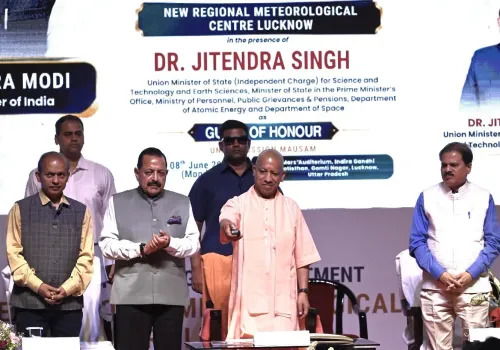
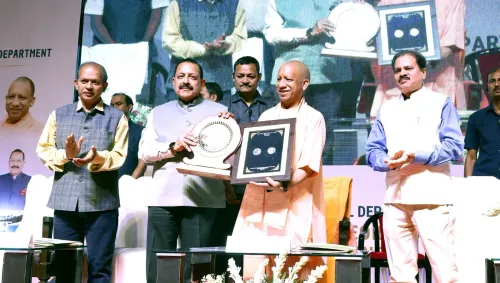
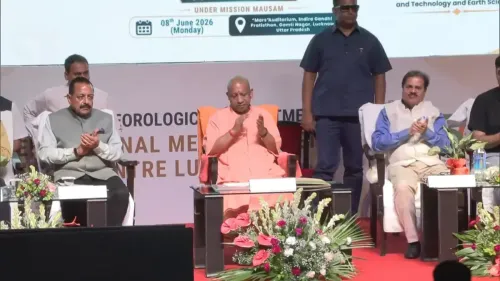
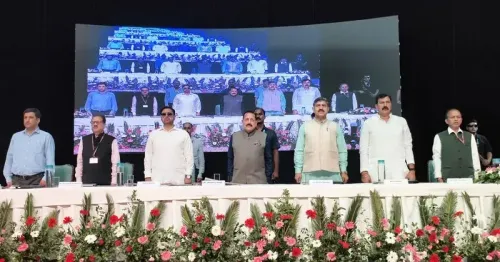
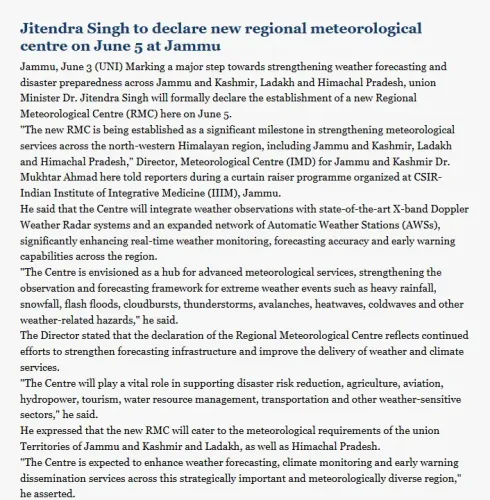
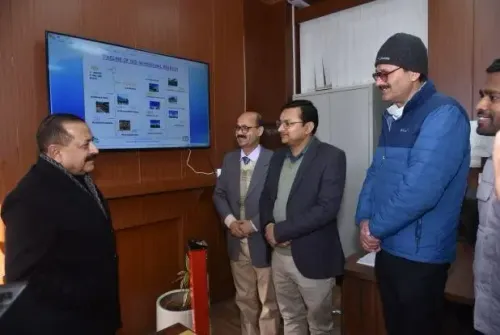
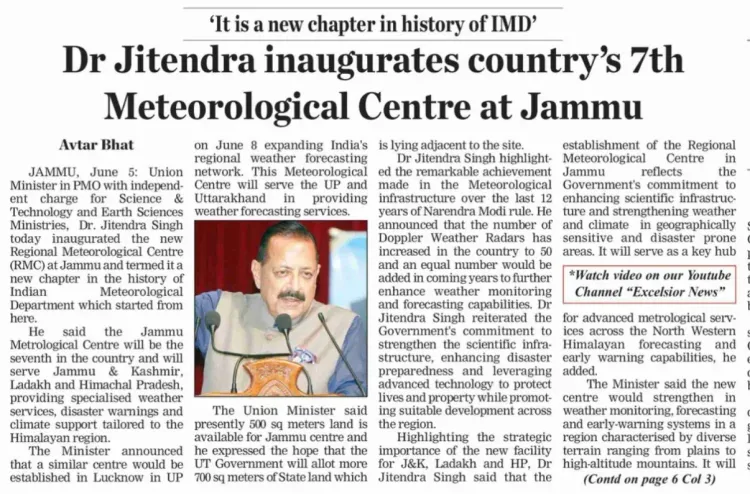
Union Science and Technology Minister Dr. Jitendra Singh inaugurated the country's seventh Meteorological Centre of the India Meteorological Department (IMD) at Jammu on Saturday, June 6, 2026, marking a significant expansion of India's regional weather forecasting infrastructure in the Himalayan frontier region.
Context
The new IMD Meteorological Centre at Jammu becomes the seventh such regional facility in the country, deepening the department's reach into a geographically complex zone where localised, accurate forecasting has long been a critical need. Jammu, the winter capital of the Jammu and Kashmir Union Territory, sits at the confluence of plains and Himalayan foothills, making it a meteorologically distinct zone from the Kashmir Valley and demanding its own dedicated observation and prediction infrastructure.
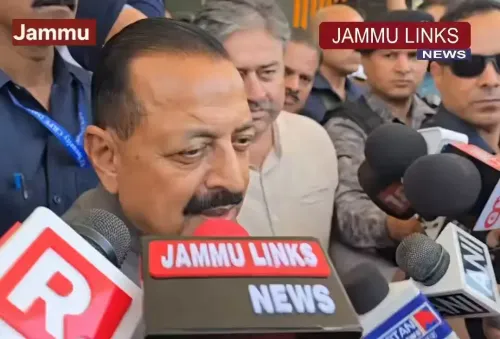
Dr. Jitendra Singh, who also holds charge as Minister of State in the Prime Minister's Office, shared the inauguration news on his official X account, linking to coverage of the event. The post was captioned: 'Dr Jitendra inaugurates country's 7th Meteorological Centre at Jammu' — flagged with the #IMD hashtag, signalling the ministry's intent to publicly highlight the infrastructure push.
Policy Backdrop
The India Meteorological Department, established in 1875, has historically operated through a network of regional and state-level meteorological centres designed to decentralise forecasting away from its New Delhi headquarters. Successive modernisation drives — including those under the 11th and 12th Five Year Plans (2007–2017) — prioritised the expansion of Doppler radar networks, automatic weather stations, and regional centres to improve district-level forecasts and early warning systems.
The Ministry of Earth Sciences, under which IMD operates, has in recent years integrated meteorological services with climate risk assessment and disaster preparedness mandates. Opening a dedicated centre in Jammu fits squarely within this policy arc, addressing a persistent gap in observational data for the Himalayan and border-state belt where extreme weather events — flash floods, cloudbursts, and cold-wave incursions — carry high human and economic cost.
Stakeholders and Impact
The most immediate beneficiaries of the Jammu Meteorological Centre are the region's farming communities, who depend on granular, localised forecasts for sowing, irrigation, and harvest decisions across the Jammu division's varied agro-climatic zones. Improved hyper-local prediction is also expected to strengthen the response capacity of state and UT disaster management agencies, particularly ahead of the monsoon season when the Jammu region is vulnerable to sudden heavy rainfall and landslides.
The aviation sector operating out of Jammu Airport and the tourism industry servicing the Vaishno Devi pilgrimage corridor — one of India's busiest religious routes — stand to gain from more precise short-range and nowcast forecasts. Better weather data integration also supports the Indian Army and paramilitary forces deployed in the region, for whom weather intelligence is operationally critical.
What's Next
The inauguration of the Jammu centre is expected to be followed by further rollout of regional IMD facilities, commissioning of new Doppler weather radars, and deeper integration of IMD data feeds into state and UT-level disaster management plans. The Ministry of Earth Sciences has signalled a broader push to ensure that every state and Union Territory has dedicated meteorological infrastructure capable of generating sub-district forecasts.
As extreme weather events grow in frequency and intensity across the Indian subcontinent, the expansion of IMD's ground-level network — particularly in climatically sensitive zones like Jammu and Kashmir — will be closely watched as a benchmark of India's climate resilience preparedness.
Point of View
A region that has been a priority constituency since the reorganisation of the erstwhile state into Union Territories in 2019. Substantively, however, the move addresses a genuine infrastructure deficit: the Jammu belt's complex topography has historically been underserved by centralised forecasting models calibrated for the plains. Placed within the broader pattern of IMD expansion under the current government — including new Doppler radars and automatic weather stations — the Jammu centre represents incremental but meaningful progress on climate resilience. The real test will be whether the facility is staffed and operationalised at full capacity quickly enough to deliver actionable district-level forecasts before the next monsoon cycle.
NationPress
21 Oct 2026
Frequently Asked Questions
What is the new IMD Meteorological Centre inaugurated in Jammu?
It is the seventh regional Meteorological Centre of the India Meteorological Department, inaugurated at Jammu on June 6, 2026, by Union Minister Dr. Jitendra Singh to provide dedicated localised weather and climate forecasting services for the Jammu and Kashmir region.
Who inaugurated the IMD centre in Jammu in 2026?
Union Minister of State (Independent Charge) for Science and Technology and Earth Sciences, Dr. Jitendra Singh, inaugurated the facility on June 6, 2026.
How many IMD Meteorological Centres are there in India now?
With the inauguration of the Jammu facility, India now has seven regional IMD Meteorological Centres, according to the post shared by Dr. Jitendra Singh.
Why is a Meteorological Centre important for Jammu?
Jammu's complex terrain — sitting at the junction of plains and Himalayan foothills — requires localised forecasting for agriculture, disaster management, aviation, and the Vaishno Devi pilgrimage corridor, which sees millions of visitors annually.
What does the India Meteorological Department do?
The India Meteorological Department, established in 1875 and operating under the Ministry of Earth Sciences, is India's national weather and climate service agency responsible for weather forecasting, climate monitoring, and early warning systems for extreme weather events.