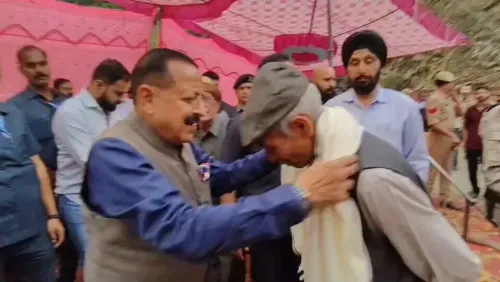
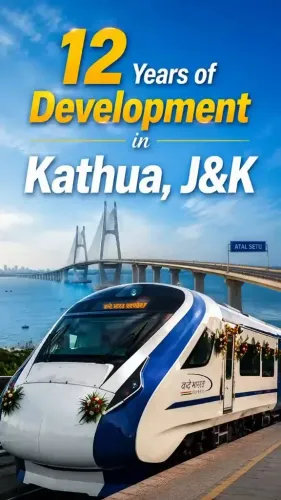
Dr. Jitendra Singh marks 12 years of progress in Doda
Synopsis
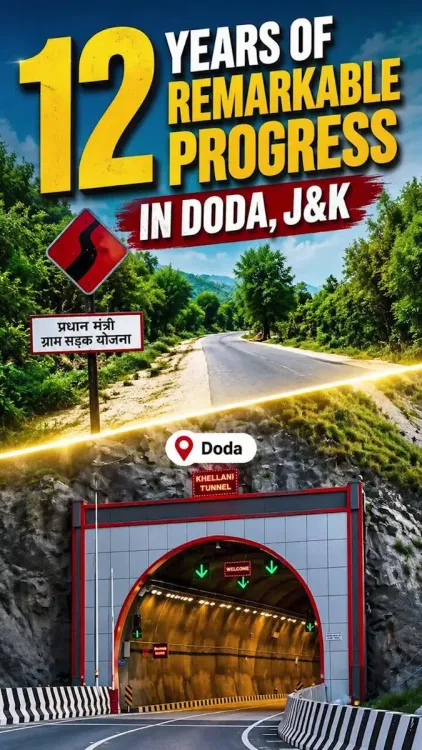
Union Minister Dr. Jitendra Singh on June 8, 2026, highlighted 12 years of development in Doda, J&K, citing PMGSY road expansion, the Khellani Tunnel, the Purple Revolution in lavender farming, and new medical and degree colleges as milestones under PM Modi's governance framework.
Key Takeaways
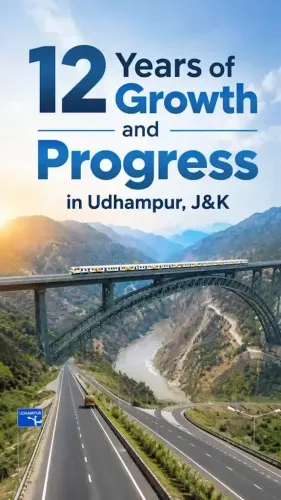
Jitendra Singh on June 8, 2026 marked 12 years of development in Doda district , Jammu and Kashmir.
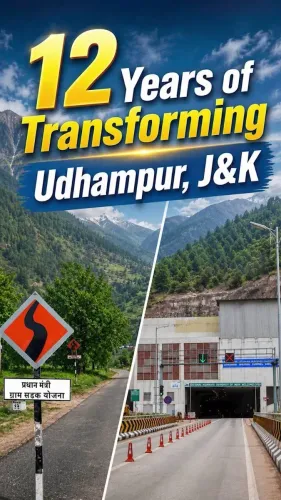
The Khellani Tunnel and new highway projects are cited as key drivers of improved regional connectivity.
PMGSY road expansion has linked remote villages to healthcare, education, and markets.
The Purple Revolution , rooted in CSIR's Aroma Mission launched in 2016 , has made Doda a national model for lavender cultivation and farmer income diversification.
A Medical College , Degree Colleges , and Kendriya Vidyalayas have been established in rural parts of the district to improve educational access.
The post frames these gains as part of PM Narendra Modi 's vision for a 'developed and self-reliant' Jammu and Kashmir .
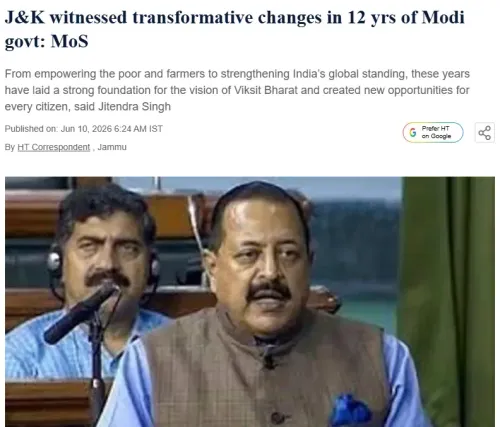
Union Science and Technology Minister Dr. Jitendra Singh on Monday, June 8, 2026, marked 12 years of what he described as unprecedented development in Doda district of Jammu and Kashmir, highlighting gains in road connectivity, agricultural transformation, and educational infrastructure under the Modi government.
Context
In a post on X under the hashtag #12YearsOfSeva, Dr. Singh catalogued a range of central-government initiatives that have reshaped Doda, a remote district in the Jammu division known for its hilly terrain and historically limited connectivity. He cited strategic road networks, the Khellani Tunnel, and new highway projects as having 'enhanced connectivity across the region.' The post comes as the Bharatiya Janata Party marks a dozen years of its political presence in the region since the 2014 general elections.
Dr. Singh specifically credited the Pradhan Mantri Gram Sadak Yojana (PMGSY) road expansion with connecting 'far-flung villages, improving access to healthcare, education and markets.' He also pointed to the establishment of a Medical College, Degree Colleges, and Kendriya Vidyalayas in remote rural areas as making education 'available to peripheral natives.'
Policy Backdrop
PMGSY, launched in 2000, was expanded in successive phases across Jammu and Kashmir after 2014, with a focus on all-weather connectivity in remote districts such as Doda. The programme forms part of a broader connectivity-plus-livelihood template that the Centre has applied uniformly across the Union Territory since its reorganisation in August 2019, when Article 370 was abrogated and direct central funding became operationally easier to route.
The Purple Revolution, which Dr. Singh highlighted as having 'placed Doda on the national map,' is linked to the Aroma Mission launched by the Council of Scientific and Industrial Research (CSIR) in 2016. Doda was identified as the initial lavender cluster under this initiative, with the aim of diversifying farmer incomes beyond traditional subsistence crops. The programme has since been cited as a model for agri-value chain development in Himalayan districts.
Sanction of new government medical colleges and Kendriya Vidyalayas in J&K districts was announced between 2014 and 2020 as part of an educational infrastructure push intended to reduce the urban-rural divide in access to quality schooling and tertiary healthcare.
Stakeholders and Impact
Residents of Doda — including lavender farmers, rural students, and communities in previously road-dark villages — stand as the primary beneficiaries of the initiatives Dr. Singh outlined. The Purple Revolution in particular has empowered smallholder farmers by creating a commercially viable aromatic crop that commands premium prices, with the model drawing attention from other Himalayan and North-Eastern states seeking similar agri-diversification pathways.
Improved road access under PMGSY has practical knock-on effects: shorter travel times to district hospitals, higher school enrolment rates in connected villages, and better market linkages for agricultural produce. The addition of a Medical College in the district addresses a longstanding gap in tertiary healthcare for a population spread across difficult mountain terrain.
What's Next
Attention will now turn to the completion timelines and funding releases for remaining stretches of the Doda-Kishtwar highway and the Khellani Tunnel, both of which are critical to year-round connectivity in the sub-region. Independent assessments of enrolment and healthcare utilisation at the newly established colleges and medical facilities will determine whether the infrastructure investments are translating into measurable human-development outcomes.
Dr. Singh framed these achievements as 'a shining example of PM Narendra Modi's vision for a developed and self-reliant Jammu and Kashmir,' signalling that the governance narrative around J&K's Union Territory status will remain a central theme for the ruling dispensation ahead of any future electoral cycle in the region.
Point of View
A message with clear resonance ahead of any future assembly or local-body elections in the UT. The invocation of the Purple Revolution is particularly strategic: it reframes a scientific mission (CSIR's Aroma Mission) as a visible, photogenic symbol of rural empowerment, giving the government a tangible story beyond road and tunnel kilometres. The post fits a broader pattern in which Union Ministers use social-media milestones to consolidate the Centre's development credentials in J&K, countering narratives of administrative neglect in the post-reorganisation period.
NationPress
22 Oct 2026
Frequently Asked Questions
What is the Purple Revolution in Doda?
The Purple Revolution refers to the large-scale promotion of lavender cultivation in Doda district under the CSIR Aroma Mission , launched around 2016 . It was designed to diversify farmer incomes by introducing a high-value aromatic crop suited to the district's climate and altitude, and has since become a national model for agri-diversification in Himalayan regions.
What is the Khellani Tunnel and why does it matter for Doda?
The Khellani Tunnel is a strategic road-tunnel project aimed at improving all-weather connectivity in the Doda sub-region of Jammu and Kashmir . It is intended to reduce travel time and ensure year-round access to areas that are frequently cut off during winters, benefiting both commuters and the movement of goods.
How has PMGSY helped Doda district?
The Pradhan Mantri Gram Sadak Yojana (PMGSY) has funded the construction and upgrade of rural roads in Doda , connecting previously isolated villages to district headquarters, healthcare facilities, schools, and agricultural markets. The programme's expansion in Jammu and Kashmir accelerated after 2014 .
What educational institutions have been set up in Doda in recent years?
According to Dr. Jitendra Singh's post, a Medical College , Degree Colleges , and Kendriya Vidyalayas have been established in remote and rural parts of Doda district as part of the Centre's push to improve access to quality education and healthcare in peripheral areas of Jammu and Kashmir .
Why did J&K's reorganisation in 2019 matter for districts like Doda?
The reorganisation of Jammu and Kashmir into a Union Territory in August 2019 , following the abrogation of Article 370 , enabled direct central funding and faster implementation of flagship schemes such as PMGSY and the Aroma Mission in districts like Doda , which had historically received limited infrastructure investment.