CM Office Uttarakhand to Strengthen Seismic Monitoring Network
Synopsis
The Chief Minister's Office of Uttarakhand announced on 28 May 2026 that the state will strengthen its seismic monitoring network. Uttarakhand lies in Seismic Zones IV and V and has a history of major earthquakes. The move aligns with India's national disaster management framework and ongoing efforts by USDMA and IMD to improve real-time earthquake detection.
Key Takeaways
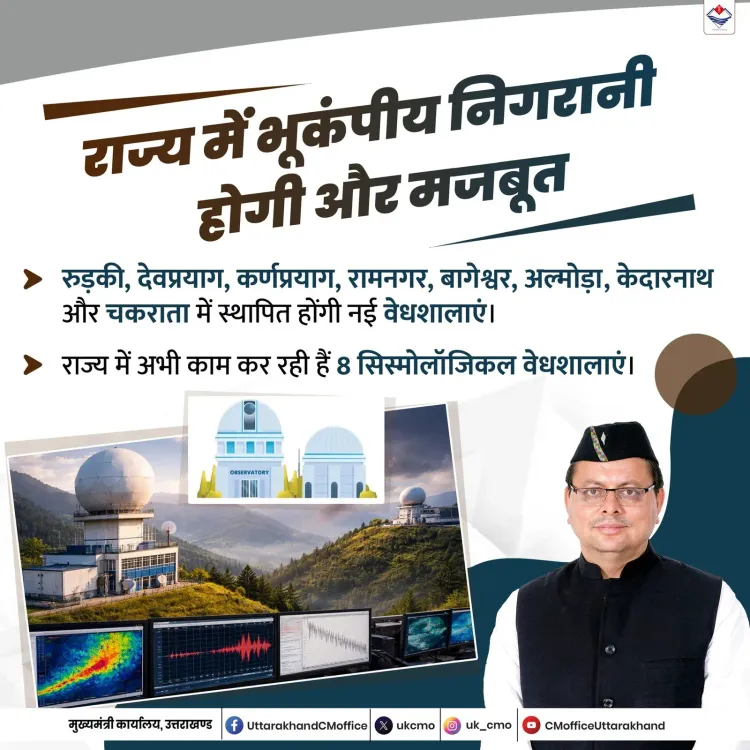
The Chief Minister's Office of Uttarakhand announced on 28 May 2026 that seismic monitoring in the state will be further strengthened.
Uttarakhand lies in Seismic Zones IV and V , among the highest hazard categories in India.
Major earthquakes including the 1991 Uttarkashi and 1999 Chamoli events have historically exposed the state's vulnerability.
The USDMA and IMD are the key institutional stakeholders responsible for seismic monitoring in the state.
The announcement aligns with the NDMA's National Earthquake Risk Mitigation Programme and the Disaster Management Act, 2005 .
Specific details on scope, technology, or funding for the upgrade have not yet been disclosed.
The Chief Minister's Office of Uttarakhand announced on Thursday, 28 May 2026 that the state will strengthen its earthquake monitoring infrastructure, signalling a renewed push to improve seismic surveillance across one of India's most hazard-prone regions.
Context
The post, shared by the official Chief Minister's Office of Uttarakhand account, stated in Hindi: 'Rajya mein bhookampiya nigrani hogi aur majboot' — 'Seismic monitoring in the state will be further strengthened.' The announcement comes as Uttarakhand continues to grapple with persistent earthquake risk stemming from its location along the active India-Eurasia tectonic plate boundary.
The state sits squarely within Seismic Zones IV and V, the two highest hazard categories in India's seismic zonation map. Historical events such as the 1991 Uttarkashi earthquake and the 1999 Chamoli earthquake underscored the region's vulnerability and the critical need for robust, real-time monitoring systems.
Policy Backdrop
India's institutional framework for seismic monitoring rests on the Disaster Management Act, 2005, which established the National Disaster Management Authority (NDMA) and mandated state-level disaster management bodies with responsibilities for seismic risk reduction. The Uttarakhand State Disaster Management Authority (USDMA) operates as the nodal state agency coordinating with central bodies on preparedness and infrastructure.
The NDMA's National Earthquake Risk Mitigation Programme, initiated in the 2000s, has guided the installation and progressive upgrading of seismological observatories across Himalayan states. The Indian Meteorological Department (IMD) maintains the national seismological network and operates dedicated stations in Uttarakhand for real-time detection and data sharing with state authorities. Successive governments in the state have periodically collaborated with IMD and NDMA to expand observatory coverage and accelerate public alert systems.
This announcement fits a well-established pattern of incremental strengthening of monitoring infrastructure in Himalayan states rather than a single standalone project, reflecting the long-term nature of seismic risk management in the region.
Stakeholders and Impact
The most direct beneficiaries of improved seismic monitoring are the millions of residents living in earthquake-prone districts of Uttarakhand, particularly in the higher Himalayan zones where infrastructure remains vulnerable. Faster detection and alert dissemination can reduce casualties by enabling timely evacuation and emergency response.
Scientific institutions, disaster response teams, and local urban bodies responsible for enforcing earthquake-resistant construction codes also stand to gain from richer, more granular seismic data. Improved monitoring data can inform land-use planning, building bye-laws, and targeted retrofitting programmes for older structures in towns such as Dehradun, Haridwar, Uttarkashi, and Chamoli.
What's Next
Specific details on the scope, timeline, technology, or funding for the proposed strengthening have not been disclosed in the post. Observers will watch for formal announcements from USDMA or state budget allocations detailing new station deployments, sensor upgrades, or memoranda of understanding with IMD for data integration.
Any tie-up with national early-warning pilot projects or expansion of the existing observatory network would mark a concrete step forward. As Uttarakhand advances its disaster resilience agenda, stronger seismic monitoring infrastructure will be foundational to any credible earthquake preparedness strategy for the state's fragile Himalayan terrain.
Point of View
Driven largely by central mandates under the Disaster Management Act. However, such announcements carry weight only when followed by concrete budgetary commitments and inter-agency MoUs with IMD or NDMA. For a state that has experienced two major earthquakes within a decade, the political optics of disaster preparedness are inseparable from the governance imperative. The real test will be whether this translates into new observatory stations, faster public alert systems, or integration with any national early-warning pilot — details the state has yet to disclose.
NationPress
26 Sept 2026
Frequently Asked Questions
Why is Uttarakhand at high risk of earthquakes?
Uttarakhand lies along the active India-Eurasia tectonic plate boundary and falls within Seismic Zones IV and V, the two highest hazard categories in India. Major earthquakes such as the 1991 Uttarkashi and 1999 Chamoli events have historically demonstrated the region's vulnerability.
What does strengthening seismic monitoring mean for Uttarakhand residents?
Stronger seismic monitoring means faster real-time detection of earthquakes, which can enable quicker emergency alerts, more timely evacuations, and better-informed disaster response, potentially reducing casualties in affected areas.
Which agencies are responsible for earthquake monitoring in Uttarakhand?
The Indian Meteorological Department (IMD) operates the national seismological network including stations in Uttarakhand, while the Uttarakhand State Disaster Management Authority (USDMA) coordinates state-level disaster response and works with NDMA on seismic risk reduction.
What is India's policy framework for seismic risk management?
The Disaster Management Act, 2005 established the National Disaster Management Authority and mandated state disaster management authorities. NDMA's National Earthquake Risk Mitigation Programme has guided the installation and upgrading of seismological observatories in Himalayan states including Uttarakhand.
What should we watch for after this Uttarakhand seismic monitoring announcement?
Key developments to watch include state budget allocations for new seismic stations, any MoUs between USDMA and IMD for expanded monitoring, and potential integration with national earthquake early-warning pilot projects.