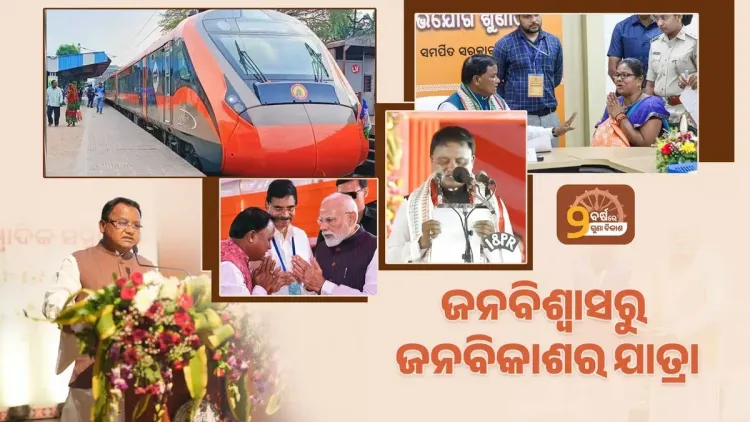
CM Majhi Marks Two Years of BJP Govt in Odisha
Synopsis
Odisha Chief Minister Mohan Charan Majhi marked two years of BJP governance on June 12, 2026, citing progress in agriculture, industry, health and education and reaffirming a commitment to a prosperous, empowered Odisha rooted in Odia cultural identity.
Key Takeaways
Chief Minister Mohan Charan Majhi marked two years of the BJP government in Odisha on June 12, 2026 .
The BJP formed its first-ever Odisha government in June 2024 , ending 24 years of BJD rule under Naveen Patnaik.
Majhi cited progress in agriculture, industry, health and education as proof of the government's development journey.
The post invoked Lord Jagannath and Odia Asmita (Odia cultural identity) as guiding principles of governance.
The government framed political power as a 'sacred vow of public service,' not merely authority.
The next Odisha assembly elections are due by 2029 , making sectoral delivery a key political benchmark.
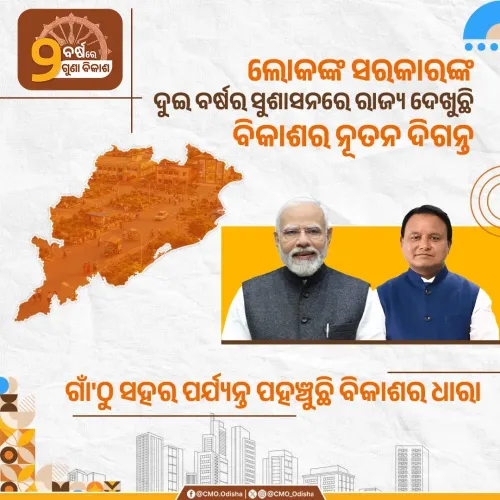
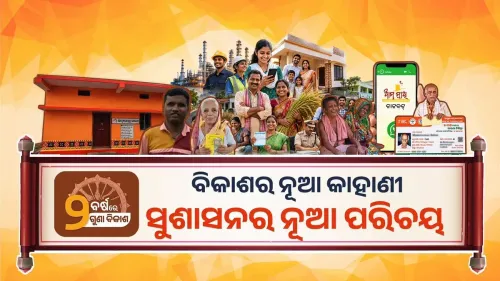
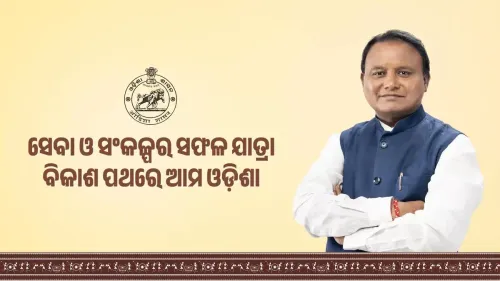
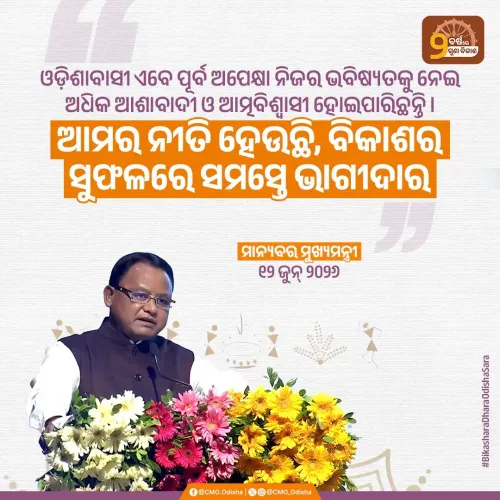
Odisha Chief Minister Mohan Charan Majhi on Friday, June 12, 2026, marked the completion of two years of his government, crediting the 'unshakeable faith of the people of Odisha' and the blessings of Mahaprabhu (Lord Jagannath) for the milestone. The BJP-led administration, which came to power in June 2024 ending 24 years of Biju Janata Dal rule, used the occasion to highlight what it described as transformative progress across agriculture, industry, health, and education.
Context
In the post, written in Odia and pinned to his official X profile, CM Majhi stated: 'By the unshakeable faith of the people of the state and the grace of Mahaprabhu, our government has today successfully completed two years. The revolutionary changes that have come in the fields of agriculture, industry, health and education in the last two years are proof of our development-oriented journey.'
He added that power, for his government, is 'not merely authority but a sacred vow of public service,' and called on citizens to join in making the journey more dynamic through collective effort. The post carried the hashtags #2YearsofLokankaSarakar (Two Years of the People's Government) and #BikasharaDharaOdishaSara (The Stream of Development for All of Odisha).
Policy Backdrop
The BJP won the 2024 Odisha assembly elections, forming the state's first BJP government and ending the two-decade-plus dominance of the BJD under former Chief Minister Naveen Patnaik. Majhi, who took oath in June 2024, became the first BJP Chief Minister of the state.
The government has publicly anchored its agenda around Odia Asmita — Odia cultural identity — as a foundational principle, seeking to tie development goals to a distinct regional pride. The two-year messaging reinforces this framing, positioning governance as rooted in local culture rather than purely administrative delivery.
Stakeholders and Impact
The anniversary communication is directed at Odisha's broad electorate, including farmers, students, and residents dependent on state-run health services — the core constituencies the government has repeatedly cited in its outreach. Agricultural and educational reforms in a state with a large rural population carry significant political weight.
The use of Odia language and religious references to Lord Jagannath, the presiding deity of the Puri temple and a central symbol of Odia identity, signals a deliberate cultural pitch alongside the governance narrative. Such messaging is characteristic of BJP state governments seeking to consolidate both developmental and identity-based voter bases.
What's Next
With the next Odisha assembly elections due by 2029, the government's ability to demonstrate measurable progress in agriculture, health, and education will be closely watched. The two-year mark sets a public benchmark against which future performance will be assessed.
How the administration translates the anniversary messaging into verifiable sectoral outcomes — particularly for rural communities — will shape the BJP's electoral narrative heading into the second half of its term.
Point of View
The messaging attempts to consolidate both aspirational and identity-driven voter segments simultaneously. The religious framing and Odia-language delivery also signal a direct challenge to the BJD's long-held positioning as the authentic custodian of Odia pride. With 2029 still three years away, the anniversary serves less as an accountability exercise and more as a momentum-building exercise to define the government's narrative on its own terms.
NationPress
26 Oct 2026
Frequently Asked Questions
When did Mohan Charan Majhi become Chief Minister of Odisha?
Mohan Charan Majhi became Chief Minister of Odisha in June 2024 , after the BJP won the state assembly elections, ending 24 years of BJD rule.
What is the significance of the BJP's two-year anniversary in Odisha?
The two-year mark represents the halfway point of the BJP's first-ever term governing Odisha, a state the party had never previously controlled despite national prominence.
What sectors did CM Majhi highlight in his two-year message?
CM Majhi highlighted progress in agriculture, industry, health and education as evidence of his government's development-oriented journey in the post.
What does 'Odia Asmita' mean and why does the BJP use it?
'Odia Asmita' means Odia cultural identity or pride. The BJP uses it to connect governance goals to regional cultural sentiment, a strategy that also challenges the BJD's legacy as the traditional champion of Odia identity.
When are the next Odisha assembly elections?
The next Odisha assembly elections are due by 2029 , giving the Majhi government roughly three more years to deliver on its sectoral promises.