CM Majhi Greets Jharkhand on Sthapna Divas
Synopsis
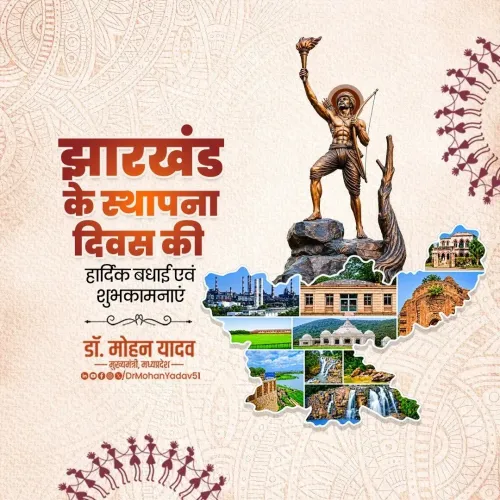
Odisha Chief Minister Mohan Charan Majhi wished Jharkhand on its Sthapna Divas on 15 November, highlighting shared tribal heritage and historical bonds between the two eastern neighbours.
Key Takeaways
Jharkhand Sthapna Divas is observed annually on 15 November , marking the state's formation from southern Bihar in 2000 .
Odisha CM Mohan Charan Majhi extended greetings citing shared tribal heritage and cultural ties between the two states.
Several Adivasi communities including the Santali, Ho, and Munda groups are historically shared across Odisha and Jharkhand.
Both states share borders, river systems, forest corridors, and mineral belts, making interstate goodwill practically significant beyond ceremonial courtesy.
The message reinforces the broader pattern of eastern-state solidarity and India's federal culture of formation-anniversary diplomacy.
Twenty-six years after a new state was carved from Bihar's southern districts, Odisha Chief Minister Mohan Charan Majhi extended warm greetings to Jharkhand on its Sthapna Divas, 15 November — invoking shared tribal roots and a neighbourly bond that runs deeper than a common border.
In his message, CM Majhi wrote: 'Bound by shared cultural values, rich tribal heritage and a strong spirit of national unity, Odisha and Jharkhand cherish deep-rooted historical and cultural ties.' He closed with best wishes for the state's 'continued growth and success.'
A border drawn in 2000, a kinship older than the map
Jharkhand came into existence on 15 November 2000, when it was bifurcated from southern Bihar — a long-pending demand of the region's predominantly tribal communities. The date is now observed annually as Jharkhand Sthapna Divas (Jharkhand Foundation Day). Odisha shares both a geographic border and an ethnographic overlap with the younger state: several Adivasi groups — including the Santali, Ho, and Munda communities — straddle both states, sharing festivals, dialects, and customs.
That cultural continuum gives Majhi's message more texture than a routine courtesy note. As Chief Minister of a state with one of India's largest Schedule Tribe populations, his invocation of 'tribal heritage' signals an affinity that is politically and socially resonant across the two administrations.
Interstate goodwill in India's eastern corridor
Ceremonial exchanges between neighbouring state governments are a fixture of India's federal calendar, but the Odisha-Jharkhand corridor carries particular weight in development conversations. Both states share river systems, forest corridors, and mineral belts that frequently require coordinated governance. Statehood-day messages from chief ministers often set the diplomatic tone for administrative cooperation that follows through the year.
As Jharkhand marks another year of statehood, the message from Bhubaneswar is clear — the east's tribal heartland sees itself as one story, written across two state boundaries.Point of View
And gestures of cultural solidarity — even ceremonial ones — build a soft-power narrative across borders. The emphasis on 'national unity alongside regional identity' also reflects the BJP's federal messaging playbook. Whether this goodwill translates into concrete administrative cooperation between the two governments remains the more substantive question to watch.
NationPress
15 Nov 2026
Frequently Asked Questions
When is Jharkhand Sthapna Divas celebrated?
Jharkhand Sthapna Divas is celebrated every year on 15 November, the date in 2000 when Jharkhand was carved out of southern Bihar as a separate state.
Why did Odisha CM Mohan Majhi wish Jharkhand on Sthapna Divas?
CM Majhi extended greetings to highlight the shared tribal heritage, cultural values, and historical ties between Odisha and Jharkhand as neighbouring eastern Indian states.
What is the connection between Odisha and Jharkhand's tribal communities?
Several Adivasi groups including the Santali, Ho, and Munda communities are indigenous to both states, sharing common languages, festivals, and cultural traditions across the border.
How was Jharkhand formed?
Jharkhand was formed on 15 November 2000 when it was bifurcated from southern Bihar, fulfilling a long-standing demand of the region's predominantly tribal population for a separate state.
Who is Mohan Charan Majhi?
Mohan Charan Majhi is the Chief Minister of Odisha and a senior BJP leader who leads the state government in Bhubaneswar.