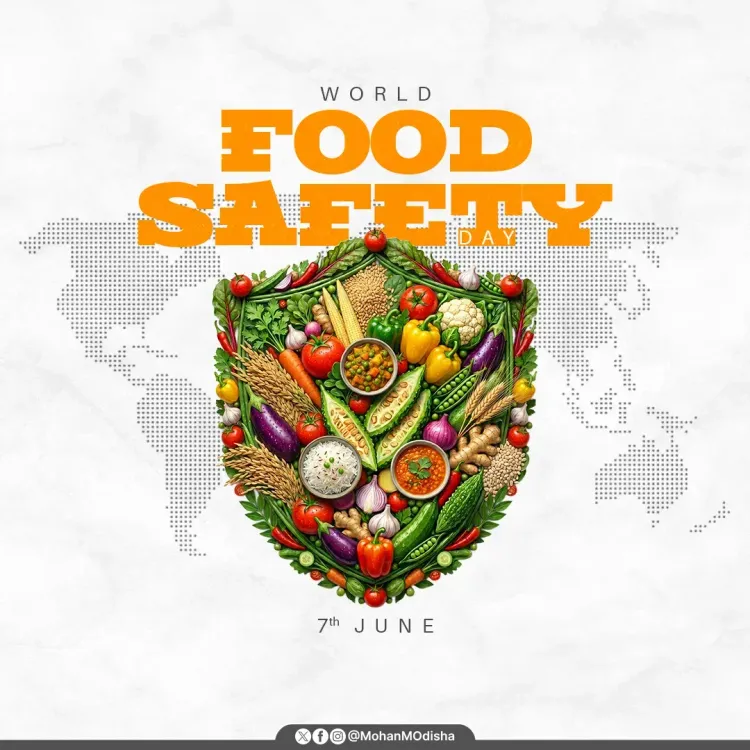
CM Majhi Calls for Food Safety Commitment on World Food Safety Day
Synopsis
On World Food Safety Day, 7 June 2026, Odisha Chief Minister Mohan Charan Majhi called for renewed commitment to food quality, hygiene, and supply chain safety, framing safe food as the foundation of a healthy and prosperous Odisha.
Key Takeaways
Odisha Chief Minister Mohan Charan Majhi issued a message on World Food Safety Day, 7 June 2026 , pledging commitment to food quality and hygiene.
World Food Safety Day is a UN-designated observance held annually on 7 June , jointly led by WHO and FAO , first observed in 2019 .
Food safety regulation in India is governed by the Food Safety and Standards Act, 2006 and administered by FSSAI in coordination with state governments.
Odisha has significant agricultural and seafood sectors, making food safety critical for both domestic consumption and export markets.
The CM's message addressed the entire food supply chain, encompassing farmers, processors, street vendors , and consumers .
Policy watchers will monitor whether the statement is followed by concrete FSSAI licensing or hygiene certification drives in the state.
Odisha Chief Minister Mohan Charan Majhi on Sunday, 7 June 2026 marked World Food Safety Day by calling on citizens to reaffirm their commitment to quality, hygiene, and safety across the food supply chain, pledging to build a healthier Odisha and a stronger future for all.
Context
World Food Safety Day is observed every year on 7 June, a date established by the UN General Assembly in 2018 and jointly led by the World Health Organization (WHO) and the Food and Agriculture Organization (FAO). The day was first observed globally on 7 June 2019 with the theme of building trust in food systems. Chief Minister Majhi's message aligns with this global observance, framing safe food as 'the foundation of a healthy and prosperous society.'
Majhi, who has led Odisha as Chief Minister since June 2024 following the state assembly elections, used the occasion to signal the state government's alignment with national and international food safety standards.
Policy Backdrop
Food safety regulation in India is anchored by the Food Safety and Standards Act, 2006, which consolidated earlier legislation and established the Food Safety and Standards Authority of India (FSSAI) as the central statutory regulator. FSSAI is responsible for licensing, inspections, and enforcement across the country, coordinating with state governments for implementation at the ground level.
Odisha has historically participated in national food safety audits and training programmes coordinated by FSSAI, covering both the formal industry and informal sector vendors. Broader national campaigns such as the Eat Right India movement and the Food Safety Compliance System have been part of the policy landscape that state governments, including Odisha, are expected to support and amplify.
Stakeholders and Impact
Odisha is an eastern Indian state with significant agricultural and seafood sectors, where food safety standards carry weight not only for domestic consumption but also for export markets. The state's food supply chain involves a wide range of stakeholders — from farmers and food processors to street vendors and end consumers.
For informal sector vendors and small food businesses, state-level messaging on food safety days often precedes or accompanies licensing drives and hygiene certification initiatives. Chief Minister Majhi's call for commitment across the 'entire food supply chain' signals an intent to address all segments, not just organised industry.
What's Next
Observers will watch for concrete follow-through at the state level, particularly around updated FSSAI licensing rules and any new hygiene certification drives that may be announced in Odisha's annual health or agriculture budget cycles. Indian states routinely use international health days to signal policy alignment, and the effectiveness of such commitments is ultimately measured by enforcement activity, inspection rates, and compliance outcomes on the ground.
As food safety concerns increasingly intersect with public health goals and export competitiveness, Odisha's ability to translate ceremonial commitments into regulatory action will be closely watched by both consumers and the food industry.
Point of View
Reinforcing the BJP-led Odisha government's positioning on public health governance. The emphasis on the 'entire food supply chain' is notable in a state where both organised agri-processing and a large informal vendor economy coexist. Such statements from state executives typically serve as a precursor to administrative action — licensing drives, inspection campaigns, or budget announcements — and their real significance lies in whether they translate into measurable enforcement. In the broader national context, it reflects the pattern of Indian state governments using UN health days to signal federal-state policy coherence on issues like the Eat Right India movement.
NationPress
19 Sept 2026
Frequently Asked Questions
What is World Food Safety Day and when is it observed?
World Food Safety Day is observed every year on 7 June. It was established by the UN General Assembly in 2018 and is jointly led by WHO and FAO to highlight the importance of safe food and raise awareness about foodborne risks.
What did Odisha CM Mohan Majhi say on World Food Safety Day 2026?
CM Mohan Charan Majhi said that safe food is the foundation of a healthy and prosperous society and called on citizens to reaffirm commitment to quality, hygiene, and safety across the food supply chain, with the goal of building a healthier Odisha.
What is FSSAI and what role does it play in Odisha?
FSSAI, the Food Safety and Standards Authority of India, is the statutory regulator created under the Food Safety and Standards Act, 2006. It is responsible for licensing, inspections, and enforcement, and coordinates with state governments including Odisha for ground-level implementation.
Why is food safety important for Odisha specifically?
Odisha has significant agricultural and seafood sectors, meaning food safety standards directly affect both domestic consumers and the state's export competitiveness. The informal food vendor economy also makes hygiene standards a public health priority.
What policy action could follow CM Majhi's food safety statement?
Policy watchers anticipate possible follow-through in the form of updated FSSAI licensing drives, hygiene certification campaigns, or food safety allocations in Odisha's health or agriculture budget, consistent with patterns seen in other Indian states after similar observances.