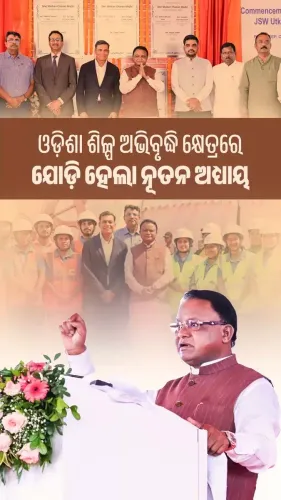
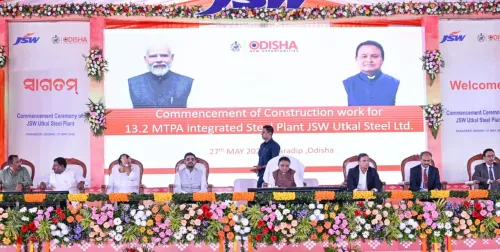
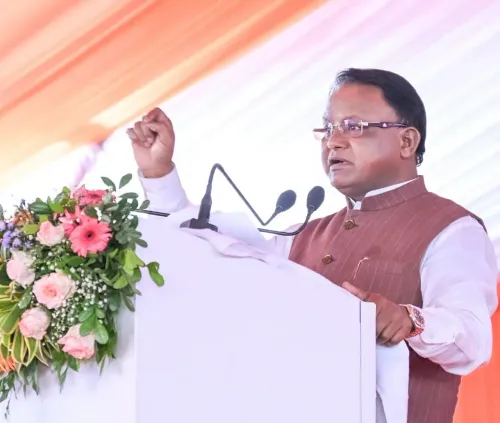
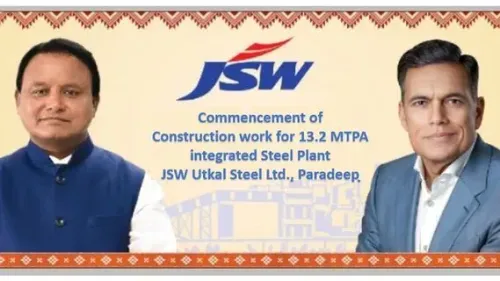
CM Majhi Launches JSW Mega Steel Plant Construction at Paradip
Synopsis
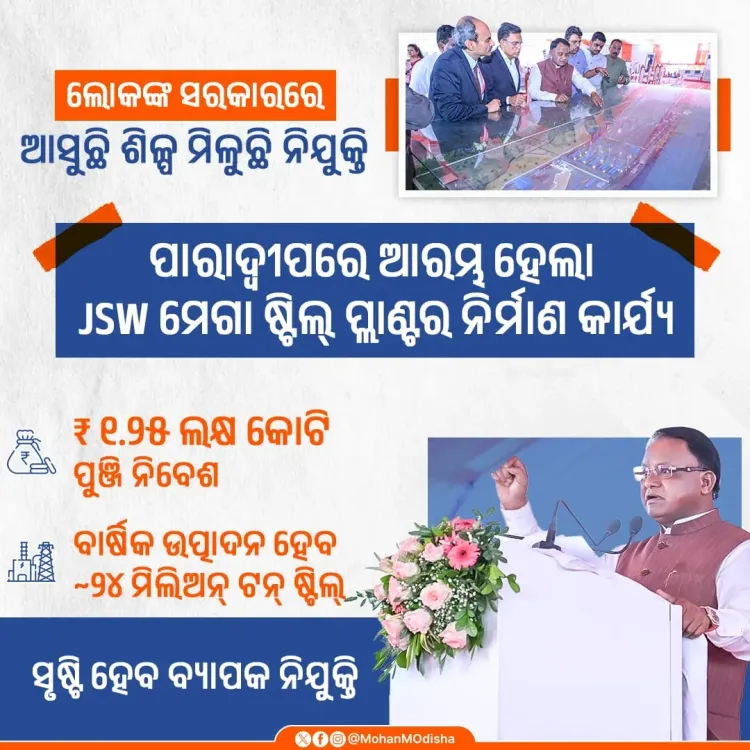
Odisha Chief Minister Mohan Charan Majhi has announced the commencement of construction on the JSW Mega Steel Plant at Paradip, backed by ₹1.25 lakh crore in investment. The project targets 24 million tonnes of annual steel production and aims to generate large-scale employment for Odisha's youth, reinforcing the state's industrial ambitions.
Key Takeaways
Construction of the JSW Mega Steel Plant at Paradip, Odisha has officially commenced.
The project involves an investment of ₹1.25 lakh crore , making it one of the largest industrial commitments in Odisha's history.
Projected annual steel production capacity stands at approximately 24 million tonnes .
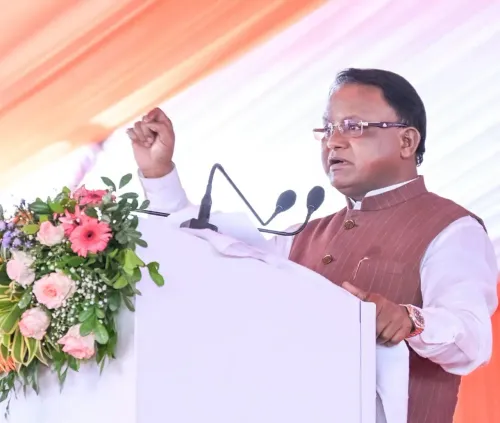
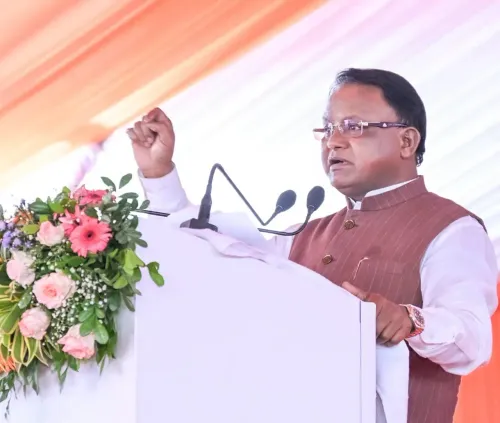
CM Mohan Charan Majhi stated the government is committed to industrial development and youth employment generation.
The plant aligns with the National Steel Policy 2017 target of 300 million tonnes national crude steel capacity by 2030.
The announcement continues Odisha's long-standing strategy of leveraging its mineral base and port infrastructure to attract private steel investment.
Odisha Chief Minister Mohan Charan Majhi announced on Wednesday, 27 May 2026 that construction has begun on the JSW Mega Steel Plant at Paradip, marking a landmark moment in the state's industrial ambitions. The project, backed by an investment of ₹1.25 lakh crore, is projected to produce approximately 24 million tonnes of steel annually and generate large-scale employment for local youth.
Context
Posting in Odia on X, CM Majhi declared: 'ଆମ ସରକାର ସଂକଳ୍ପବଦ୍ଧ' ('Our government is committed') to industrial development and creating extensive employment opportunities for the youth of Odisha. He described the project as one that will give Odisha a new identity in the industrial arena. The announcement was accompanied by the hashtag #InvestInOdisha, signalling the state's continued pitch to attract private capital.
Paradip, a deep-water port town in Jagatsinghpur district, has long been identified as a strategic location for a steel cluster, given its proximity to raw material sources and its port infrastructure capable of handling bulk cargo. The commencement of construction formalises years of planning around this corridor.
Policy Backdrop
Odisha has pursued large-scale steel investments through successive industrial policy frameworks, including the Odisha Industrial Policy 2015 and the series of Make in Odisha conclaves that offered incentives to attract mega projects. These efforts were aligned with the National Steel Policy 2017, which set a national crude steel capacity target of 300 million tonnes by 2030, explicitly encouraging capacity addition in mineral-rich states like Odisha and Chhattisgarh.
JSW Steel, one of India's largest private steel producers, has been expanding its footprint through greenfield projects in states with abundant iron ore reserves. Odisha, with its significant mineral base, has been a natural destination for such expansion. Other major players, including Tata Steel, have similarly deepened their presence in the state over the past two decades, establishing a pattern of private-sector-led industrial clustering.
Stakeholders and Impact
The primary beneficiaries cited by CM Majhi are local youth and the broader Odisha workforce, with the plant expected to create substantial direct and indirect employment in the steel and ancillary sectors. At an annual production capacity of 24 million tonnes, the plant would rank among the largest single-site steel facilities in the country, with significant downstream effects on logistics, construction, and services in the Paradip region.
The project also carries implications for the state's revenue base and economic diversification. Odisha's economy has historically leaned on mining and agriculture; a mega steel plant of this scale could accelerate a structural shift toward manufacturing, boosting the state's GDP contribution from the industrial sector.
What's Next
Attention will now turn to the phased rollout of construction milestones, as well as the status of land and environmental clearances required for a project of this magnitude. Skill-development and recruitment programmes tied to the plant are expected to be announced in subsequent phases, which will be closely watched by employment advocates and local communities in Jagatsinghpur and surrounding districts.
With Odisha positioning itself as a preferred destination for industrial investment under the #InvestInOdisha brand, the JSW plant's successful execution will serve as a critical proof point for the state government's ability to translate investment pledges into operational capacity — and ultimately into jobs for the next generation.
Point of View
Who has staked his government's early identity on industrial job creation in a state where youth unemployment remains a persistent concern. The ₹1.25 lakh crore investment figure, if realised, would represent one of the single largest private industrial commitments in eastern India, lending credibility to the BJP-led government's 'Viksit Odisha' narrative ahead of future electoral cycles. The move also fits into a broader national arc: central policy has consistently pushed mineral-rich states to add steel capacity domestically rather than export raw ore, and Odisha's port infrastructure at Paradip gives this project a logistical advantage that peers in landlocked regions lack. The real test, however, lies in execution — land acquisition, environmental compliance, and skill-linkage programmes will determine whether this announcement translates into durable economic transformation or joins the long list of announced-but-delayed mega projects in the state's industrial history.
NationPress
25 Sept 2026
Frequently Asked Questions
What is the JSW Mega Steel Plant at Paradip?
The JSW Mega Steel Plant at Paradip is a large greenfield steel facility in Odisha's Jagatsinghpur district, backed by an investment of ₹1.25 lakh crore and designed to produce approximately 24 million tonnes of steel annually.
Who announced the JSW steel plant construction in Odisha?
Odisha Chief Minister Mohan Charan Majhi announced the commencement of construction on 27 May 2026, stating that his government is committed to industrial development and employment for local youth.
How much will the JSW Paradip steel plant invest in Odisha?
The project involves an investment of ₹1.25 lakh crore, as stated by CM Mohan Charan Majhi in his official post on X.
How many jobs will the JSW Paradip plant create?
CM Majhi described the project as one that will create 'extensive employment opportunities' for Odisha's youth, though specific job numbers have not yet been officially announced.
Why is Paradip chosen for the JSW steel plant?
Paradip is a deep-water port town in Jagatsinghpur district with strong logistics infrastructure and proximity to Odisha's iron ore reserves, making it a strategic location for large-scale steel manufacturing.