CM Majhi Announces Odisha-Specific Blue Economy Plan

Synopsis
Odisha Chief Minister Mohan Charan Majhi has announced a dedicated state Blue Economy plan, promising modern fisheries infrastructure at Paradip, Dhamra, Gopalpur, Chandipur and Astrang to boost the state's maritime contribution and uplift coastal communities.
Key Takeaways
Chief Minister Mohan Charan Majhi announced on 9 July 2026 that Odisha is preparing a dedicated Blue Economy plan .
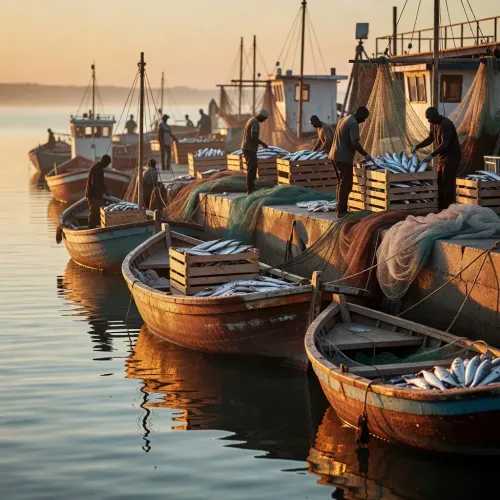
Modern fisheries infrastructure is planned at Paradip, Dhamra, Gopalpur, Chandipur and Astrang .
The plan aims to strengthen Odisha's contribution to India's national Blue Economy agenda.
The announcement builds on existing central schemes: the Sagarmala Project (2015) and PM Matsya Sampada Yojana (2020) .
Coastal fishermen, port operators and marine-sector investors are the primary stakeholders expected to benefit.
Budget, scope and implementation timelines for the Odisha Blue Economy plan have not yet been disclosed.
Odisha Chief Minister Mohan Charan Majhi announced on Thursday, 9 July 2026 that his government is preparing a dedicated Blue Economy plan for the state, pledging to build modern fisheries infrastructure across multiple coastal locations to strengthen Odisha's contribution to India's maritime growth agenda.
Context
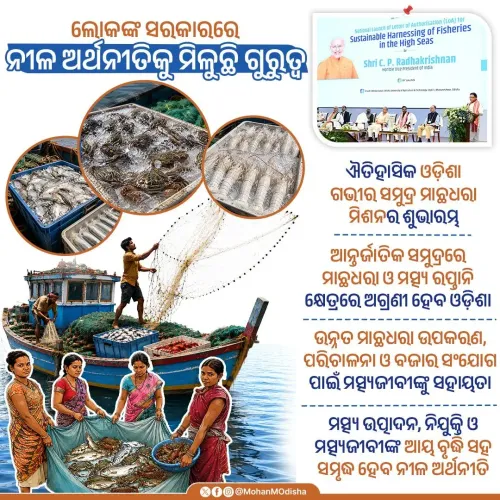
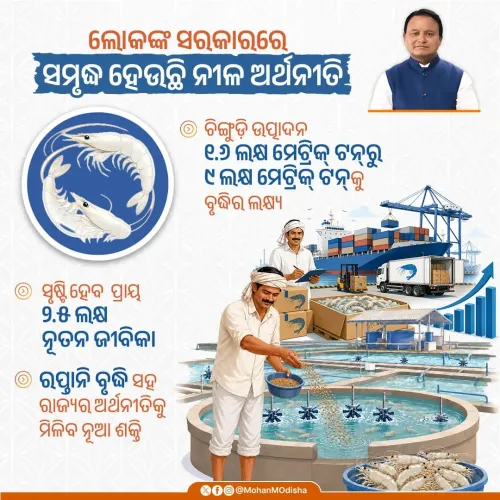
Posting in Odia on X, Chief Minister Majhi wrote: 'ନୀଳ ଅର୍ଥନୀତି ହେଉଛି ଓଡ଼ିଶାର ସମୃଦ୍ଧି ଓ ଉପକୂଳବର୍ତ୍ତୀ ଅଞ୍ଚଳର ବିକାଶର ନୂଆ ଦିଗ' — 'The Blue Economy is the new direction of Odisha's prosperity and the development of coastal areas.' He added that the 'people's government' is preparing a special Blue Economy scheme for Odisha, with continuous firm steps being taken to further strengthen the state's contribution to the country's Blue Economy by building state-of-the-art fisheries infrastructure in coastal areas.
The post specifically names Paradip, Dhamra, Gopalpur, Chandipur, and Astrang as locations earmarked for modern fisheries infrastructure development. The announcement signals a structured, state-level policy push rather than a standalone project.
Policy Backdrop
Odisha's Blue Economy announcement fits within a well-established national framework. The central government's Sagarmala Project, approved in 2015, promotes port-led development and coastal connectivity across India, with Odisha's major ports — Paradip in Jagatsinghpur district and Dhamra in Bhadrak district — already playing significant roles in bulk cargo and mineral exports.
The PM Matsya Sampada Yojana, launched in 2020, further targeted fisheries infrastructure upgrades and value-chain development in coastal states including Odisha. CM Majhi's proposed state-specific Blue Economy plan would layer a dedicated Odisha framework on top of these existing central schemes, potentially directing resources toward the smaller coastal nodes such as Gopalpur, Chandipur, and Astrang that have received comparatively less attention.
Stakeholders and Impact
Odisha's coastline stretches approximately 480 kilometres, supporting hundreds of thousands of coastal fishermen and their families whose livelihoods depend directly on the quality of landing infrastructure, cold-chain facilities, and market linkages. Upgraded fisheries infrastructure at the named locations could reduce post-harvest losses and improve income for artisanal and small-scale fishing communities.
Port operators and logistics firms stand to benefit from an expanded maritime services ecosystem, while the broader coastal economy — including tourism, aquaculture, and marine manufacturing — could see multiplier effects if the plan is implemented at scale. The announcement is also likely to be watched by investors in the fisheries processing and export sectors, given Odisha's proximity to major seafood markets.
What's Next
The immediate focus will be on the formal launch of the Odisha Blue Economy plan, including details of its scope, allocated budget, and implementation timelines — none of which have been disclosed in the post. Tendering processes for fisheries infrastructure projects at Paradip, Dhamra, Gopalpur, Chandipur, and Astrang will be a key indicator of the government's pace of execution.
If the state follows through with a comprehensive plan that complements central schemes, Odisha could emerge as a model for state-driven Blue Economy governance — a template that other coastal states may look to replicate as India accelerates its maritime ambitions.
Point of View
Which could resonate with artisanal fishing communities often left out of large-port development stories. The framing of a 'people's government' preparing a 'special scheme' also reflects a deliberate effort by the BJP administration, in power since 2024, to establish its own policy identity distinct from the previous government's legacy. The real test will come when budgetary allocations and tender timelines are made public — only then will it be possible to assess whether this is a substantive policy shift or a high-visibility declaration.
NationPress
8 Oct 2026
Frequently Asked Questions
What is the Odisha Blue Economy plan announced by CM Majhi?
It is a proposed state-specific framework announced by Chief Minister Mohan Charan Majhi on 9 July 2026 to develop modern fisheries infrastructure at coastal locations including Paradip, Dhamra, Gopalpur, Chandipur and Astrang, with the aim of boosting Odisha's contribution to India's Blue Economy. Detailed budget and timelines have not yet been disclosed.
Which coastal areas will benefit from Odisha's Blue Economy scheme?
CM Majhi specifically named Paradip, Dhamra, Gopalpur, Chandipur and Astrang as locations earmarked for state-of-the-art fisheries infrastructure under the new Blue Economy plan.
How does Odisha's Blue Economy plan relate to central government schemes?
Odisha's plan complements existing central programmes: the Sagarmala Project (2015), which promotes port-led coastal development, and the PM Matsya Sampada Yojana (2020), which targets fisheries infrastructure upgrades in coastal states including Odisha.
Who will benefit from Odisha's Blue Economy infrastructure push?
Coastal fishermen and their families stand to gain most directly through improved landing and cold-chain facilities. Port operators, marine logistics firms, aquaculture businesses and seafood exporters are also expected to benefit from an expanded maritime services ecosystem.
What is the Blue Economy and why is it important for Odisha?
The Blue Economy refers to the sustainable use of ocean and coastal resources for economic growth, including fisheries, ports, shipping and marine tourism. With a coastline of approximately 480 kilometres and major ports at Paradip and Dhamra, Odisha is well-positioned to be a significant contributor to India's national Blue Economy ambitions.