CM Manik Saha orders daily Vande Mataram in Tripura schools
Synopsis
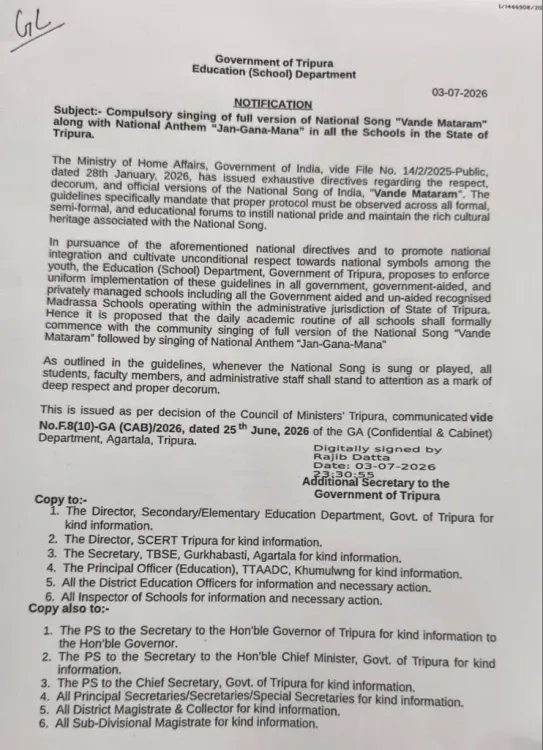
Tripura Chief Minister Dr. Manik Saha has directed all schools in the state to begin each day with a full collective rendition of 'Vande Mataram' followed by 'Jana Gana Mana', citing goals of patriotism, discipline, and national consciousness among students.
Key Takeaways
Manik Saha has ordered all state schools to sing 'Vande Mataram' in full, followed by 'Jana Gana Mana' , at the start of every school day.
The directive is aimed at strengthening patriotism, discipline, and national consciousness among school students.
Both the national song and national anthem were adopted by India's Constituent Assembly in 1950 .
The move aligns with the National Education Policy 2020 's emphasis on constitutional values and cultural rootedness in schools.
Similar mandates have been introduced in BJP -governed states including Gujarat , Madhya Pradesh , and Rajasthan over the past decade.
Implementation guidelines from the Tripura Education Department , including district-wise rollout, are awaited.
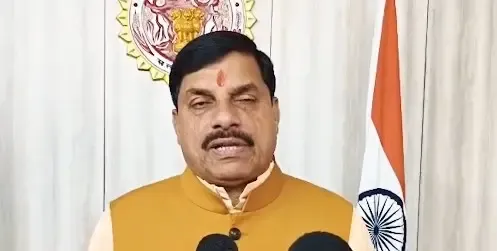
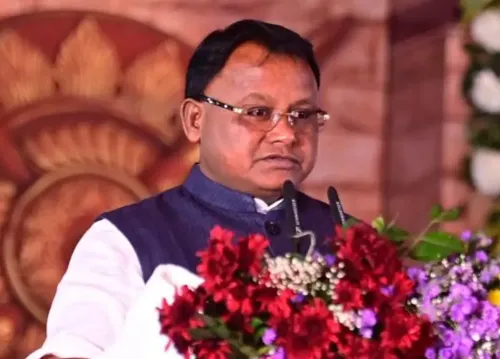
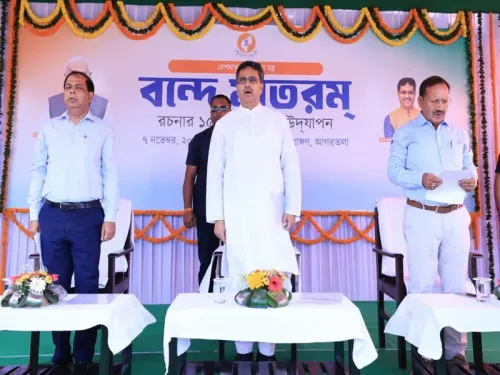
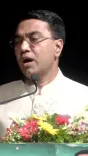
Tripura Chief Minister Dr. Manik Saha announced on Tuesday, 7 July 2026 that the state government has mandated the daily singing of the national song 'Vande Mataram' followed by the national anthem 'Jana Gana Mana' in all schools across Tripura before classes begin. The directive, shared by the Chief Minister on X, frames the move as a step toward deepening patriotism, discipline, and national consciousness among students.
In his post, Dr. Saha wrote in Bengali: 'শিক্ষার্থীদের মধ্যে দেশপ্রেম, শৃঙ্খলা ও জাতীয় চেতনা আরও সুদৃঢ় করতে ত্রিপুরা সরকার একটি গুরুত্বপূর্ণ সিদ্ধান্ত গ্রহণ করেছে' [The Tripura government has taken an important decision to further strengthen patriotism, discipline and national consciousness among students]. He added that the effort is aimed at building national unity, respect for cultural heritage, and a sense of responsibility toward the state, with the goal of shaping the next generation into more aware and patriotic citizens.
Context
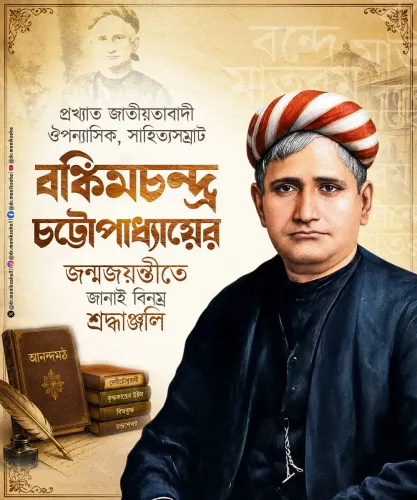
The order makes the full collective rendition of 'Vande Mataram' the first activity of every school day, followed immediately by 'Jana Gana Mana'. 'Vande Mataram', composed by Bankim Chandra Chattopadhyay, was adopted as India's national song by the Constituent Assembly in 1950, the same year 'Jana Gana Mana' was formally designated the national anthem. While the national anthem carries a statutory obligation in specific contexts, the national song has historically been observed on a voluntary or institutional basis.
Dr. Manik Saha, a dentist-turned-politician who has served as Chief Minister of Tripura since May 2022, has consistently emphasised cultural nationalism as a pillar of his administration. Tripura, a northeastern state bordering Bangladesh, has been governed by the BJP since 2018, ending decades of Left Front rule.
Policy Backdrop
The directive aligns with the National Education Policy 2020, which recommends instilling constitutional values, patriotism, and cultural rootedness through school curricula. The move also follows a broader pattern among BJP-governed states — including Gujarat, Madhya Pradesh, and Rajasthan — that have introduced mandates for daily recitation or singing of national symbols in educational institutions over the past decade.
A Supreme Court order in 2016 had made playing of the national anthem compulsory in cinema halls before feature films, signalling judicial recognition of such mandates in public spaces. The Tripura order extends a comparable logic into the school environment, embedding the practice within the daily academic routine rather than reserving it for special occasions.
Stakeholders and Impact
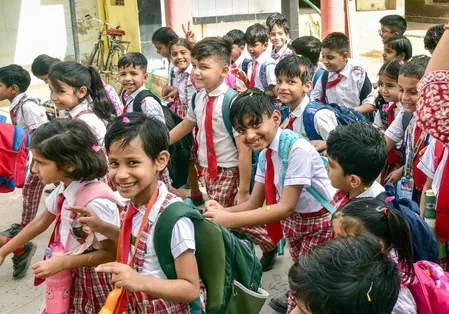
The directive directly affects school students and teachers across all government and, potentially, private schools in Tripura. Teachers will be responsible for organising the daily assembly performance, adding a structured patriotic element to the start of the school day. Students from the earliest grades upward will participate in the collective singing of both compositions.
Supporters of the measure argue it fosters a shared sense of national identity and cultural pride from an early age. However, mandating the national song — as distinct from the national anthem — in schools may draw scrutiny from educators and civil society groups who distinguish between voluntary cultural participation and institutional compulsion.
What's Next
Attention will now turn to the Tripura Education Department for detailed implementation guidelines, including the rollout timeline across all districts, provisions for schools with multilingual student bodies, and any exemptions. Responses from teachers' associations and the state assembly will be closely watched. If the order is implemented uniformly and without significant friction, it could serve as a model that other BJP-ruled states reference in their own school policy frameworks.
Point of View
The order elevates the national song to near-parity with the legally recognised anthem, a symbolic choice with political resonance. The framing around NEP 2020's cultural-rootedness goals gives the directive an administrative cover that makes it harder to contest on procedural grounds. How Tripura's diverse, multilingual student population and its teachers' bodies respond will determine whether this becomes a replicable template or a friction point in the state's education system.
NationPress
7 Jul 2026
Frequently Asked Questions
What has the Tripura government decided about schools?
The Tripura government has mandated that all schools in the state begin each day with a full collective singing of 'Vande Mataram' followed by 'Jana Gana Mana' before classes start.
Who announced the Vande Mataram order in Tripura schools?
Tripura Chief Minister Dr. Manik Saha announced the directive on 7 July 2026 via a post on X, stating the goal is to deepen patriotism and national consciousness among students.
Is Vande Mataram compulsory in Indian schools?
There is no central law making 'Vande Mataram' compulsory in schools nationwide. Individual state governments, including Tripura now, can issue directives for their own schools. The national anthem 'Jana Gana Mana' carries stronger statutory backing in specific public contexts.
Which other states have made Vande Mataram mandatory in schools?
BJP-governed states including Gujarat, Madhya Pradesh, and Rajasthan have introduced similar mandates for daily recitation or singing of national symbols in schools over the past decade.
What is the difference between Vande Mataram and Jana Gana Mana?
'Jana Gana Mana' is India's national anthem, formally adopted in 1950 and carrying statutory obligations in certain public contexts. 'Vande Mataram', composed by Bankim Chandra Chattopadhyay, is the national song, also adopted in 1950, but observed on a more institutional or voluntary basis.