Vande Mataram compulsory in Bengal schools: Parties back move, flag secular concerns

Synopsis
Every major political party in West Bengal — including the opposition TMC, Congress, and CPI(M) — has backed the BJP state government's order making Vande Mataram compulsory in schools, a striking show of cross-party consensus. But each party's support came with the same quiet caveat: secularism and the national anthem must not be compromised — a signal that the political peace around this directive may be thinner than it appears.
Key Takeaways
The West Bengal government on 13 May directed all state-run and aided schools to make Vande Mataram compulsory at morning assemblies, with immediate effect.
BJP leader Shatorupa welcomed the order, saying it would instil patriotism after the previous TMC government had discontinued the practice.
TMC spokesperson Arup Chakraborty backed the move but urged that secularism and brotherhood not be overshadowed.
Congress leader Ashutosh Chatterjee and CPI(M) leader Kaustav Chatterjee also expressed support while stressing the national anthem must not be compromised.
The directive follows a proposed Union government amendment to the Prevention of Insults to National Honour Act, 1971 , which would criminalise obstruction to the singing of Vande Mataram.
Previously, the TMC government had introduced 'Banglar Mati Banglar Jol' — penned by Rabindranath Tagore in 1905 — as the state song in schools.
The West Bengal government's directive making the singing of 'Vande Mataram' compulsory in all state-run and aided schools during morning assemblies has drawn broad cross-party support, even as opposition parties cautioned that the national anthem 'Jana Gana Mana' and constitutional values of secularism must not be sidelined. The order, issued by the Director of Education on 13 May, takes effect immediately.
The Government Directive
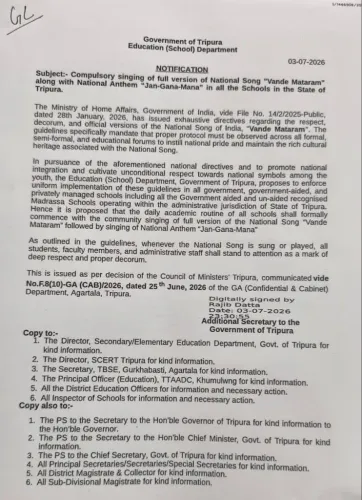
The state education department communicated to school heads on 13 May that 'Vande Mataram' must be sung by all students at the start of every school day, prior to the commencement of classes. Heads of institutions have been directed to ensure strict compliance. Previously, schools in the state had traditionally sung only the national anthem, 'Jana Gana Mana', composed by Rabindranath Tagore.
This comes shortly after the Union government initiated steps to strengthen provisions related to respect for national symbols, including a proposed amendment to the Prevention of Insults to National Honour Act, 1971, that would make obstruction to the singing of Vande Mataram a punishable offence.
BJP Welcomes the Move
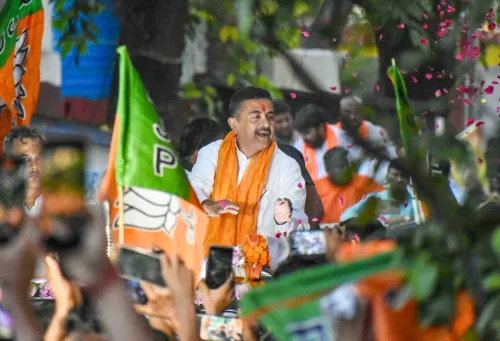
Bharatiya Janata Party (BJP) leader Shatorupa said the directive would foster patriotism among the younger generation. 'The entire country has been singing Vande Mataram. The previous Trinamool Congress government had stopped it in West Bengal. Now the Bharatiya Janata Party government has implemented it once more. We welcome the decision. This will help instil a sense of patriotism among students,' she said.
The BJP has long advocated for the national song's inclusion in school routines, making the directive a significant political milestone for the party in the state.
Trinamool, Congress and Left Echo Conditional Support
All India Trinamool Congress (TMC) spokesperson Arup Chakraborty said the party had no objection, noting the song's Bengali literary roots. 'The song was written by a Bengali. It helps take Bengal's traditions and cultural values forward. We have no objection to it. But it must be ensured that the message of secularism, brotherhood, and amity is not overshadowed by this,' he said.
Congress leader Ashutosh Chatterjee also welcomed the decision but added a caveat: 'No one should have any objection or reservation to this. We welcome the decision to sing Vande Mataram in schools. But we must not oppose Rabindranath Tagore and his songs in any way.'
Communist Party of India (Marxist) leader Kaustav Chatterjee struck a similar note. 'There is no objection to singing Vande Mataram. But the national anthem must not be compromised. We have to protect the Constitution and secularism. That aspect must not be overlooked,' he said.
Historical and Cultural Context
Under the previous Trinamool Congress government, schools had introduced 'Banglar Mati Banglar Jol' — also penned by Tagore in 1905 during protests against the partition of Bengal — as the state song. Critics had at the time pointed to the sidelining of Vande Mataram from school routines as a political choice. The new directive effectively reverses that position.
Notably, Vande Mataram was composed by Bankim Chandra Chattopadhyay and holds the status of India's national song, distinct from the national anthem. Its compulsory inclusion in school assemblies has periodically sparked debate across states on questions of cultural identity and religious inclusivity.
What Happens Next
With all major political formations in the state — BJP, TMC, Congress, and CPI(M) — publicly backing the directive, implementation is unlikely to face organised political resistance. However, the recurring refrain across party lines about safeguarding secularism and the primacy of the national anthem signals that the conversation around the directive's framing is far from settled. How school administrations navigate compliance will be closely watched in the weeks ahead.
Point of View
But none wants to own the cultural politics behind it either. The BJP secured a symbolic win; the opposition secured deniability. What the directive actually changes in classrooms is secondary to what it signals politically: that in Bengal, even the left and the TMC now find it electorally safer to endorse the national song than to question it. The real test will come if the Centre's proposed amendment to the Prevention of Insults to National Honour Act passes — at that point, the conditional support of the opposition will face a harder choice.
NationPress
15 Sept 2026
Frequently Asked Questions
What has the West Bengal government ordered regarding Vande Mataram in schools?
The West Bengal government directed all state-run and state-aided schools to make the singing of Vande Mataram compulsory during morning assemblies, with immediate effect from 13 May. The Director of Education issued the communication to school heads, mandating strict compliance.
How have political parties in West Bengal reacted to the Vande Mataram directive?
All major parties — BJP, TMC, Congress, and CPI(M) — welcomed the directive. However, TMC, Congress, and CPI(M) each added that the national anthem Jana Gana Mana must not be compromised and that secularism must be upheld.
Was Vande Mataram previously sung in West Bengal schools?
Under the previous Trinamool Congress government, the practice of singing Vande Mataram in schools had been discontinued. The TMC government had instead introduced 'Banglar Mati Banglar Jol', penned by Rabindranath Tagore in 1905, as the state song.
What is the difference between Vande Mataram and Jana Gana Mana?
Jana Gana Mana is India's national anthem, composed by Rabindranath Tagore, and its singing is constitutionally mandated at official occasions. Vande Mataram, composed by Bankim Chandra Chattopadhyay, holds the status of India's national song — a distinction that has historically fuelled debate about its compulsory inclusion.
Is there a proposed central law related to Vande Mataram?
Yes. The Union government has reportedly initiated steps to amend the Prevention of Insults to National Honour Act, 1971, which would make obstruction to the singing of Vande Mataram a punishable offence. The West Bengal directive comes in that broader national context.