CM Bhagwant Mann Hails Chandigarh's Adoption of Punjab Right to Business Act
Synopsis
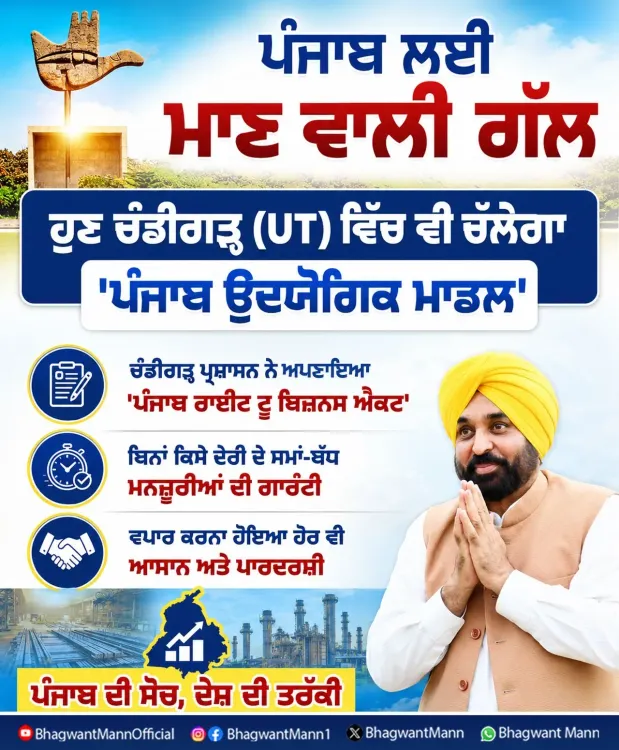
Punjab CM Bhagwant Mann has welcomed Chandigarh UT's decision to adopt the Punjab Right to Business Act, which guarantees time-bound business approvals and protection from inspector raj. Mann called it a major recognition of the 'Punjab Model' and reaffirmed his commitment to making Punjab India's most preferred industrial destination.
Key Takeaways
Chandigarh Administration (UT) has decided to adopt the Punjab Right to Business Act , as announced by CM Bhagwant Mann on 28 May 2026 .
The Act provides a legal guarantee of time-bound approvals for businesses and protection from excessive regulatory inspections ( inspector raj ).
Mann described the development as a major recognition of Punjab's industry-friendly policies and a source of pride for the state.
The CM stated that the success of the 'Punjab Model' is now resonating in other states and Union Territories across India.
The development positions the AAP government's legislative framework as an exportable governance template under competitive federalism.
Focus now shifts to implementation timelines within Chandigarh UT and potential adoption by additional states.
Punjab Chief Minister Bhagwant Mann on Thursday, 28 May 2026, welcomed the Chandigarh Administration (Union Territory)'s decision to adopt the Punjab Right to Business Act, calling it a major recognition of the state's industry-friendly policies and a matter of pride for all Punjabis.
Context
Posting in Punjabi on X, Mann wrote: 'ਪੰਜਾਬ ਦੀਆਂ ਉਦਯੋਗ ਪੱਖੀ ਨੀਤੀਆਂ ਨੂੰ ਵੱਡੀ ਮਾਨਤਾ' ['A major recognition for Punjab's industry-friendly policies'], adding that it is 'a matter of great pride for all of us' that Chandigarh UT Administration has decided to adopt the 'Punjab Right to Business Act' — referred to as a law of 'ਤੁਹਾਡੀ ਸਰਕਾਰ' ['your government']. He further said the law provides a 'legal guarantee of time-bound approvals for businesses and protection from inspector raj.'
Mann also noted that 'today the echo of the success of the Punjab Model is being heard in other states and Union Territories as well,' reaffirming his government's commitment to making Punjab the country's most preferred destination for industry.
Policy Backdrop
The Punjab Right to Business Act is a legislative framework enacted by the Aam Aadmi Party government in Punjab, designed to guarantee time-bound clearances for businesses and shield entrepreneurs from excessive regulatory inspections — a practice commonly referred to as inspector raj. The Act represents a legal, enforceable commitment rather than a mere administrative guideline, distinguishing it from earlier single-window clearance mechanisms introduced by other states.
The broader national push for ease of doing business gained momentum after the Government of India launched its Ease of Doing Business initiative and Business Reforms Action Plan in 2014, prompting states to compete in reducing regulatory burdens. States such as Maharashtra and Gujarat introduced time-bound approval systems between 2015 and 2020, but Punjab's approach of encoding these guarantees into a standalone statute adds a layer of legal accountability.
Stakeholders and Impact
Businesses and industries operating in or considering investment in Chandigarh stand to benefit most directly, as the UT's adoption of the Act means entrepreneurs will be entitled to approvals within defined timelines and protected from arbitrary inspections. For the AAP government in Punjab, the development is politically significant — it positions the 'Punjab Model' as an exportable governance template rather than a state-specific experiment.
Under competitive federalism, Union Territories and states frequently benchmark and replicate successful policy experiments. Chandigarh's geographic and administrative proximity to Punjab makes it a natural first adopter, but Mann's post signals an ambition for wider replication across India.
What's Next
Attention will now turn to the rollout timelines and actual implementation of the adopted Act within Chandigarh UT, including whether the UT administration frames its own supplementary rules or adopts Punjab's framework wholesale. Observers will also watch whether additional states or Union Territories announce similar adoptions, which would lend further credibility to Mann's claim of a growing 'Punjab Model' resonance nationally.
For Bhagwant Mann and the AAP, the development offers a governance narrative ahead of future electoral cycles — that policy innovation in Punjab is setting benchmarks for the rest of the country.
Point of View
It serves a dual purpose: demonstrating governance credibility and building a 'Punjab Model' brand that can travel across state lines. In the context of competitive federalism, a Union Territory adopting a state's law wholesale is relatively uncommon and signals the Act's perceived robustness. The broader political subtext is that AAP, which has struggled to expand electorally beyond Punjab and Delhi, can now point to policy adoption as a form of ideological influence even where it does not hold power.
NationPress
23 Sept 2026
Frequently Asked Questions
What is the Punjab Right to Business Act?
The Punjab Right to Business Act is a law enacted by the AAP government in Punjab that provides businesses a legal guarantee of time-bound approvals from government departments and protects entrepreneurs from excessive or arbitrary inspections, commonly known as inspector raj.
Why has Chandigarh adopted the Punjab Right to Business Act?
Chandigarh Administration decided to adopt the Punjab Right to Business Act to extend similar industry-friendly protections — time-bound clearances and curbs on inspector raj — to businesses operating in the Union Territory, as announced by Punjab CM Bhagwant Mann on 28 May 2026.
What is the 'Punjab Model' that Bhagwant Mann refers to?
The 'Punjab Model' refers to the AAP government's package of governance and industry-friendly reforms in Punjab, including the Right to Business Act, which Mann says is gaining recognition in other states and Union Territories as a replicable framework for attracting investment.
How does the Punjab Right to Business Act protect businesses from inspector raj?
The Act legally restricts the frequency and scope of government inspections on businesses and mandates that approvals be granted within defined timeframes, removing the discretionary power that officials previously had to delay clearances or conduct repeated inspections.
Which other states have similar ease of doing business laws?
States such as Maharashtra and Gujarat introduced time-bound approval and single-window clearance mechanisms between 2015 and 2020 as part of the national Ease of Doing Business initiative, though Punjab's approach of encoding these guarantees in a standalone statute adds a distinct layer of legal enforceability.