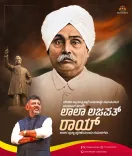
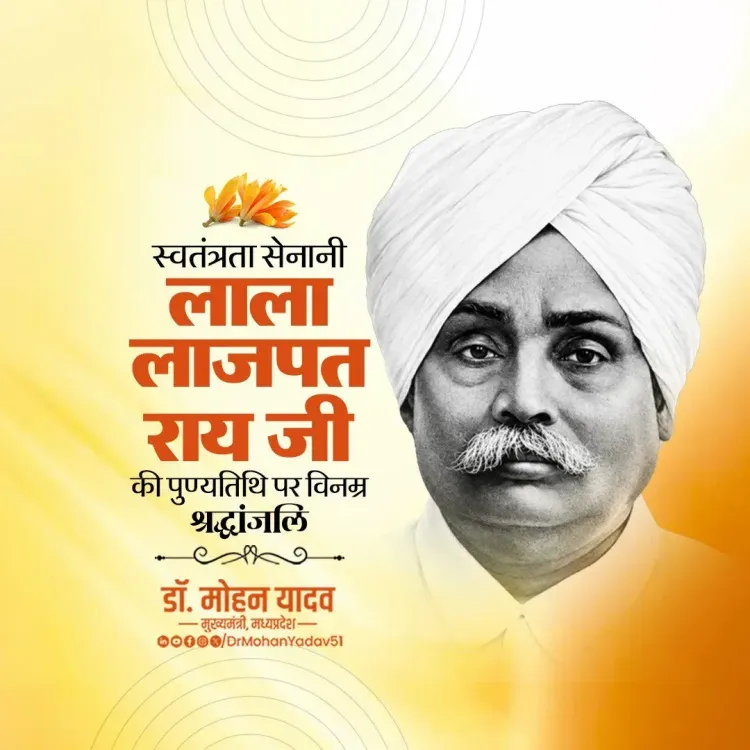
CM Mohan Yadav Pays Tribute to Lala Lajpat Rai on Death Anniversary
Synopsis
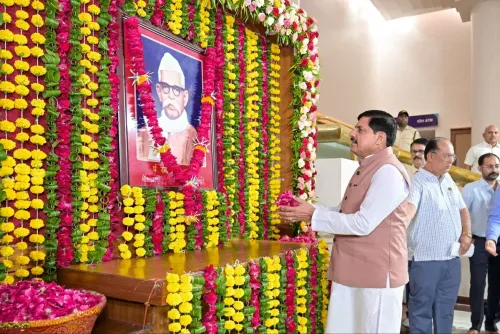
On the 98th death anniversary of Lala Lajpat Rai, Madhya Pradesh Chief Minister Dr. Mohan Yadav honoured the independence icon, recalling his founding of the Indian Home Rule League of America in 1917 and his ultimate sacrifice following the Simon Commission protests.
Key Takeaways
Lala Lajpat Rai died on 17 November 1928 from injuries sustained during protests against the Simon Commission in Lahore .
He founded the Indian Home Rule League of America in 1917 , mobilising diaspora and international support for Indian self-rule.
Known as Punjab Kesari (Lion of Punjab), he was a lawyer, journalist, and independence activist of the first order.
Mohan Yadav posted the tribute on 17 November 2026 , emphasising Rai's themes of self-reliance and anti-colonial resolve.
BJP leaders routinely mark Rai's anniversary, connecting his philosophy of self-reliance to contemporary national policy.
Ninety-eight years after Lala Lajpat Rai fell to injuries sustained on a protest line in Lahore, Madhya Pradesh Chief Minister Dr. Mohan Yadav paused on Tuesday, 17 November 2026 to honour the man Indians still call Punjab Kesari — the Lion of Punjab.
In his post, Dr. Yadav wrote: 'Swavlamban se Swarajya ka sankalp jagrit kar unhone America tak Indian Home Rule League of America ki chingari sulagayi' — 'By awakening the resolve for self-rule through self-reliance, he lit the spark of the Indian Home Rule League of America all the way in the United States.' The tribute called his contribution to India's freedom struggle 'unforgettable.'
The Man Who Carried India's Fight Across the Atlantic
Lala Lajpat Rai was among the most formidable figures of the pre-independence era — a lawyer, journalist, and orator who understood that colonial rule had to be challenged on every front, including diplomatic and diaspora ones. During his time in the United States, he founded the Indian Home Rule League of America in 1917, channelling the energy of the Indian diaspora and international sympathisers toward the cause of self-rule at a moment when World War I had scrambled global politics.
That act was quietly radical. At a time when the British Empire still projected invincibility, Rai was building anti-colonial infrastructure on foreign soil — framing India's freedom not as a domestic petition but as an international moral cause. The League amplified Indian voices in Western public discourse years before independence became a mainstream global conversation.
17 November 1928: A Date That Did Not Fade
Lala Lajpat Rai died on 17 November 1928, weeks after leading protests against the all-British Simon Commission — a parliamentary committee tasked with reviewing India's constitutional future that included no Indian members. During the demonstration in Lahore, police baton-charged the marchers. Rai, struck repeatedly, is reported to have declared that every blow would become a nail in the coffin of British rule. He died from his injuries 18 days later. His death galvanised a generation, directly inspiring the events that followed in the independence movement.
His death anniversary has since anchored annual commemorations across India, particularly in Punjab and among BJP leaders who regularly invoke his themes of self-reliance — a philosophical thread that maps closely onto contemporary policy vocabulary around Atmanirbhar Bharat (self-reliant India).
Nearly a century on, the Lion of Punjab's legacy endures not just as history — but as a living argument for what conviction, carried far enough, can achieve.
Point of View
With Lala Lajpat Rai's emphasis on self-reliance lending historical depth to the party's contemporary Atmanirbhar Bharat framework. The specific call-out of the Indian Home Rule League of America is notable — it frames India's freedom struggle as a global diplomatic campaign, not merely a domestic agitation, which carries resonance as India courts its diaspora more assertively in foreign policy. For state-level leaders, such anniversaries serve a dual purpose: affirming national cultural memory while reinforcing regional pride, particularly in the broader northern heartland BJP base. The tribute is ceremonial, but its vocabulary is carefully chosen.
NationPress
17 Nov 2026
Frequently Asked Questions
When did Lala Lajpat Rai die and why?
Lala Lajpat Rai died on 17 November 1928 in Lahore from injuries sustained when police baton-charged protesters demonstrating against the Simon Commission, the all-British parliamentary panel reviewing India's constitutional future.
What was the Indian Home Rule League of America?
The Indian Home Rule League of America was an organisation founded by Lala Lajpat Rai in 1917 during his time in the United States, aimed at building international and diaspora support for Indian independence.
Why is Lala Lajpat Rai called Punjab Kesari?
Punjab Kesari , meaning 'Lion of Punjab,' was the title given to Lala Lajpat Rai in recognition of his fierce and fearless leadership in India's independence movement, particularly in the Punjab region.
What did CM Mohan Yadav say about Lala Lajpat Rai?
On 17 November 2026 , Madhya Pradesh Chief Minister Dr. Mohan Yadav paid tribute to Lala Lajpat Rai on his death anniversary, praising his resolve to achieve self-rule through self-reliance and his founding of the Indian Home Rule League of America.
What was the Simon Commission that Lala Lajpat Rai protested against?
The Simon Commission was a British parliamentary committee formed to review India's constitutional arrangements; it was widely boycotted by Indian leaders because it included no Indian members, making it a symbol of colonial exclusion.