CM Mohan Yadav Welcomes Nadda to Bhopal for 'Save Democracy' March

Synopsis
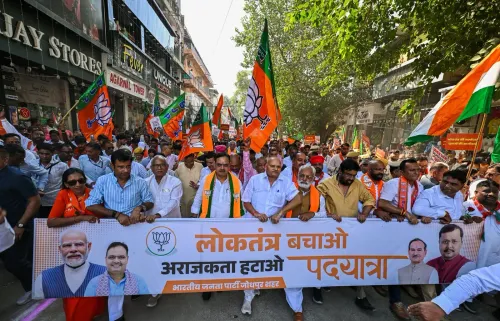
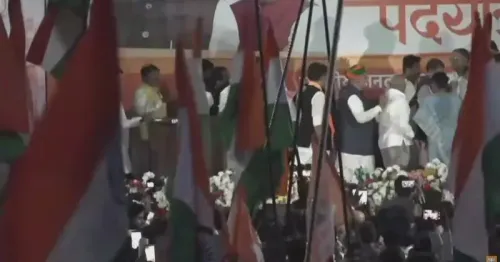
Madhya Pradesh CM Dr. Mohan Yadav welcomed BJP National President J.P. Nadda to Bhopal on 4 November 2026 for the 'Loktantra Bachao – Anarchtata Hatao' padyatra, framing the march as a defence of democracy against opposition-led disorder.
Key Takeaways
BJP National President J.P.
Nadda arrived in Bhopal on 4 November 2026 to participate in the 'Loktantra Bachao – Anarchtata Hatao' padyatra.
Mohan Yadav extended a formal welcome on behalf of all residents of Madhya Pradesh.
The event's hashtag #SaveDemocracyRemoveAnarchy frames the march as a counter to what BJP characterises as opposition-driven anarchy.
Bhopal, historically known as the city of Raja Bhoj , serves as the venue — adding symbolic resonance to the gathering.
The padyatra reflects BJP's standard inter-election mobilisation strategy in states it governs, particularly after its 2023 assembly election victory in Madhya Pradesh.
Nadda's physical presence at a state-level event signals that the party's central leadership is treating Madhya Pradesh as a flagship political showcase.
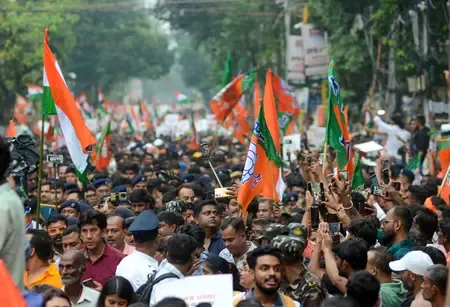
The streets of Bhopal are set for a show of political muscle on Wednesday, 4 November 2026, as Madhya Pradesh Chief Minister Dr. Mohan Yadav extended a formal welcome to Union Minister and BJP National President J.P. Nadda ahead of the party's 'Loktantra Bachao – Anarchtata Hatao' (Loktantra Bachao – Anarchtata Hatao) padyatra in the state capital.
Posting on X, Dr. Yadav greeted Nadda on behalf of the people of Madhya Pradesh, writing warmly of Raja Bhoj's city — Bhopal's historic epithet — as the venue for the march. The hashtag #SaveDemocracyRemoveAnarchy framed the event explicitly as a counter-narrative exercise, signalling that the BJP intended the padyatra to carry a pointed political message about governance and what it characterises as opposition-led disorder.
Nadda in Bhopal: Party Chief Anchors the March
The arrival of J.P. Nadda — simultaneously the country's most senior BJP office-bearer and a Union Cabinet minister — gives the padyatra unusual organisational weight. When a national party president physically participates in a state-level programme, it typically signals that the event is meant to set the tone for a wider political cycle, not merely tick a local mobilisation box. Madhya Pradesh, which the BJP reclaimed decisively in the 2023 assembly elections, remains a flagship state the party is determined to hold and showcase.
Dr. Yadav, who took charge as Chief Minister in December 2023, has consistently co-ordinated closely with the central party leadership on outreach programmes. The padyatra format — a walking rally through urban or semi-urban stretches — is a staple of BJP's between-election mobilisation playbook: it is visible, media-friendly, and allows the party to interact directly with citizens rather than relying solely on rallies.
'Loktantra Bachao': The Message Behind the March
The slogan 'Save Democracy, Remove Anarchy' is an unmistakable broadside at the opposition, casting the BJP as the defender of constitutional order against what the party frames as disruptive political conduct. Such sloganeering during inter-election periods serves a dual purpose: it keeps the party base energised and shapes the vocabulary of public debate ahead of future electoral contests.
Bhopal, as both the state capital and a city with deep historical resonance — named after the legendary king Raja Bhoj — provides a symbolically loaded backdrop. Hosting the national president here underlines that Madhya Pradesh is not merely a state the BJP governs, but one it uses as a model and a stage.
With Nadda on the ground and the Chief Minister leading the welcome, the BJP is making clear that in Madhya Pradesh, the state machinery and the party organisation are moving in lockstep — a unity of purpose that will define the political weather in the state for the months ahead.
Point of View
The party signals that Madhya Pradesh — won emphatically in 2023 — is being groomed as a template for governance-plus-mobilisation. The slogan is calibrated: 'democracy under threat' is a universally legible frame that simultaneously rallies the base and pressures opposition parties to respond on BJP's chosen terrain. For CM Yadav, hosting Nadda reinforces his standing as a trusted state-level co-ordinator of the central party's agenda.
NationPress
4 Nov 2026
Frequently Asked Questions
What is the 'Loktantra Bachao Anarchtata Hatao' padyatra?
It is a BJP-organised walking rally in Bhopal, Madhya Pradesh, held on 4 November 2026, under the slogan 'Save Democracy, Remove Anarchy', aimed at political mobilisation and messaging against what the party frames as opposition-driven disorder.
Why did JP Nadda visit Bhopal on 4 November 2026?
JP Nadda, BJP National President and Union Minister, visited Bhopal to participate in the 'Loktantra Bachao – Anarchtata Hatao' padyatra alongside Madhya Pradesh Chief Minister Dr. Mohan Yadav.
Who is Dr. Mohan Yadav?
Dr. Mohan Yadav is the Chief Minister of Madhya Pradesh, a post he has held since December 2023, and a senior leader of the Bharatiya Janata Party.
Why is Bhopal called the city of Raja Bhoj?
Bhopal, the capital of Madhya Pradesh, is historically associated with the legendary Paramara king Raja Bhoj, a celebrated patron of learning and arts, and the city's name is popularly traced to his legacy.
What does the BJP's padyatra strategy aim to achieve between elections?
BJP uses padyatras as a between-election mobilisation tool to maintain direct contact with citizens, energise party workers, and set the political narrative — especially in key states like Madhya Pradesh that it governs and treats as flagship models.