CM Nayab Saini: Haryana to Welcome First Agniveer Batch in November
Synopsis
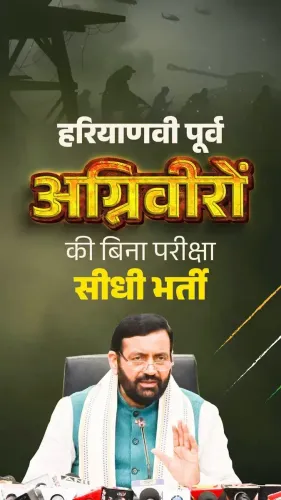
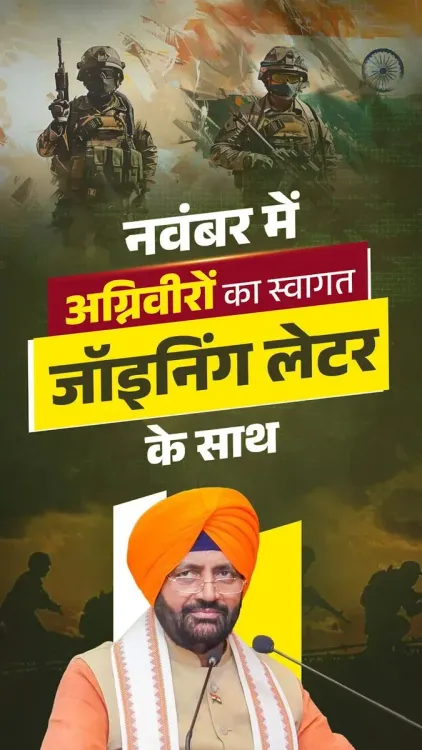
Haryana Chief Minister Nayab Singh Saini announced that the first batch of Agniveers from the state will be formally welcomed with joining letters in November, marking the first tangible output of the Agnipath scheme in Haryana since its contested 2022 launch.
Key Takeaways
Haryana CM Nayab Singh Saini announced on 25 October 2026 that the first Agniveer batch will receive joining letters in November .
The Agnipath scheme was launched by the Union Government in June 2022 , offering four-year contractual military service with a 25 percent permanent retention option.
Haryana is a historically significant military-recruitment state, with districts like Rohtak and Mahendragarh having deep traditions of armed-forces service.
The November joining ceremony will be the first concrete public proof point of the Agnipath scheme delivering recruits in Haryana.
The scheme faced protests at launch, but BJP-ruled states including Haryana backed it and promised state-police reservations for exiting Agniveers.
Haryana is about to mark a milestone in the country's contested defence recruitment overhaul. Haryana Chief Minister Nayab Singh Saini announced on Sunday, 25 October 2026, that the state's first batch of Agniveers will be formally welcomed with joining letters in November — a signal that the Agnipath scheme, launched amid nationwide protests in 2022, is now delivering its earliest cohort to the forces.
Posting on X with India's tricolour, CM Saini wrote: 'Navambar mein Agniviron ke pahle batch ka swagat joining letter ke saath kiya jayega.' ('In November, the first batch of Agniveers will be welcomed with joining letters.') The brevity of the message belies its weight — for thousands of young men and women from Haryana who cleared the gruelling Agniveer selection process, a joining letter is the crossing of a threshold that once felt uncertain.
What the Agnipath scheme promised — and where it stands now
The Union Government unveiled the Agnipath scheme in June 2022 as a structural reset of military recruitment: four years of service, a tax-free Seva Nidhi corpus on exit, and a 25 percent retention window for permanent absorption into the regular cadre. The remaining 75 percent would return to civilian life as trained, disciplined young adults — employable, the government argued, across police forces, paramilitary units, and the private sector.
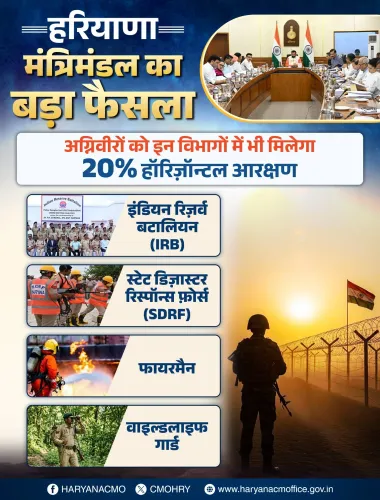
The announcement triggered sharp protests in several states, with demonstrators arguing the scheme stripped away the promise of a full military career and its accompanying pension. Haryana — a state that punches well above its demographic weight in defence recruitment — was among the flashpoints. Yet BJP-ruled states, including Haryana, remained publicly committed, facilitating recruitment rallies and promising reservations for Agniveers in state police forces.
Haryana's stake in every joining letter
Haryana has historically supplied a disproportionately large share of the Indian Army's volunteer ranks relative to its population. Districts like Rohtak, Jhajjar, and Mahendragarh have multi-generational traditions of military service; a government job in the forces carries social currency that transcends the salary. That cultural context makes the November ceremony more than administrative paperwork — it is a public statement that the new recruitment architecture is producing real outcomes.
CM Saini, who took office in March 2024 succeeding Manohar Lal Khattar, has consistently positioned Haryana as a model implementer of central government defence initiatives. The November joining event, whenever formally scheduled, will be watched as a template — both for the families of recruits weighing the scheme's promise and for opposition parties that have demanded the Agnipath framework be scrapped entirely.
The joining letter as a political and policy proof point
Governments rarely get clean before-and-after moments in policy. This may be one. The first batch of Agniveers crossing into service means four years of actual data — on retention rates, on post-service employment, on unit cohesion — will soon begin accumulating. That evidence will shape every debate about whether the 25 percent absorption ceiling should be revised upward and whether state-level reservation promises translate into real jobs after the four-year tenure ends.
For now, the message from Chandigarh is straightforward: the first cohort is real, November is the timeline, and the joining letter is coming.
Point of View
Datable event — the joining letter — that Haryana families can see and verify. By personally flagging November as the moment, Saini aligns the state government visibly with the Agnipath scheme's success narrative at a time when opposition parties continue to demand its rollback. The first-batch milestone also starts the clock on the harder accountability question: what happens to the 75 percent of Agniveers who exit after four years, and whether Haryana's promised state-police reservations materialise for them.
NationPress
25 Oct 2026
Frequently Asked Questions
What is the Agnipath scheme and how does it work?
The Agnipath scheme, launched by the Union Government in June 2022, recruits soldiers called Agniveers on a four-year contractual basis into the Indian Army, Navy, and Air Force. After four years, 25 percent of each batch is eligible for permanent absorption into the regular armed forces; the remaining 75 percent receive a tax-free Seva Nidhi corpus and return to civilian life.
When will Haryana's first Agniveer batch receive joining letters?
Haryana Chief Minister Nayab Singh Saini announced on 25 October 2026 that the first batch of Agniveers from the state will be welcomed with joining letters in November.
Who is Nayab Singh Saini and what is his role?
Nayab Singh Saini is the Chief Minister of Haryana and a BJP leader. He assumed office in March 2024, succeeding Manohar Lal Khattar.
Why did the Agnipath scheme face protests when it was launched?
When the Agnipath scheme was announced in June 2022, it triggered protests in several states — including Haryana — because many aspirants argued the four-year contractual model replaced the promise of a full military career with its associated pension and long-term job security.
What benefits do Agniveers get after their four-year service ends?
Agniveers who are not selected for the 25 percent permanent retention receive a tax-free Seva Nidhi financial corpus on exit. Several BJP-ruled state governments, including Haryana, have also announced reservations for ex-Agniveers in state police and paramilitary recruitment.