Will the Tenure of the First Batch of Agniveers Conclude in July?
Synopsis
Haryana's Minister Rao Narbir Singh confirms that the first Agniveers' tenure ends in July, leading to new employment policies to support their future. Discover how Haryana is paving the way for veteran welfare and job security!
Key Takeaways
First batch of Agniveers' tenure ends in July.
Haryana Agniveer Policy - 2024 to offer job opportunities.
Haryana leads in providing employment security for Agniveers.
Significant recruitment numbers from Haryana showcase patriotism .
Welfare initiatives for ex-servicemen are expanding.
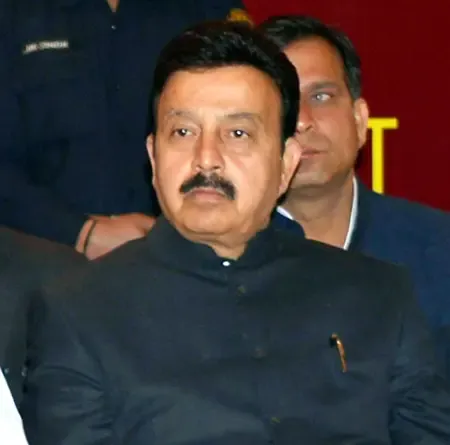
Chandigarh, Jan 5 (NationPress) Haryana's Minister for Sainik and Ardh-Sainik Welfare, Rao Narbir Singh, announced on Monday that the tenure of the inaugural group of ex-servicemen enlisted under the Agnipath Scheme will conclude in July.
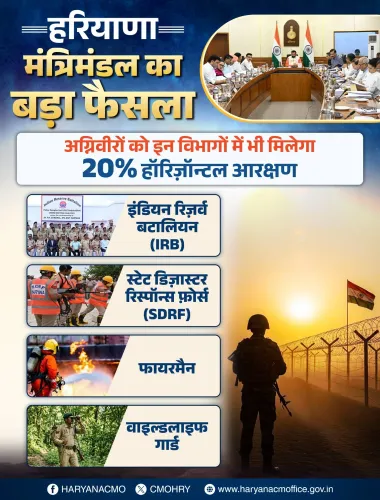
“Following this, the government has devised the Haryana Agniveer Policy - 2024, which is set to be implemented starting August to guarantee a prosperous future for Agniveers,” he stated. “This initiative will facilitate employment prospects in both government and private sectors for Agniveers.”
According to Rao Narbir Singh, Haryana has emerged as the first state nationwide to extend an employment security framework to Agniveers post their military service.
He mentioned that for the fiscal year 2022-23, a national recruitment target of 26,649 Agniveers was established for the Indian Army, Navy, and Air Force. In this context, Haryana contributed 1,830 Agniveers in 2022-23 and 2,215 in 2023-24, showcasing the remarkable patriotic spirit among Haryana’s youth despite their limited demographic representation.
“The youth eagerly opt for military uniforms over conventional white-collar positions. This is why one out of every ten soldiers in the Indian armed forces is from Haryana,” stated Rao Narbir Singh. He also highlighted the establishment of a dedicated Department of Sainik and Ardh-Sainik Welfare in 2016 for the benefit of ex-servicemen, paramilitary personnel, and their families. Since October 2014, the state has offered government jobs on compassionate grounds to the families of 418 martyrs.
During the Seva Pakhwada events held from September 17 to October 2, 2025, reunions for ex-servicemen were organized according to various military corps and regiments. Additionally, there are proposals under the state government’s policy to honor martyrs from the 1962, 1965, 1971, and Kargil wars by naming schools and institutions after them. During these events, ex-servicemen, paramilitary forces, and the families of martyrs participated in tree planting activities.
Point of View
The initiatives taken by Haryana to support Agniveers post-service reflect a significant step towards acknowledging the sacrifices made by military personnel. Such policies not only ensure job security but also serve as a model for other states to follow, reinforcing the nation's commitment to its defenders.
NationPress
30 Sept 2026
Frequently Asked Questions
What is the Agnipath Scheme?
The Agnipath Scheme is a recruitment initiative launched by the Indian government aimed at enlisting young individuals into the armed forces for a short duration, providing them with training and experience.
What is the Haryana Agniveer Policy?
The Haryana Agniveer Policy is a state initiative designed to provide employment opportunities for Agniveers in both government and private sectors after their service in the armed forces.
How many Agniveers were recruited from Haryana?
Haryana recruited 1,830 Agniveers in the fiscal year 2022-23 and 2,215 in 2023-24, showcasing the strong patriotic spirit of its youth.
What welfare measures are in place for ex-servicemen in Haryana?
Haryana has established a dedicated Department of Sainik and Ardh-Sainik Welfare and has provided government jobs on compassionate grounds to the families of 418 martyrs since October 2014.
What events were held for ex-servicemen in Haryana?
The Seva Pakhwada programs included reunions for ex-servicemen and tree plantation activities, along with proposals to honor war martyrs by naming institutions after them.