CM Nayab Saini pays tribute to Bhikaji Cama on her birth anniversary
Synopsis
Haryana Chief Minister Nayab Singh Saini marked the birth anniversary of Bhikaji Rustom Cama on 24 September 2026, saluting the pioneering independence activist who famously unfurled an early Indian tricolour at the 1907 Stuttgart Congress and spent decades championing India's freedom from exile in Europe.
Key Takeaways
Haryana CM Nayab Singh Saini posted a tribute to Bhikaji Rustom Cama on her birth anniversary on 24 September 2026 .
Bhikaji Cama was born in 1861 and operated from exile in Europe, advocating for India's independence at international forums.
She unfurled an early Indian tricolour at the International Socialist Congress in Stuttgart in 1907 — one of the first times an Indian flag was raised on foreign soil for independence.
CM Saini praised her as a symbol of patriotism and fearlessness, noting her activism and sacrifice across multiple countries.
Tributes to independence-era figures on birth anniversaries are a recurring pattern among Indian political leaders across parties.
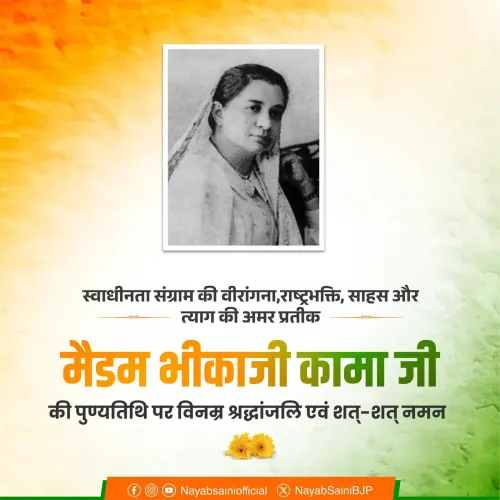
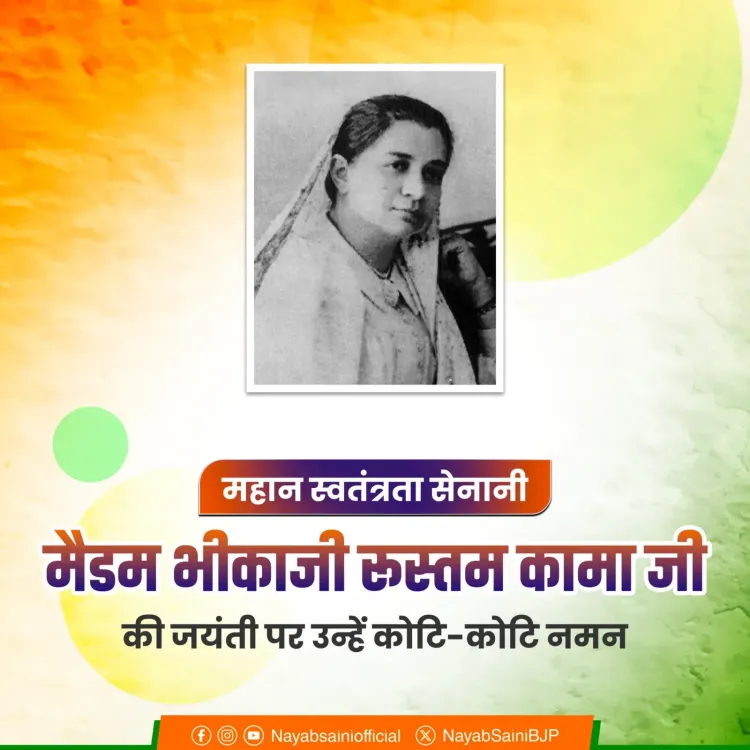
A woman who carried India's freedom struggle to the drawing rooms of Europe, Bhikaji Rustom Cama was never content with silence — and Haryana Chief Minister Nayab Singh Saini marked her birth anniversary on Thursday, 24 September 2026, with a heartfelt tribute on X, saluting her as a symbol of patriotism and fearlessness.
In his post, CM Saini wrote: 'भारतीय स्वतंत्रता संग्राम की अग्रणी, राष्ट्रभक्ति और निर्भीकता की प्रतीक मैडम भीकाजी रुस्तम कामा जी की जयंती पर उन्हें कोटि-कोटि नमन एवं विनम्र श्रद्धांजलि।' — 'Heartfelt salutations and humble tributes to Madam Bhikaji Rustom Cama, a pioneer of India's freedom struggle and a symbol of patriotism and fearlessness, on her birth anniversary.' He added that the standards of activism, sacrifice, and dedication she set — not only within India but by travelling to foreign shores — will remain unforgettable forever.
The woman who took India's cause to Stuttgart
Bhikaji Rustom Cama was born in 1861 into a prosperous Parsi family in Bombay. What set her apart from many contemporaries was scale: she did not confine her advocacy to Indian soil. Operating largely from exile in Europe, she built networks with Irish, Egyptian, and Russian revolutionaries, weaving India's demand for self-rule into a broader global conversation about colonial injustice.
Her most dramatic moment came at the International Socialist Congress in Stuttgart in 1907, where she unfurled an early version of the Indian tricolour — believed to be one of the first times an Indian flag was raised on foreign ground in the name of independence. The image became iconic: a lone woman standing before an international audience, declaring that a nation under occupation still had a flag, still had a voice.
Exile, sacrifice, and a legacy that outlasted empire
Cama spent decades abroad — in Britain and then France — publishing revolutionary literature, fundraising for the independence movement, and corresponding with activists inside India at considerable personal and legal risk. The British colonial government labelled her a dangerous agitator and barred her return for years. She was eventually allowed back to India in poor health and died in Bombay in 1936, just over a decade before the independence she had devoted her life to would finally arrive.
Her story resonates precisely because it was international — proof that the freedom movement was not a domestic grievance but a moral argument India made to the world.
For CM Saini and leaders across the political spectrum, anniversaries like this one serve a dual purpose: honouring a genuine historical figure while anchoring present-day governance in the sacrificial lineage of the independence era. The tribute keeps that lineage visible — and keeps Bhikaji Cama's extraordinary, globe-spanning defiance from fading into a footnote.
Point of View
But Bhikaji Cama carries a specific resonance: her international activism offers a ready narrative about India's global moral stature — one that cuts across party lines. For the BJP, invoking figures who operated beyond India's borders aligns with a broader foreign-policy-meets-civilisational pride messaging. What is notable is that Cama — a woman, a Parsi, and a self-exile — represents the pluralism of the freedom movement, making her a figure leaders invoke to signal historical breadth. As India's commemorative calendar intensifies around independence-era milestones, such tributes will only grow in political frequency and visibility.
NationPress
24 Sept 2026
Frequently Asked Questions
Who was Bhikaji Rustom Cama?
Bhikaji Rustom Cama was an Indian independence activist born in 1861 in Bombay. She operated largely from exile in Europe, advocated for India's freedom at international forums, and famously unfurled an early Indian tricolour at the 1907 Stuttgart International Socialist Congress .
Why is Bhikaji Cama famous?
Bhikaji Cama is most famous for raising an early version of the Indian flag at the International Socialist Congress in Stuttgart in 1907 , one of the first times an Indian flag was displayed on foreign soil in the name of independence. She also published revolutionary literature and built international networks in support of India's freedom movement.
When is Bhikaji Cama's birth anniversary?
Bhikaji Rustom Cama's birth anniversary falls on 24 September , and her jayanti is marked annually with tributes from leaders and institutions across India.
What did Haryana CM Nayab Saini say about Bhikaji Cama?
Haryana CM Nayab Singh Saini called Bhikaji Cama a pioneer of India's freedom struggle and a symbol of patriotism and fearlessness, noting that the standards of activism, sacrifice, and dedication she established — both within India and abroad — will remain unforgettable.
What was Bhikaji Cama's role in the international freedom movement?
Bhikaji Cama spent years in exile in Britain and France, building alliances with anti-colonial activists worldwide, publishing revolutionary literature, and presenting India's case for independence before international audiences — most dramatically at the 1907 Stuttgart Congress .