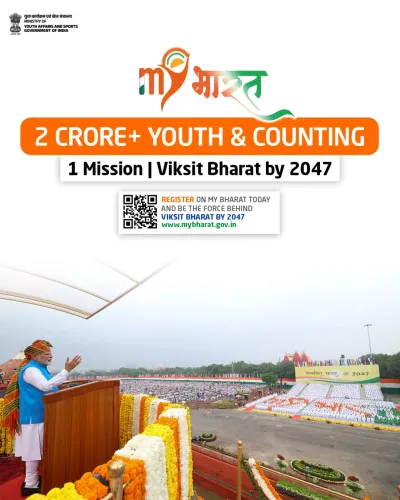
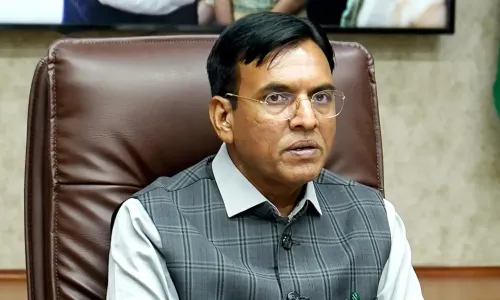
MY Bharat Portal Crosses 3 Crore Youth Registrations
Synopsis
The MY Bharat portal, launched in 2023 under PM Modi to connect Indian youth aged 15-29 with volunteering opportunities, has crossed 3 crore registrations. Union Minister Giriraj Singh called it a historic milestone and linked it to the Viksit Bharat 2047 vision of a fully developed India by independence's centenary.
Key Takeaways
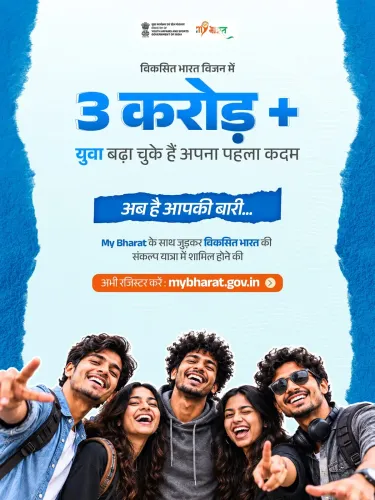
MY Bharat (Mera Yuva Bharat) portal has crossed 3 crore youth registrations , a milestone flagged by Union Textiles Minister Giriraj Singh on 24 September 2026 .
The platform targets Indians aged 15 to 29 , connecting them with service and volunteering opportunities under a single digital interface.
MY Bharat was launched in 2023 under Prime Minister Narendra Modi's guidance to consolidate earlier youth programmes.
The portal builds on the legacy of the National Service Scheme (NSS) and Nehru Yuva Kendra Sangathan (NYKS) by adding centralised digital registration and opportunity-matching.
Singh explicitly linked the milestone to the Viksit Bharat 2047 vision, framing youth mobilisation as foundational to India's long-term development goals.
A digital platform for civic volunteering has quietly crossed a landmark that few government portals achieve: more than 3 crore registered users. Union Textiles Minister Giriraj Singh on Thursday, 24 September 2026, flagged the milestone of the MY Bharat (Mera Yuva Bharat) portal, calling it a historic step in mobilising India's youth for nation-building.
Posting on X, Singh wrote — 'युवा शक्ति, विकसित भारत की सबसे बड़ी ताकत है' ('Youth power is the greatest strength of a Developed India') — and credited Prime Minister Narendra Modi's guidance for the portal's rapid growth. He described MY Bharat as an engine linking young Indians aged 15 to 29 with service and volunteering opportunities, building in them what he called 'seva bhav aur kartavya bodh' — a spirit of service and a sense of duty.What MY Bharat does — and where it fits in India's youth policy history
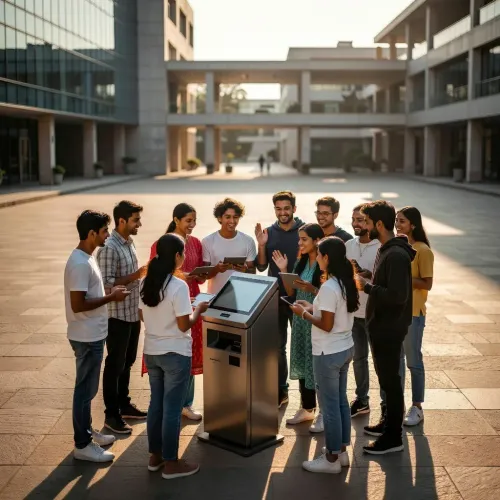
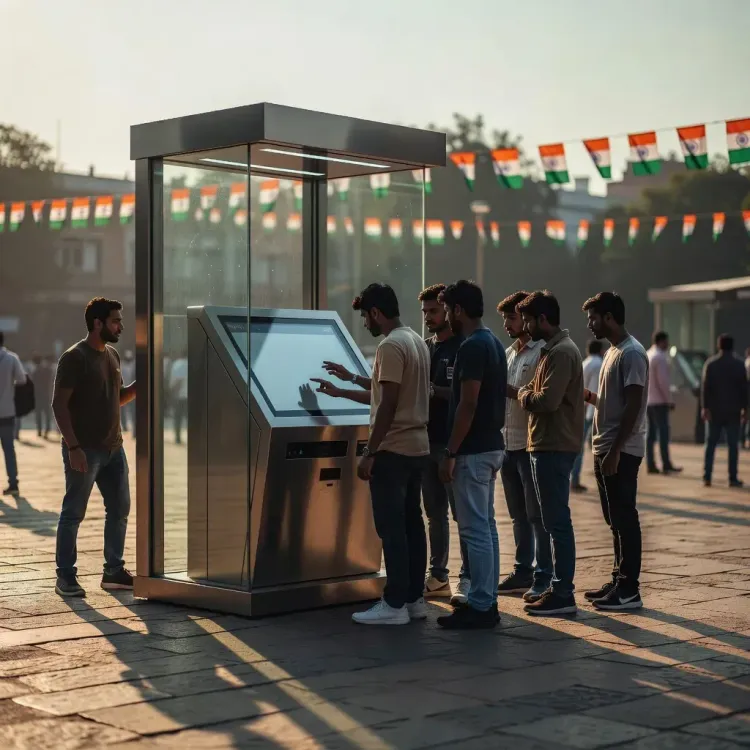
Launched in 2023, the MY Bharat platform was designed to consolidate India's scattered youth engagement programmes under one centralised digital interface. It connects volunteers with opportunities in areas ranging from community service to skill drives, functioning as a single gateway rather than a collection of siloed portals.
The platform builds on a long lineage of state-backed youth mobilisation: the National Service Scheme (NSS) and the Nehru Yuva Kendra Sangathan (NYKS) both preceded it by decades, but neither offered centralised digital registration or real-time opportunity matching. MY Bharat's architecture attempts exactly that — aggregating demand (young volunteers) and supply (service opportunities) in one place.
The 2047 thread running through the 3-crore number
Singh's post does not treat 3 crore as a standalone statistic. He frames it explicitly as fuel for Viksit Bharat 2047, the government's long-horizon vision of a fully developed India by the centenary of independence. The logic is demographic: India's youth bulge — the largest such cohort in its history — peaks roughly in this decade. Channelling it into civic participation now, the argument runs, compounds into national capacity over the next two decades.
Whether 3 crore active registrations translate into equivalent boots-on-ground volunteering remains the key question policymakers will need to answer. Registration numbers and sustained engagement are two different curves — the next milestone worth watching is how MY Bharat converts sign-ups into measurable service hours and, eventually, integration with existing skill and employment programmes.
India's youth dividend has always been cited as a structural advantage. Singh's post is a reminder that the government is betting heavily on a digital platform to turn that advantage into organised civic energy — and that, at least on the registration scoreboard, the numbers are moving.
Point of View
District-level coordination under the NSS and NYKS into a scalable, data-trackable national platform. The explicit Viksit Bharat 2047 framing is deliberate: it ties a soft-power metric (volunteerism) to the government's hardest long-term economic narrative. The critical next test is depth, not breadth — whether registrations convert into sustained civic participation or remain a headline number. If the platform succeeds at that conversion, it could become a significant instrument of social capital formation; if not, it risks being remembered as a large but hollow sign-up drive.
NationPress
24 Sept 2026
Frequently Asked Questions
What is the MY Bharat portal?
MY Bharat, short for Mera Yuva Bharat, is a government digital platform launched in 2023 that connects young Indians aged 15 to 29 with volunteering and community service opportunities, serving as a centralised hub for youth engagement programmes.
How many people have registered on MY Bharat?
According to Union Textiles Minister Giriraj Singh's post on 24 September 2026, the MY Bharat portal has crossed 3 crore (30 million) youth registrations.
Who launched the MY Bharat portal?
The MY Bharat portal was launched in 2023 under the guidance of Prime Minister Narendra Modi as part of the government's initiative to consolidate youth engagement and volunteering programmes under a single digital interface.
What is Viksit Bharat 2047?
Viksit Bharat 2047 is the Indian government's long-term national vision to transform India into a fully developed nation by 2047, the centenary of independence. Youth participation through platforms like MY Bharat is framed as central to achieving this goal.
How is MY Bharat different from NSS or NYKS?
Unlike the National Service Scheme (NSS) or Nehru Yuva Kendra Sangathan (NYKS), which operated as separate, largely offline programmes, MY Bharat provides centralised digital registration and real-time matching of young volunteers with service opportunities across the country.