Yami Gautam's black Maheshwari saree honours 7-gen weaving legacy

Synopsis
Yami Gautam's Instagram post revealed that the black Maheshwari saree she wore to accept the National Award for Best Actress was woven by a seventh-generation Salvi family artisan from Maheshwar — turning a celebrity fashion moment into a quiet but pointed spotlight on India's endangered handloom heritage.
Key Takeaways
Yami Gautam shared an Instagram post on 24 September 2026 about her black Maheshwari saree woven by a seventh-generation Salvi family artisan from Maheshwar, Madhya Pradesh .
The saree is crafted in silk, cotton, and zari and was the same outfit she wore while receiving the National Award for Best Actress for 'Article 370' .
The 72nd National Film Awards were held on 22 September 2026 in Kevadia, Gujarat .
Maheshwari weaving was historically promoted by Queen Ahilyabai Holkar of the Holkar dynasty in the 18th century .
India's handloom sector supports an estimated 35 lakh weavers and allied workers, according to government data.
Actress Yami Gautam made a statement on 24 September 2026 that went beyond fashion — sharing an Instagram post celebrating the legacy of Maheshwari handloom, she wore a black saree woven by a seventh-generation Salvi family artisan from Maheshwar, Madhya Pradesh. The saree, crafted using silk, cotton, and zari, drew wide attention for its cultural significance as much as its elegance.
The Story Behind the Saree
In the Instagram post, Gautam shared that the piece was the work of a weaver from the Salvi family of Maheshwar, who has carried forward generations of handloom expertise. In her own words, she wrote: 'The black Maheshwari saree is woven by a seventh-generation Salvi family weaver from Maheshwar, carrying forward a family legacy of handloom craftsmanship. Woven in silk, cotton and Zari. Maheshwari weaving was nurtured by Maharani Ahilyabai Holkar, who brought skilled weavers to Maheshwar. The beauty is in the hands that have kept this craft alive for generations.'
A Saree Worn at the National Awards
Notably, this was the very same black Maheshwari saree that Gautam wore while receiving the National Award for Best Actress for her performance in 'Article 370'. The 72nd National Film Awards were held on 22 September 2026 in Kevadia, Gujarat. By choosing to wear a handloom creation — and then publicly attributing it to its artisan — the actress turned a red-carpet moment into an act of advocacy for India's textile heritage.
Historical Roots of Maheshwari Weaving
Maheshwari sarees trace their origins to the 18th century, when Queen Ahilyabai Holkar of the Holkar dynasty invited skilled weavers from Surat and South India to settle in Maheshwar and create sarees for royal guests. The craft is characterised by its distinctive reversible border and the use of natural fibres with metallic zari. Over three centuries, artisan families such as the Salvis have preserved the weave largely through oral tradition and generational practice.
How Gautam Styled the Look
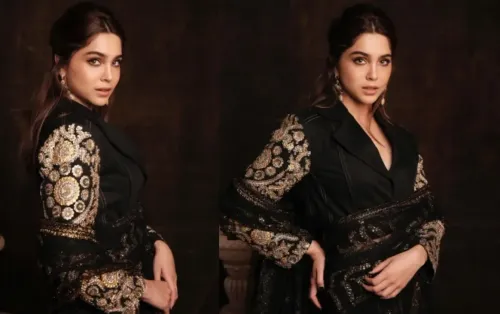
In a series of photographs, the 'Kaabil' actress was seen posing in the black saree featuring golden embroidery along the sides. She paired it with matching earrings, wore her hair in a high bun, and opted for subtle makeup — allowing the craftsmanship of the textile to take centre stage.
Why the Spotlight on Handloom Matters
India's handloom sector supports an estimated 35 lakh weavers and allied workers, making it the country's second-largest rural employment source after agriculture, according to government data. Yet the sector continues to face pressure from power-loom imitations and declining artisan incomes. Celebrity-led visibility — particularly from an actress who has just won the country's highest film honour — can meaningfully shift consumer interest and market demand for authentic handloom products. This is not the first time Gautam has used public appearances to draw attention to Indian craft traditions.
Point of View
On the surface, a celebrity fashion update. But the subtext is sharper: by naming the artisan family and tracing the saree's lineage to Ahilyabai Holkar, she shifted the narrative from wearer to maker — a rare inversion in Bollywood's style coverage. The timing is not incidental; wearing the same saree to the National Awards and then publicising it amplifies the statement considerably. India's handloom sector has struggled for decades against power-loom imitation and falling artisan incomes, and mainstream media rarely covers the supply chain behind a celebrity's outfit. When they do — and when the celebrity owns the attribution publicly — it tends to move Google search interest and, eventually, consumer behaviour. The more interesting question is whether this translates into anything lasting for the weavers of Maheshwar, or whether it remains a well-intentioned Instagram moment.
NationPress
24 Sept 2026
Frequently Asked Questions
Why is Yami Gautam's black Maheshwari saree getting attention?
Yami Gautam's black Maheshwari saree gained attention because she wore it to receive the National Award for Best Actress on 22 September 2026, and then posted on Instagram naming the seventh-generation Salvi family weaver from Maheshwar who crafted it, drawing focus to the artisan and the heritage behind the textile.
What is a Maheshwari saree?
A Maheshwari saree is a traditional handloom textile originating from Maheshwar in Madhya Pradesh, crafted using silk, cotton, and zari. The craft was nurtured in the 18th century by Queen Ahilyabai Holkar, who brought skilled weavers from Surat and South India to Maheshwar.
Which film did Yami Gautam win the National Award for?
Yami Gautam won the National Award for Best Actress for her performance in 'Article 370'. The award was presented at the 72nd National Film Awards held on 22 September 2026 in Kevadia, Gujarat.
Who wove Yami Gautam's saree?
The saree was woven by a seventh-generation artisan from the Salvi family of Maheshwar, who has carried forward a multigenerational legacy of handloom craftsmanship using silk, cotton, and zari.
Why does Maheshwari handloom matter today?
Maheshwari handloom is part of India's broader handloom sector, which supports an estimated 35 lakh weavers and is the country's second-largest rural employer after agriculture, according to government data. The craft faces ongoing pressure from power-loom imitations and declining artisan incomes, making public visibility through figures like Yami Gautam significant for sustained demand.