CM Nayab Saini Pays Tribute to Nanaji Deshmukh on Birth Anniversary
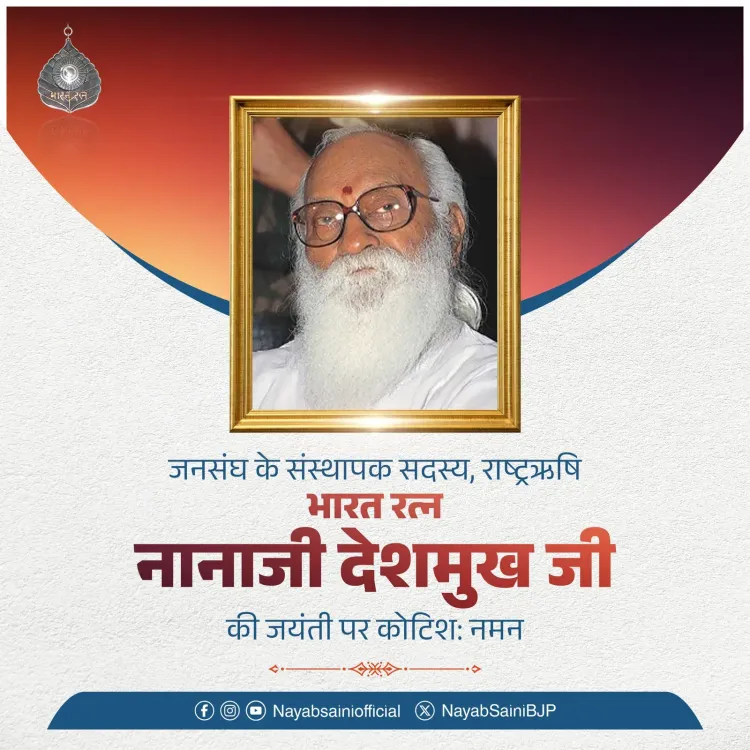
Synopsis
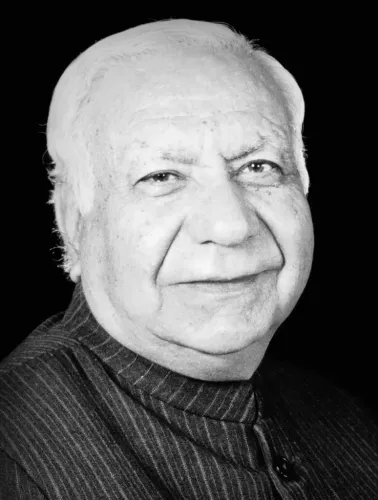
Haryana Chief Minister Nayab Singh Saini paid tribute to Bharat Ratna Nanaji Deshmukh on his birth anniversary, honouring the Jana Sangh founder's Chitrakoot rural development vision, his resistance to the Emergency, and his lifelong commitment to village self-reliance and national service.
Key Takeaways
Nanaji Deshmukh was born on October 11, 1916 , and was a founding member of the Bharatiya Jana Sangh in 1951.
He built a landmark rural development model in Chitrakoot based on the philosophy of 'Graamodaya se Rashtrodaya' — village uplift as the foundation of national prosperity.
He was awarded the Bharat Ratna posthumously in 2019 by the Modi government.
CM Saini specifically remembered Nanaji's resistance to the Emergency (1975–77) as a defining contribution to democratic values.
Nanaji refused a cabinet post in the 1977 Janata Party government , choosing grassroots social work over political office.
He passed away on February 27, 2010 , in Chitrakoot at the age of 93 .
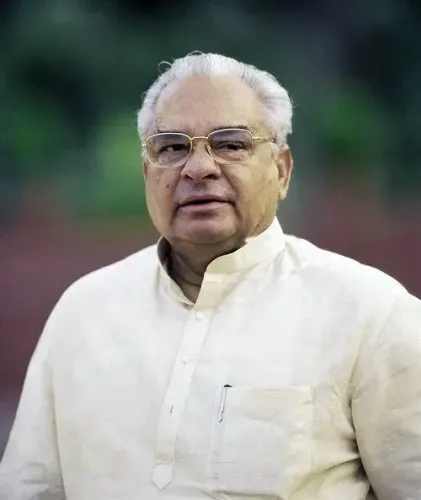
On the birth anniversary of Nanaji Deshmukh — founding member of the Jana Sangh, recipient of the Bharat Ratna, and one of independent India's most revered rural reformers — Haryana Chief Minister Nayab Singh Saini offered his tribute on Sunday, October 11, 2026, honouring a life lived entirely in service of the nation.
In his post, CM Saini described Nanaji as 'Rashtra Rishi' — a sage of the nation — and recalled his defining contributions: 'Gram Swaraj, Aatmanirbharta evam Gramin Vikas ko nayi disha' ('giving new direction to village self-rule, self-reliance, and rural development'). The tribute was warm, grounded, and pointed — not ceremonial filler, but a deliberate invocation of a specific philosophy.
The Chitrakoot Experiment That Redefined Rural India
Nanaji Deshmukh, born October 11, 1916, in Hingoli district of present-day Maharashtra, dedicated the final decades of his life to a bold social experiment in Chitrakoot, one of India's most economically distressed regions straddling Uttar Pradesh and Madhya Pradesh. There, he gave shape to the idea of 'Graamodaya se Rashtrodaya' — 'from village uplift, national uplift' — establishing the Chitrakoot Gramodaya Vishwavidyalaya and a network of self-sustaining village units that became a reference model for integrated rural development.
The model was radical in its simplicity: empower villages with health, education, and livelihood infrastructure so they no longer depend on distant state machinery. Nanaji called it 'antyodaya in practice' — serving the last person first. CM Saini's tribute specifically named this Chitrakoot vision, signalling its continued relevance to the BJP's rural governance vocabulary.
Jana Sangh Roots and the Emergency-Era Stand
Nanaji Deshmukh was among the founding architects of the Bharatiya Jana Sangh in 1951, working closely with Syama Prasad Mookerjee to build the party's organisational backbone, particularly in Uttar Pradesh. His political career, however, was always secondary to his social work — he famously refused a cabinet berth when the Janata Party came to power in 1977, choosing instead to focus on grassroots service.
His resistance to the Emergency (1975–77) imposed by the then Congress government remains one of his most cited chapters. CM Saini's tribute explicitly remembered this — 'Aapatkal ke viruddh sangharsh aur loktantrik mulyon ki raksha mein unka yogdan sadaiv smaraneey rahega' ('his contribution to the struggle against the Emergency and the protection of democratic values will always be remembered'). For the BJP, this is not merely history — it is a living political argument about the party's democratic credentials.
Bharat Ratna and a Legacy the Ruling Party Claims
Nanaji Deshmukh was awarded the Bharat Ratna posthumously in 2019 by the Modi government — a conferral that carried unmistakable political symbolism, formally placing a Jana Sangh founding figure in the republic's highest civilian honour roll. He had passed away on February 27, 2010, at the age of 93, in Chitrakoot itself, where he had chosen to spend his final years among the villagers he served.
CM Saini's tribute closes with a forward-looking note: 'Seva, Sanskar aur Samarpan par aadharit unke aadarsh hamen jankalyan evam rashtra nirman ke path par aage badhne ki prerana dete rahenge' — 'his ideals, rooted in service, values, and dedication, will continue to inspire us on the path of public welfare and nation-building.' It is a formulation that doubles as a governing philosophy, not just a birthday salutation.
Nanaji Deshmukh did not leave behind monuments of stone. He left behind a proof of concept — that a determined individual, working village by village, can move the needle on poverty, illiteracy, and disempowerment. Haryana's Chief Minister invoked that proof today, and the challenge it implicitly sets is one every government in India is still working to meet.
Point of View
Rural self-reliance, and resistance to authoritarian overreach. By naming the Chitrakoot model and the Emergency stand in the same breath, CM Saini is doing double work: claiming a governance philosophy and a democratic credential simultaneously. The posthumous Bharat Ratna in 2019 institutionalised this claim at the national level, and state-level tributes like Saini's reinforce it in the electoral geography of Hindi-belt states where Nanaji's legacy remains culturally resonant. For a ruling party that frequently frames its rural schemes as continuations of older service traditions, Nanaji Deshmukh is an indispensable reference point.
NationPress
11 Oct 2026
Frequently Asked Questions
Who was Nanaji Deshmukh and why is he remembered?
Nanaji Deshmukh (1916–2010) was a founding member of the Bharatiya Jana Sangh, a social reformer, and a pioneer of integrated rural development in Chitrakoot. He is remembered for his 'Graamodaya se Rashtrodaya' model, his resistance to the Emergency, and his Bharat Ratna awarded posthumously in 2019.
When was Nanaji Deshmukh born?
Nanaji Deshmukh was born on October 11, 1916, in Hingoli district of present-day Maharashtra.
What was Nanaji Deshmukh's Chitrakoot model?
In Chitrakoot, Nanaji Deshmukh built a network of self-sustaining villages with integrated health, education, and livelihood infrastructure, embodying his philosophy that empowered villages are the foundation of a prosperous nation — a concept he called 'Graamodaya se Rashtrodaya.'
When did Nanaji Deshmukh receive the Bharat Ratna?
Nanaji Deshmukh was awarded the Bharat Ratna posthumously in 2019 by the Government of India.
Why did Nayab Singh Saini pay tribute to Nanaji Deshmukh?
Haryana Chief Minister Nayab Singh Saini paid tribute on October 11, 2026, the birth anniversary of Nanaji Deshmukh, honouring his contributions to rural development, democratic values, and national service as part of the BJP's tradition of remembering its ideological forebears.