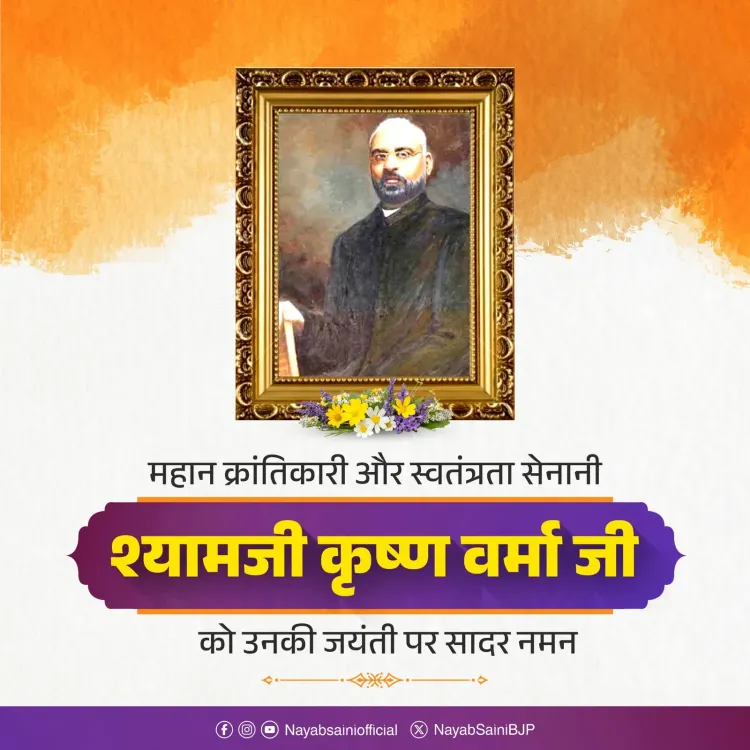
CM Nayab Saini Pays Tribute to Shyamji Krishna Varma on Birth Anniversary
Synopsis
Haryana Chief Minister Nayab Singh Saini paid tribute to Shyamji Krishna Varma on his 169th birth anniversary, honouring the Kutch-born revolutionary who founded India House in London and spent decades in European exile defying British colonial rule.
Key Takeaways
Shyamji Krishna Varma was born on 4 October 1857 in Mandvi, Kutch , the same year as the First War of Indian Independence.
He founded India House in Highgate, London and the Indian Home Rule Society in 1905 , ahead of mainstream Swaraj demands.
His journal The Indian Sociologist was an early platform calling for complete independence from British rule.
He lived in exile in Paris and Geneva , dying there in 1930 ; his ashes were repatriated to India only in 2003 .
A memorial complex, Kranti Teerth , was built in Mandvi to honour his legacy.
CM Nayab Singh Saini offered the tribute on 4 October 2026 , calling Varma's life a total dedication to national liberation.
On the birth anniversary of one of India's most fiercely committed freedom fighters, Haryana Chief Minister Nayab Singh Saini offered a heartfelt salute to Shyamji Krishna Varma, whose life was a relentless declaration of war against colonial rule — waged not on a battlefield, but in the libraries, lecture halls, and revolutionary networks of Europe.
Posting on Sunday, October 4, 2026, CM Saini wrote in Hindi: 'Rashtra ki swatantrata ke liye apna sarvasy arpit karne wale mahan deshbhakt Shyamji Krishna Varma ji ki jayanti par koti-koti naman' — 'Countless salutations on the birth anniversary of the great patriot Shyamji Krishna Varma, who offered everything for the freedom of the nation.' He added that Varma dedicated his entire life to the cause of national service, with the resolve to liberate India from subjugation.
The Revolutionary Who Fought From Afar
Shyamji Krishna Varma was born on 4 October 1857 in Mandvi, Kutch — the very year the First War of Indian Independence shook British rule. A scholar of extraordinary range, he mastered Sanskrit and earned the admiration of Orientalist scholars in Britain before turning his intellectual energy entirely toward political resistance. He founded the India House in Highgate, London, which became a crucible for a generation of radical Indian nationalists.
Varma also established The Indian Sociologist, a journal that gave ideological voice to the demand for complete independence at a time when even moderate nationalists hesitated to use the word. His Indian Home Rule Society, founded in 1905, predated the formal articulation of 'Swaraj' by the mainstream Congress. Figures who passed through India House's charged atmosphere included revolutionaries who would go on to shape the most daring chapters of India's independence movement.
Exile, Defiance, and a Final Return Home
Facing the threat of arrest by British authorities, Varma moved to Paris and later to Geneva, spending decades in self-imposed exile rather than submit to colonial courts. He died in Geneva in 1930, his ashes remaining in Europe for over seven decades. It was only in 2003 that the Government of Gujarat brought his ashes back to India — a homecoming that drew national attention and was received with full state honours in his native Mandvi.
A memorial complex, Kranti Teerth, was built in Mandvi to honour his legacy — a recognition that arrived late, but with the weight of long-overdue justice.
Why This Tribute Resonates Beyond Ceremony
Varma's story sits at the intersection of intellectual defiance and personal sacrifice — a scholar who could have built a comfortable life within the empire's institutions but chose permanent exile instead. CM Saini's tribute underlines a broader effort to bring lesser-celebrated freedom fighters into mainstream national memory, honouring those whose contributions were written in quiet, sustained resolve rather than a single dramatic act. On the anniversary of his birth, that resolve deserves to be read plainly for what it was: total.
Point of View
Complementing the party's cultural-nationalist narrative. Varma represents an intellectual strand of the independence movement — transnational, radical, and uncompromising — whose reclamation carries symbolic weight beyond ceremonial remembrance. Honouring him also implicitly celebrates Gujarat's role in repatriating his ashes in 2003, a moment the current ruling establishment has repeatedly cited as an act of corrective history. The tribute thus functions simultaneously as personal homage, historical restitution, and political signalling.
NationPress
4 Oct 2026
Frequently Asked Questions
Who was Shyamji Krishna Varma?
Shyamji Krishna Varma was an Indian revolutionary and scholar born on 4 October 1857 in Mandvi, Kutch . He founded India House in London and the Indian Home Rule Society in 1905, dedicating his life to securing India's independence from British rule from exile in Europe.
What is India House London and why is it significant?
India House was a residence and meeting place founded by Shyamji Krishna Varma in Highgate, London . It became a hub for radical Indian nationalists in the early 20th century, nurturing revolutionary thought at a time when open dissent in India was dangerous and suppressed.
When were Shyamji Krishna Varma's ashes brought back to India?
His ashes were brought back to India in 2003 by the Government of Gujarat , more than seven decades after his death in Geneva in 1930. They were received with state honours in his hometown of Mandvi, Kutch .
What is Kranti Teerth?
Kranti Teerth is a memorial complex built in Mandvi, Kutch, Gujarat to honour the legacy of Shyamji Krishna Varma. It was established to recognise his contributions to India's freedom struggle and to preserve his memory for future generations.
Why did Nayab Singh Saini pay tribute to Shyamji Krishna Varma?
Haryana Chief Minister Nayab Singh Saini posted a tribute on 4 October 2026 , the birth anniversary of Shyamji Krishna Varma, honouring him as a great patriot who sacrificed everything for India's liberation and dedicated his entire life to national service.