CM Nayab Saini warns Haryana youth against 'regime change' unrest
Synopsis
Haryana CM Nayab Singh Saini on October 16 urged youth to resist opposition-led 'regime change' agitations, warning of conspiracies to spread anarchy and asserting that democracy is driven by electoral mandates, not street disruption.
Key Takeaways
Haryana Chief Minister Nayab Singh Saini posted a direct warning to youth on October 16, 2026 .
He cautioned against being misled by the opposition and resisting 'REGIME CHANGE'-framed agitations.
Saini described such movements as 'conspiracies to spread anarchy,' invoking democratic mandate as the only legitimate route to power.
The post referenced a prior appeal made 'a few days ago,' indicating a deliberate escalation in messaging.
The BJP , which governs Haryana, has used this framing of street agitation as anti-democratic in multiple state-level political contests.
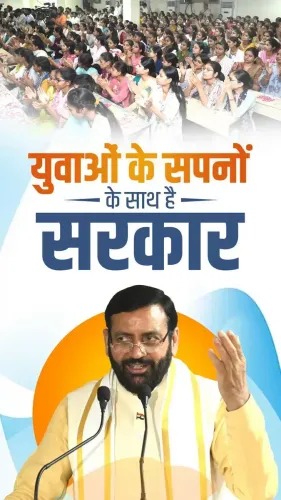
A direct warning to Haryana's youth — and a clear shot at the opposition. Haryana Chief Minister Nayab Singh Saini took to X on Friday, October 16, 2026, urging young people to resist what he called conspiracies to spread anarchy under the banner of 'regime change,' asserting that democracy runs on electoral mandates, not street chaos.
Posting in Hindi, Saini wrote: 'कुछ दिन पहले ही मैंने युवाओं से निवेदन किया था - विपक्ष के बहकावे में न आएँ' — 'Just a few days ago I had appealed to the youth: do not fall for the opposition's misleading.' He doubled down with a sharper line: 'Stay alert to conspiracies that spread anarchy in the name of REGIME CHANGE. Democracy runs on the people's mandate, not on anarchy.'
The 'regime change' warning and what it signals
The capitalised phrase 'REGIME CHANGE' in an otherwise Hindi post is deliberate — it signals that Saini is framing a domestic political challenge in the language of external or orchestrated destabilisation. It is a framing device ruling-party leaders across Indian states have deployed with increasing frequency: casting opposition-led agitations not as legitimate dissent but as coordinated attempts to subvert a democratic mandate.
The rhetorical architecture here is tight. By invoking a prior appeal to youth — one made 'a few days ago' — Saini positions this post not as a first alarm but as an escalation. Something, in his telling, has not changed. The repetition itself becomes the message: the threat, as he sees it, is live and growing.
Saini's political footing and the BJP's Haryana playbook
Nayab Singh Saini has led Haryana since March 2024, when he succeeded long-serving Chief Minister Manohar Lal Khattar. The Bharatiya Janata Party retains both state and central power, making messaging that conflates street agitation with anti-democratic activity a natural political instrument — it reinforces electoral legitimacy while putting opponents on the defensive.
Saini's appeal to youth is also strategically weighted. Young voters are both the most mobile constituency and the most active on the digital platforms where opposition movements gain oxygen. Reaching them directly, before the opposition narrative consolidates, is textbook preemptive political communication.
No specific triggering event for the post has been independently confirmed. But the pattern is familiar: when political temperature rises in a state, the ruling party's chief executive moves first to lock down the youth narrative. Saini has now done that twice in quick succession.
Whether the opposition responds — and how — will determine if this warning becomes a flashpoint or fades as routine political noise. In Haryana, that gap rarely stays quiet for long.
Point of View
Not routine. The deliberate use of the English phrase 'REGIME CHANGE' inside a Hindi post is a signal flare — it imports the language of externally-driven destabilisation into a domestic political dispute, a framing that is hard for opponents to counter without appearing to endorse instability. For Saini personally, who took the CM's chair only in early 2024, pre-empting a youth-led momentum shift is existential: young, digitally-connected voters were central to the BJP's Haryana arithmetic, and losing that narrative early could compound into a structural challenge well before the next electoral cycle.
NationPress
16 Oct 2026
Frequently Asked Questions
What did Haryana CM Nayab Singh Saini say about 'regime change'?
Saini warned Haryana's youth on October 16, 2026 to stay alert to what he called conspiracies to spread anarchy in the name of 'regime change,' urging them not to be misled by the opposition and asserting that democracy runs on electoral mandates, not street agitation.
Who is Nayab Singh Saini?
Nayab Singh Saini is the Chief Minister of Haryana and a leader of the Bharatiya Janata Party, who assumed office in March 2024 after Manohar Lal Khattar.
Why did Saini address Haryana youth specifically?
Saini directed his warning at youth because young voters are both the most politically mobile constituency and most active on digital platforms where opposition-led movements often gain momentum, making them a key audience in preemptive political messaging.
What does 'REGIME CHANGE' mean in Saini's post?
Saini used the capitalised phrase 'REGIME CHANGE' to frame opposition-led agitations not as legitimate political dissent but as coordinated conspiracies aimed at destabilising an elected government, a rhetorical device increasingly common in ruling-party political communication in Indian states.
Has Saini made similar appeals before this post?
Yes, Saini's October 16 post itself references a prior appeal made 'a few days ago,' indicating this was an escalation in messaging rather than a first warning, though the specific triggering events have not been independently confirmed.