Giriraj Singh Flags Weaver Uplift via Skill, Credit and Subsidy Push
Synopsis
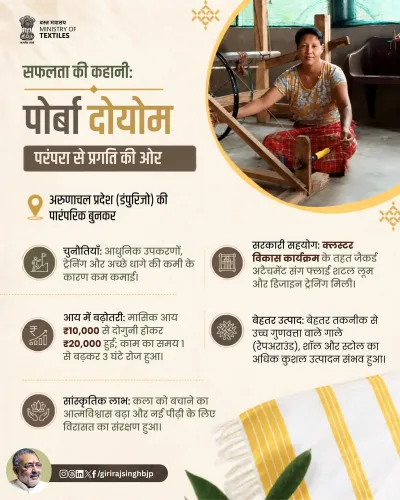
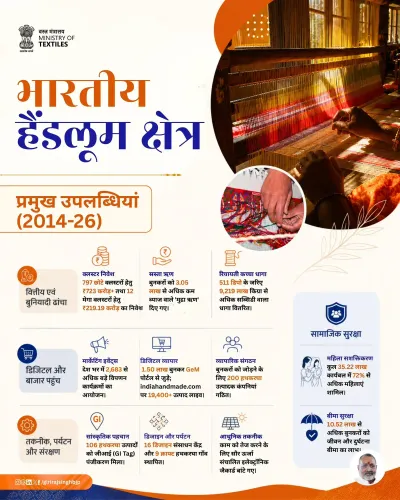
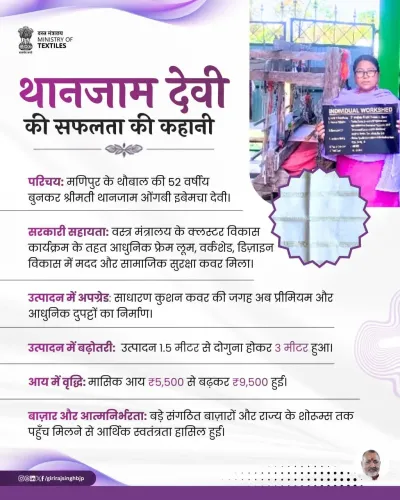
Union Textiles Minister Giriraj Singh has highlighted the government's effort to empower handloom weavers through skill training, Mudra loans and raw-material subsidies, while pushing to expand market access for weaver products both domestically and overseas.
Key Takeaways
Union Textiles Minister Giriraj Singh posted on 16 October 2026 highlighting weaver-empowerment schemes covering skill training, loan assistance and raw-material subsidies.
The Pradhan Mantri Mudra Yojana (launched 2015 ) provides collateral-free micro-loans to handloom weavers and small textile enterprises.
The Skill India Mission (launched 2015 ) includes dedicated training components for traditional handloom workers and artisans.
The ministry's stated goal is to link weaver empowerment directly to expanded access in both domestic and international markets.
Handloom is one of India's largest rural employment sectors; policy support combines welfare and export promotion for maximum multiplier effect.
Upcoming Union Budget allocations for the National Handloom Development Programme will be a key indicator of how far ministerial intent is backed by fresh capital.
India's handloom sector — a livelihood lifeline for millions of rural families — is getting a fresh ministerial spotlight. Union Textiles Minister Giriraj Singh took to X on Friday, 16 October 2026, underlining the government's multi-pronged drive to empower weavers through skill training, loan assistance and raw-material subsidies, while simultaneously opening new domestic and international market corridors for their products.
In his post, Singh wrote: 'बुनकरों के हुनर को संबल, कारोबार को विस्तार!' — 'Strength to the weavers' skill, expansion to their trade!' — framing the ministry's agenda as one that connects artisan empowerment directly to commercial growth. The combination of skill development, credit linkages and subsidised raw material, he stated, is 'paving the path' to markets both within India and abroad.
The Three Pillars: Training, Credit and Raw-Material Relief
The architecture the minister describes rests on a familiar but still-evolving structure. The Skill India Mission, launched in 2015, has progressively incorporated training modules for traditional handloom workers and artisans, giving rural weavers access to certified courses that sharpen both craft technique and basic business literacy. Alongside it, the Pradhan Mantri Mudra Yojana — also from 2015 — provides collateral-free micro-loans to weavers and small textile enterprises, addressing the chronic credit gap that has historically forced artisans into the grip of informal money-lenders.
Raw-material subsidies round out the trio, reducing input costs for fibre and yarn that can otherwise eat deeply into thin margins. Together, these three levers are designed to solve the sector's perennial problem: craft excellence that never quite translates into commercial scale.
Why Market Access Is the Real Prize
Skill and credit are necessary — but market reach is where the multiplier kicks in. Indian handloom has long suffered a distribution bottleneck: world-class weaves from clusters in Varanasi, Pochampally, Chanderi and Bhagalpur routinely struggle to find buyers beyond local mandis. Singh's emphasis on opening both domestic and export channels signals that the ministry sees market linkage — not just welfare support — as the endgame.
The handloom sector is one of India's largest rural employers after agriculture, and it carries deep cultural weight. Successive governments have combined welfare schemes with export promotion precisely because the two reinforce each other: a weaver with a reliable overseas order has more reason to invest in quality; a quality product earns higher premiums that justify the subsidy spend.
What to Watch as Budget Season Approaches
With the next Union Budget cycle drawing closer, the minister's post lands at a pointed moment. Allocations to the National Handloom Development Programme and any revisions to Mudra loan limits for textile micro-enterprises will be the concrete test of how far the intent in Singh's post translates into rupees on the ground. Industry bodies and weaver cooperatives will be watching for fresh capital infusion, expanded export incentives, and whether the raw-material subsidy pipeline is widened to cover more fibre categories.
India's handloom story is one of extraordinary skill meeting structural neglect — and every incremental policy push matters. The minister's message is clear: the loom must feed the market, not just the tradition.
Point of View
Geographically dispersed vote-bank concentrated in states like Bihar, Uttar Pradesh, Andhra Pradesh and West Bengal, making weaver welfare a perennial policy priority across party lines. What makes the current moment distinct is the minister's equal stress on market linkage alongside welfare, signalling a shift from pure subsidy thinking to value-chain integration. Whether this intent gets translated into measurable export growth or higher weaver incomes will hinge on next year's budget allocations and the implementation bandwidth of schemes already on the books.
NationPress
16 Oct 2026
Frequently Asked Questions
What schemes does the Indian government offer to support handloom weavers?
The government supports handloom weavers primarily through the Pradhan Mantri Mudra Yojana (collateral-free micro-loans), the Skill India Mission (craft and business training), raw-material subsidies, and the National Handloom Development Programme which covers market development and infrastructure.
What did Giriraj Singh say about weavers on X?
On 16 October 2026 , Textiles Minister Giriraj Singh posted that skill training, loan assistance and raw-material subsidies are empowering weavers while also opening pathways for their products to reach domestic and international markets.
How does Pradhan Mantri Mudra Yojana help handloom weavers?
Launched in 2015 , the Pradhan Mantri Mudra Yojana provides collateral-free micro-loans to weavers and small textile enterprises, helping them access working capital without depending on informal moneylenders.
How large is India's handloom sector as an employer?
Handloom is one of India's largest sources of rural employment after agriculture, supporting millions of weavers and artisans in states like Bihar, Uttar Pradesh, Andhra Pradesh and West Bengal.
What is the National Handloom Development Programme?
The National Handloom Development Programme is a central scheme that provides financial and infrastructural support to handloom clusters across India, covering raw-material banks, skill upgradation and market promotion for weaver products.