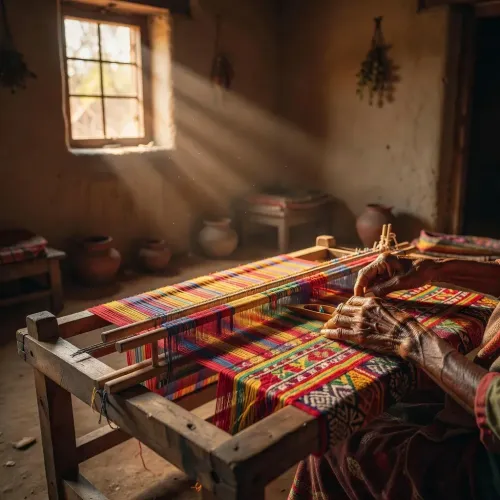
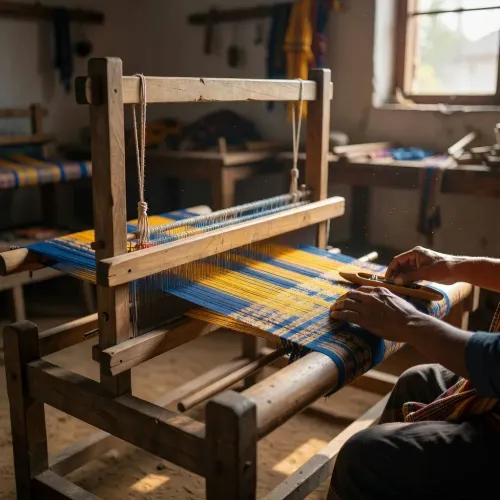
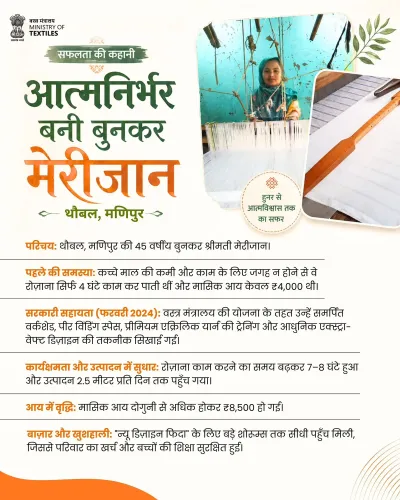
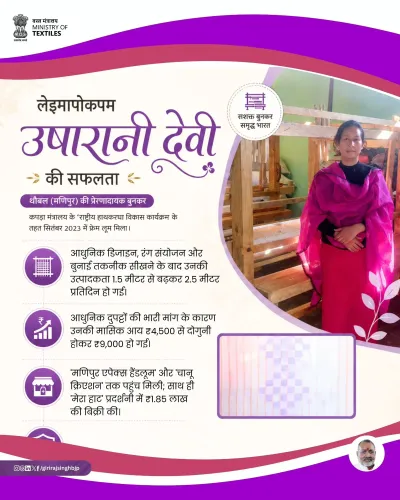
Giriraj Singh Highlights Manipur Weaver's Rise via Govt Support
Synopsis
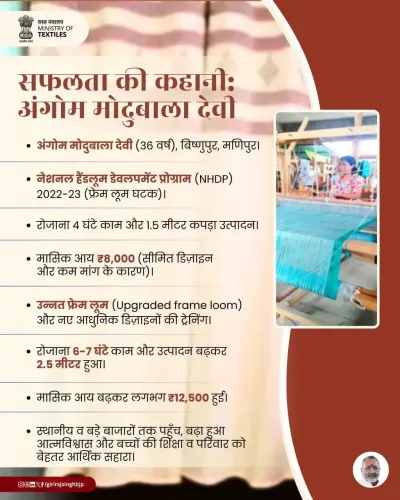
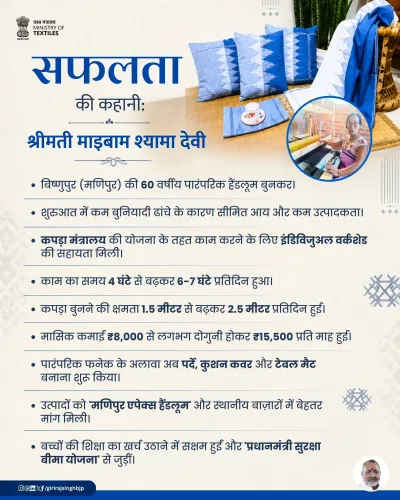
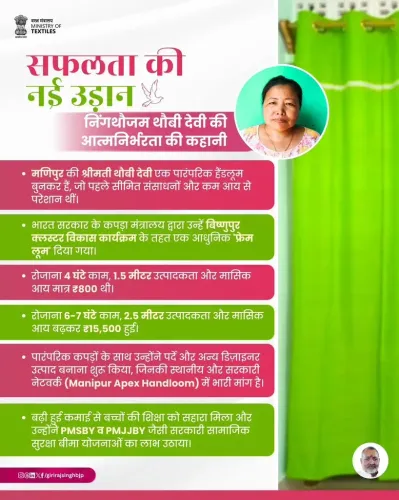
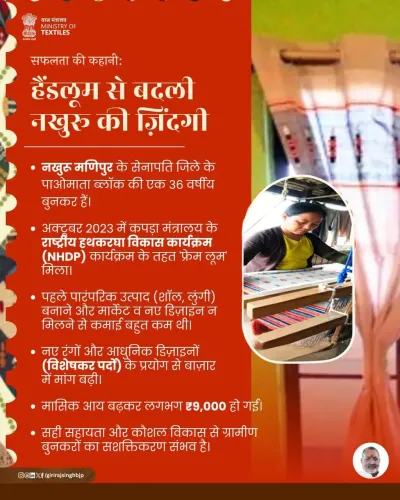
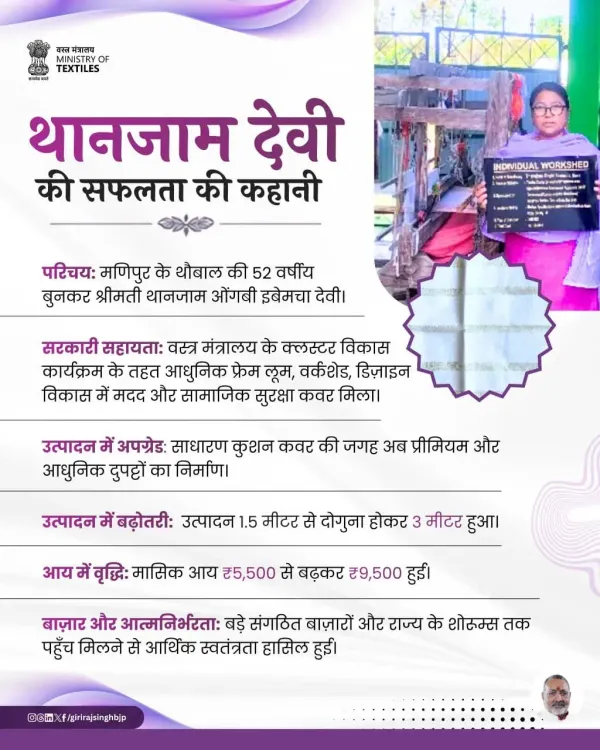
Union Textiles Minister Giriraj Singh on June 19 shared the story of Manipur weaver Smt. Thanjam Devi, who has boosted her production and income through modern looms and government-backed skill training — holding her up as a model of the Atmanirbhar Bharat vision for India's handloom sector.
Key Takeaways
Union Textiles Minister Giriraj Singh spotlighted Smt.
Thanjam Devi , a weaver from Manipur , on June 19, 2026 as an example of artisan self-reliance.
Access to modern looms and skill-development training has increased Thanjam Devi's production and income, per the minister's post.
The post connects her story to the Atmanirbhar Bharat Abhiyan , launched in May 2020 , and the Vocal for Local campaign.
The Ministry of Textiles oversees handloom welfare through the National Handloom Development Programme and cluster development schemes.
Manipur is a priority zone for handloom welfare due to its dense population of traditional weavers, predominantly women.
Wider market access for artisans — enabling them to reach larger buyers — was cited as a key outcome of government support.
Union Textiles Minister Giriraj Singh on Friday, June 19, 2026, spotlighted Smt. Thanjam Devi, a weaver from Manipur, as a symbol of self-reliance achieved through government-backed skill development and modern loom access, sharing her story on X to underscore the human impact of the Ministry of Textiles' outreach programmes.
Context
In his post, Giriraj Singh wrote — 'मणिपुर की बुनकर श्रीमती थानजाम देवी जी अपने परिश्रम और सरकारी सहायता के बल पर आत्मनिर्भरता की नई मिसाल बन रही हैं' ('Manipur's weaver Smt. Thanjam Devi is becoming a new example of self-reliance through her hard work and government support'). He noted that access to modern looms and skill-development training had increased her production and income, enabling her to reach larger markets. The minister concluded with a rallying line: 'सशक्त बुनकर, समृद्ध भारत' — 'Empowered weavers, prosperous India.'
Manipur has a centuries-old handloom tradition rooted in Meitei and tribal communities, and the state's weavers are among the most recognised in the northeastern region for their distinctive textile styles.
Policy Backdrop
The story of Thanjam Devi sits within the framework of the Atmanirbhar Bharat Abhiyan, launched by Prime Minister Narendra Modi in May 2020, which directed economic support toward local manufacturing, MSMEs, and artisan communities including handloom weavers. The Ministry of Textiles has since channelled these priorities through the National Handloom Development Programme and cluster development schemes that supply modern looms and training to weavers across states.
The Vocal for Local campaign, referenced in the minister's hashtags, has consistently framed artisan welfare as both an economic and cultural imperative, pushing for market linkages that allow small producers to access buyers beyond local haats and state emporiums.
Stakeholders and Impact
For Manipur's handloom community — which includes thousands of home-based weavers, predominantly women — government interventions that combine equipment upgrades with skill training represent a potential shift from subsistence weaving to viable small enterprise. The Ministry of Textiles has repeatedly cited the northeast as a priority zone for handloom welfare, given the region's high density of traditional weavers and the cultural significance of its textiles.
Wider market access, a point specifically highlighted by Giriraj Singh, addresses one of the sector's persistent bottlenecks: artisans with high-quality output but limited distribution reach. Digital platforms and government-organised buyer-seller meets have been among the mechanisms used to bridge this gap.
What's Next
Attention will now turn to whether the Ministry of Textiles scales such interventions through enhanced budget allocations in the next Union Budget and through parliamentary accountability on artisan income data. The minister's public amplification of individual success stories like that of Thanjam Devi signals continued political investment in weaver welfare as a visible policy deliverable. Progress reports on handloom cluster schemes and any expansion of modern-loom distribution programmes in the northeast will be closely watched by industry bodies and artisan welfare groups.
Point of View
The minister also signals sensitivity to a region that has faced prolonged socio-political tensions, linking cultural heritage to economic empowerment. The Atmanirbhar Bharat narrative has increasingly leaned on such individual success stories to demonstrate ground-level impact of what are otherwise macro-level policy pronouncements. Whether these spotlights translate into measurable, scaled outcomes for Manipur's handloom sector will be the harder test that parliamentary scrutiny and budget allocations will eventually surface.
NationPress
19 Sept 2026
Frequently Asked Questions
Who is Thanjam Devi and why is she in the news?
Smt. Thanjam Devi is a handloom weaver from Manipur highlighted by Union Textiles Minister Giriraj Singh on June 19, 2026, as an example of a weaver who has increased her production and income through modern looms and government-backed skill training under the Atmanirbhar Bharat framework.
What government schemes support handloom weavers in India?
The National Handloom Development Programme and cluster development schemes under the Ministry of Textiles provide modern looms, skill training, and market linkages to weavers. These sit within the broader Atmanirbhar Bharat Abhiyan launched in May 2020 .
What is Giriraj Singh's role in India's textile sector?
Giriraj Singh is the Union Minister of Textiles , responsible for formulating and implementing policies for India's textile and handloom sector, including artisan welfare programmes, skill development, and market access initiatives.
Why is Manipur significant for India's handloom industry?
Manipur has a centuries-old handloom tradition rooted in Meitei and tribal communities, making it one of the most culturally significant weaving regions in northeastern India. The state is a priority zone for the Ministry of Textiles due to its high density of traditional, predominantly women weavers.
What does Atmanirbhar Bharat mean for handloom artisans?
Atmanirbhar Bharat ('Self-Reliant India'), launched in May 2020 , directed support toward local artisans including handloom weavers through equipment upgrades, skill training, and market linkages, aiming to raise incomes while reducing dependence on imports and preserving indigenous craft traditions.