Giriraj Singh Highlights Manipur Weaver's Rise via Textiles Ministry
Synopsis
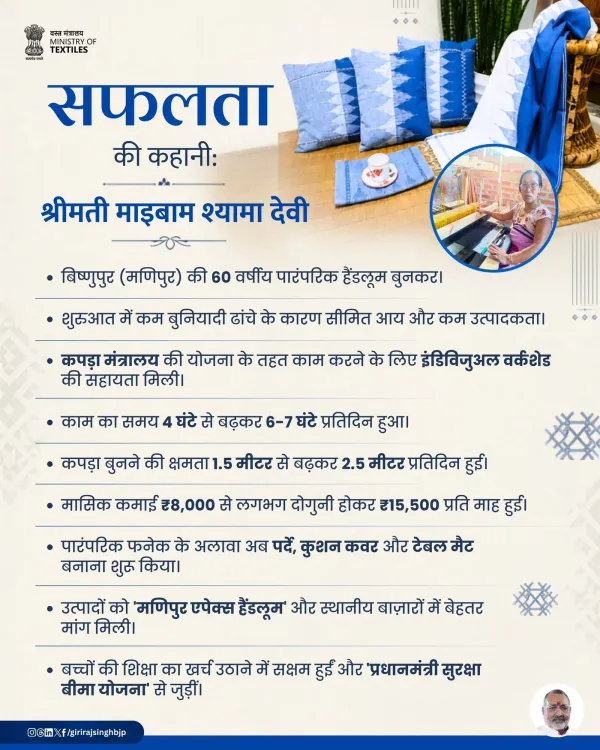
Union Textiles Minister Giriraj Singh on 31 May 2026 highlighted Bishnupur weaver Maibam Shyama Devi as a self-reliance model, saying Ministry of Textiles support doubled her productivity and income, and called on citizens to adopt local handloom products.
Key Takeaways
Union Textiles Minister Giriraj Singh spotlighted Maibam Shyama Devi , a traditional handloom weaver from Bishnupur, Manipur , on 31 May 2026 .
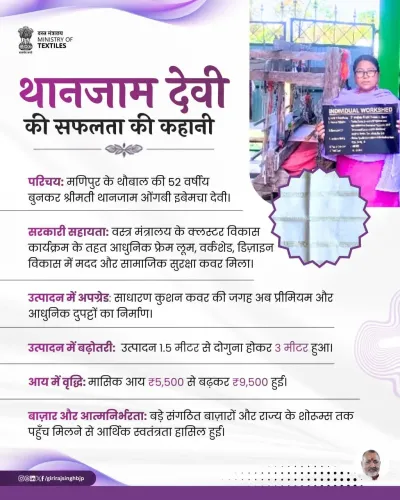
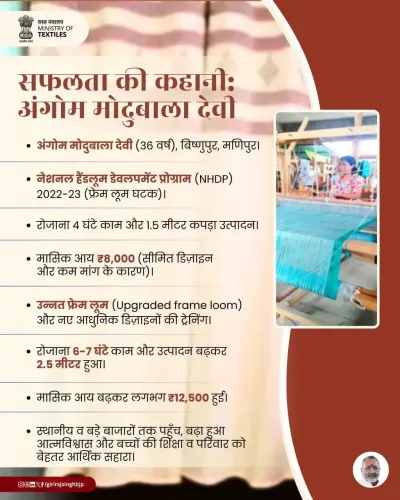
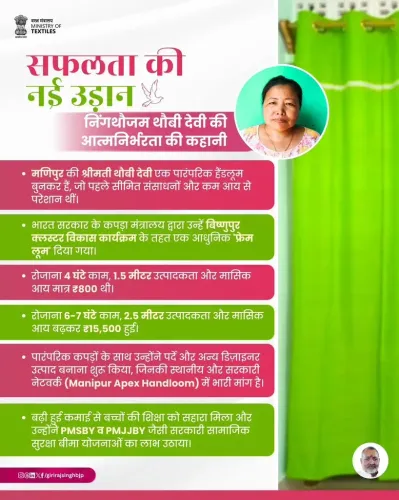
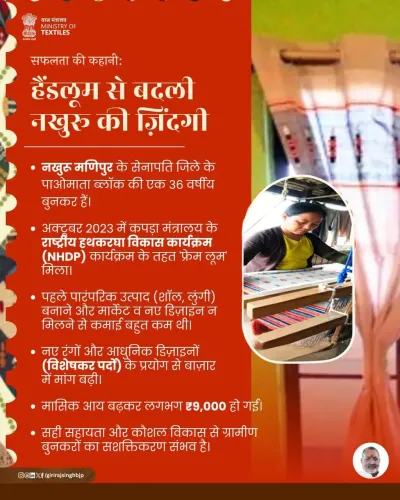
Singh credited Ministry of Textiles support for reportedly doubling Shyama Devi's productivity and income and helping her products gain wider recognition.
The post invoked the Vocal for Local and Atmanirbhar Bharat frameworks, urging citizens to buy domestic handloom goods.
The India Handloom Brand (launched 2015 ) and the National Handloom Development Programme (revamped 2015-16 ) form the policy backbone behind such weaver-support initiatives.
Manipur 's handloom clusters have been included in multiple central skill-upgradation and cluster-development schemes, reflecting sustained policy focus on the Northeast.
Upcoming handloom census data and monsoon-session parliamentary questions are expected to reveal broader scheme uptake figures in the state.
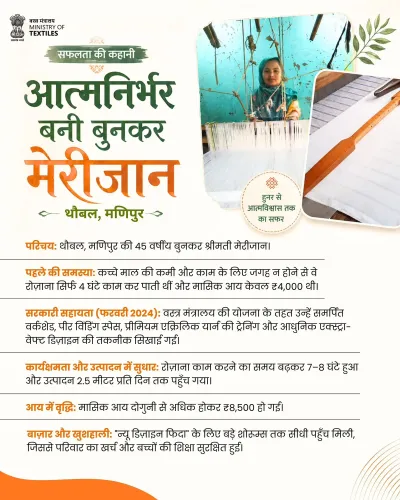
Union Textiles Minister Giriraj Singh on Sunday, 31 May 2026 spotlighted Maibam Shyama Devi, a traditional handloom weaver from Bishnupur, Manipur, as a model of self-reliance, crediting Ministry of Textiles support for helping her double her productivity and income while taking her products toward global recognition.
Context
Posting in Hindi on 31 May 2026, Singh described Shyama Devi as 'aatmanirbharta ki ek prernadayi misaal' — 'an inspiring example of self-reliance.' He stated that with the ministry's collaboration she had 'not only doubled her work capacity and income, but is also giving her new products global recognition through her skill.' He concluded with a call to action: 'Let us appreciate the talent of such empowered women and adopt local products.'
The post carried the hashtags #VocalForLocal, #EmpoweringWomen, #Handloom, #ManipurCrafts, and #MinistryOfTextiles, situating the individual story within the government's broader domestic-manufacturing campaign.
Policy Backdrop
The Ministry of Textiles launched the India Handloom Brand in 2015 to provide quality certification and market access to genuine handloom products across the country. The National Handloom Development Programme (NHDP), revamped in 2015-16, extended block-level cluster support and technology upgradation to weaving communities in states including Manipur.
In 2020, targeted credit and marketing packages for handloom weavers were announced as part of the Atmanirbhar Bharat economic relief framework — the same self-reliance vocabulary Singh invoked in his post. The Vocal for Local campaign, launched alongside those measures, has since become a recurring communication pillar for the textiles ministry, especially in promoting Northeast Indian crafts.
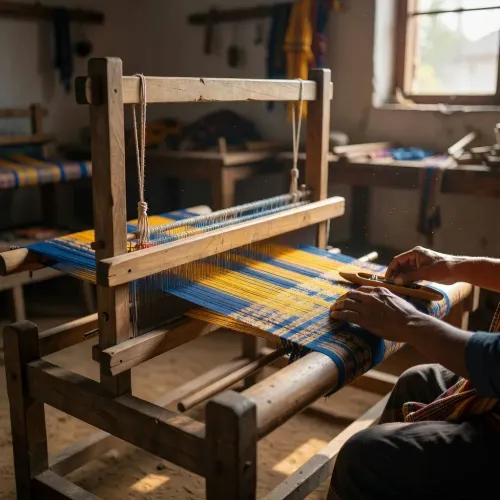
Manipur has a centuries-old handloom tradition, producing items such as the Phanek and distinctive tribal shawls. The state's weaving clusters have been included in successive iterations of cluster-development and skill-upgradation schemes run by the ministry, reflecting a sustained policy focus on integrating northeastern artisans into wider commercial value chains.
Stakeholders and Impact
Handloom weaving remains one of the largest sources of rural employment in India after agriculture, with women constituting the overwhelming majority of the workforce. In the Northeast, the sector carries additional cultural and economic weight, with weaving traditions tied closely to community identity and livelihoods.
By highlighting an individual weaver from Bishnupur, Singh's post follows a pattern of using human-interest stories to communicate scheme outcomes — a format the ministry has deployed consistently to build public buy-in for the 'local products' message. For artisans in Manipur's clusters, visibility at the ministerial level can translate into access to national exhibitions, e-commerce platforms, and export facilitation programmes run by the ministry.
What's Next
The government's next handloom census data release and any fresh budget allocations for northeastern textile clusters will be closely watched by industry bodies and weaver cooperatives. Parliamentary questions on scheme uptake in Manipur are expected during the upcoming monsoon session, which could shed more light on the scale of beneficiaries under the NHDP and allied programmes.
As the ministry continues to position traditional handloom as both a cultural asset and an export opportunity, stories such as that of Maibam Shyama Devi are likely to feature more prominently in its outreach — with GI tagging of regional crafts and integration into global supply chains emerging as the next frontier for weavers in the Northeast.
Point of View
Emotionally resonant content. Anchoring the message in a woman weaver from conflict-affected Manipur serves a dual purpose: it signals developmental progress in a sensitive northeastern state while advancing the broader Atmanirbhar Bharat narrative ahead of potential budget and parliamentary scrutiny. The emphasis on 'global recognition' for local crafts also signals a quiet pivot from purely domestic consumption messaging toward export ambition. Sustained political attention on Northeast handloom clusters suggests the ministry views the sector as both an electoral and economic asset in the region.
NationPress
14 Oct 2026
Frequently Asked Questions
Who is Maibam Shyama Devi and why is she in the news?
Maibam Shyama Devi is a traditional handloom weaver from Bishnupur district in Manipur. She came into the news after Union Textiles Minister Giriraj Singh highlighted her on social media as an example of self-reliance, saying Ministry of Textiles support had doubled her productivity and income.
What is the Vocal for Local campaign in textiles?
Vocal for Local is a national campaign launched in 2020 that encourages Indian consumers to buy domestically made products. The Ministry of Textiles has used it extensively to promote handloom goods, especially from the Northeast, as part of the broader Atmanirbhar Bharat initiative.
What government schemes support handloom weavers in Manipur?
The National Handloom Development Programme, revamped in 2015-16, provides block-level cluster support and technology upgradation to weavers in Manipur and other states. The India Handloom Brand, launched in 2015, offers quality certification and market access, and targeted credit packages were added under Atmanirbhar Bharat in 2020.
What is the India Handloom Brand?
The India Handloom Brand is a certification and branding initiative launched by the Ministry of Textiles in 2015. It guarantees the authenticity and quality of handloom products and helps weavers access larger markets, including export channels.
What is the significance of Bishnupur, Manipur for handloom?
Bishnupur is a district in Manipur with a well-established handloom weaving tradition. The region produces distinctive textiles including Phanek fabric and tribal shawls, and its weaving clusters have been supported under multiple central government skill-upgradation and cluster-development programmes.